
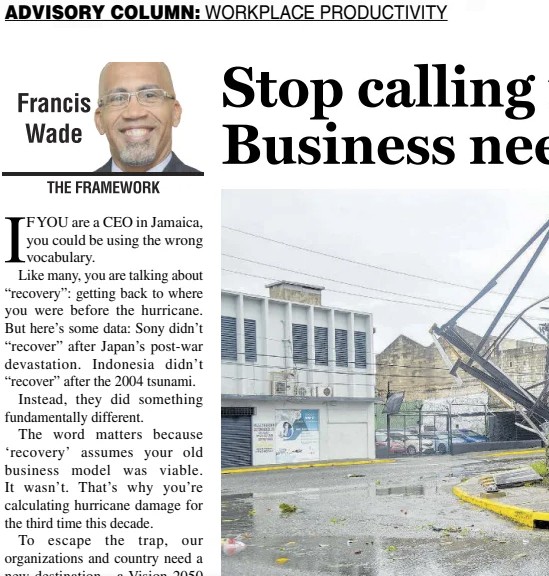
When disaster strikes, the language leaders choose reveals everything about their future.
In late October 2024, Hurricane Melissa tore through Jamaica as a Category 4 storm, causing widespread devastation. Within days, business leaders across the island were using the same word: “recovery.” Getting back to where they were before the hurricane hit.
But here’s the problem with that word—and why it matters far beyond Jamaica’s shores.
“Recovery” assumes your old business model was viable. For most organizations, it wasn’t. That’s why they’re calculating hurricane damage for the third time this decade, why they’re responding to their fourth supply chain crisis in two years, why they’re addressing the same vulnerabilities again and again.
The word matters because it shapes the destination. And if that destination is simply “back to normal,” you’re planning to fail in exactly the same way next time.
The Recovery Trap
Let me be direct: If your post-crisis strategic plan looks like “restore operations to pre-crisis levels,” you’re planning to fail again.
Recovery language creates a dangerous illusion. It suggests there was a golden era you need to return to—a time when the business was humming, customers were happy, and growth was steady. Then the crisis hit and disrupted everything.
But that’s fiction.
The truth most leaders know but won’t say out loud: Your business had fundamental vulnerabilities long before the crisis made them visible. The hurricane, the pandemic, the market shock—it didn’t create your problems. It revealed them.
You already knew your supply chain was too dependent on a single source. You already knew your physical infrastructure couldn’t handle severe weather. You already knew your cash reserves were too thin. You already knew your team’s digital capabilities were years behind competitors.
The crisis just made these truths undeniable.
So when you talk about “recovery,” what are you actually recovering to? A fragile business model? An outdated strategy? An eroded competitive position? A workforce unprepared for what’s coming?
That’s not a plan. That’s a delusion.
What Transformation Actually Looks Like
Let’s look at what organizations that escaped this trap actually did.
Sony, Post-War Japan: When Sony emerged from the devastation of World War II, they didn’t try to rebuild Japan’s pre-war electronics industry. That industry was based on cheap labor and imitation of Western products. Instead, Sony’s founders asked a different question: “What could Japan become if we built for the world that’s coming?”
They invested in miniaturization technology when everyone said radios had to be large. They pioneered the transistor radio when the market didn’t exist. While Japan was rebuilding roads, they built global distribution networks.
Sony didn’t recover. They transformed into something their pre-war selves couldn’t have imagined.
The defining moment came in 1955 when Bulova proposed a massive deal that would have guaranteed immediate revenue. Co-founder Akio Morita refused: “If we accept, they will be promoting the Bulova name. In five years, no one will remember Sony. But if I spend 50 years selling Sony-branded products, I will build a brand that lasts for decades.”
That’s the difference between recovery thinking and transformation thinking.
Indonesia, Post-Tsunami: After the 2004 tsunami devastated Aceh province, killing over 160,000 people in Indonesia alone, the government didn’t just rebuild the fishing villages that were destroyed. They relocated entire communities to higher ground, created early warning systems that didn’t exist before, and diversified local economies away from single-industry dependence.
The new Aceh wasn’t a recreation of the old one. It was designed for a future where tsunamis would happen again—but with radically different outcomes.
New Orleans, Post-Katrina (A Counter-Example): What happens when you choose recovery over transformation? Look at New Orleans after Hurricane Katrina in 2005.
The city spent billions rebuilding in the same flood-prone areas, restoring the same vulnerable levee systems, recreating the same economic dependencies. Twenty years later, the city remains vulnerable to the same threats. The recovery was successful. The transformation never happened.
That’s the cost of choosing the wrong word—and the wrong destination.
The Question That Changes Everything
Here’s what transformational thinking looks like in practice:
Instead of asking “How do we get back to normal?” you ask a different question: “If we were building this business from scratch today, knowing what we know about technology, climate, markets, and geopolitics, what would we build?”
This isn’t theoretical. Jamaica is facing exactly this choice right now.
Since 2009, Jamaica has been working toward Vision 2030 Jamaica—a national development plan with the ambitious goal of achieving developed-country status by 2030. It was a bold, comprehensive framework covering everything from education to economic policy to social development.
But as Prime Minister Andrew Holness acknowledged in late 2024, many of its original aspirations are now beyond reach. Jamaica won’t become a developed country in the remaining years of the plan.
Yet Vision 2030 did something crucial: it demonstrated that long-term thinking is possible, even in a country accustomed to short-term crisis management. It planted the seeds of what comes next.
Vision 2050: Transformation, Not Restoration
What Jamaica needs now—and what your organization likely needs too—is a Vision 2050.
Not a recovery plan. Not a restoration strategy. A transformation roadmap.
A Vision 2050 should be hard-hitting enough that it forces uncomfortable questions. What does a mid-century resilient organization look like in a world of climate chaos, technological disruption, and geopolitical instability? What capabilities must we build? What dependencies must we eliminate? What assumptions must we abandon?
It should be detailed enough that you can work backward to inform today’s decisions. If we need X capability in 2050, what must we start building in 2025? If Y vulnerability will be fatal in 2040, what must we eliminate now?
And it should be transformative, not restorative. The goal isn’t to get back to 2024. The goal is to leapfrog to something that would have been impossible to imagine in 2024.
The Opportunity Crisis Creates
Here’s the paradox: Crisis is the only time most organizations have permission – the full freedom – to transform.
In normal times, there’s too much momentum, too many stakeholders invested in the status quo, too many reasons to optimize rather than revolutionize. Crisis breaks that inertia. It creates a brief window where fundamental change becomes possible—even expected.
Hurricane Melissa offers Jamaica this opportunity. Your next crisis—and there will be one—offers it to you also.
The question is whether you’ll use it for recovery or transformation.
Recovery is easier. It’s more comfortable. It doesn’t require you to question fundamental assumptions or abandon familiar approaches. You can point to what existed before and say “let’s get back to that.”
Transformation is harder. It requires admitting that what you’re losing wasn’t worth preserving in its current form. It demands imagination about futures that don’t yet exist. It means making irreversible decisions based on incomplete information.
But only one of these approaches positions you for the world that’s actually coming.
The Fork in the Road
Every organization facing disruption stands at a fork in the road. One path leads back. One path leads forward. They’re labeled with different words.
One sign says “Recovery.”
The other says “Transformation.”
The choice reveals everything about what comes next—and whether you’ll be having this same conversation after the next crisis hits.
Choose the right word. It determines your destination.
——————————-
This article is based on a column published in the Jamaica Sunday Gleaner Business Section by Francis Wade