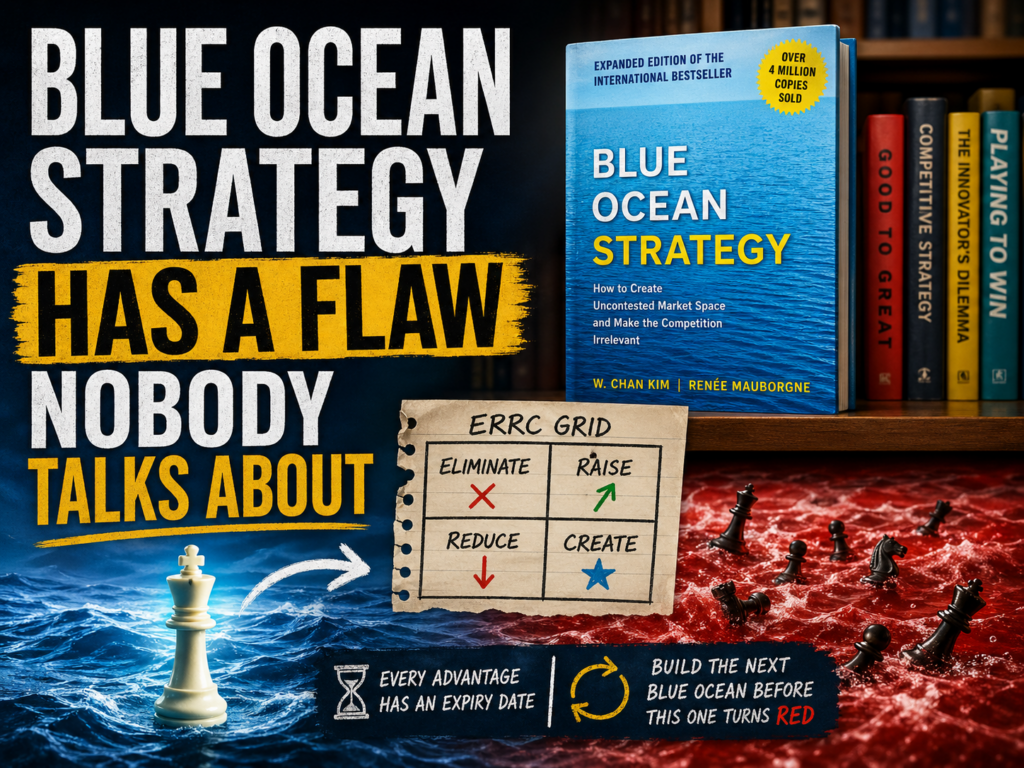

There is a book on the shelf of almost every serious executive in the world. It has sold over four million copies, been translated into 46 languages, and spawned an entire consulting industry. Its central idea is so compelling that once you hear it, you cannot unhear it.
The book is Blue Ocean Strategy (BOS), published in 2004 by W. Chan Kim and Renée Mauborgne. The central idea: stop fighting competitors for the same shrinking pool of customers. Create new market space where competition is irrelevant. Stop swimming in a Red Ocean of blood and churn. Find your Blue Ocean.
Every executive who has heard this wants it. The aspiration is sound. The problem is that the book quietly fails to deliver what its title promises – and that failure has cost organizations time in over two decades of strategy retreats.
The Word That Did the Damage
The most consequential editorial decision in modern management publishing happened when the authors agreed to put the word “Strategy” in the title.
That single word changed how executives read the book. Strategy implies a plan. A method. A set of steps you can follow to get from where you are to where you want to be. Executives arrived at the book expecting operational guidance. What they received instead was one of the most elegant collections of business case studies ever assembled — and no instructions for replication.
Consider the cases. Cirque du Soleil, the book’s showcase story, reinvented the circus by eliminating animals and creating a sophisticated adult entertainment category. Yellow Tail wine made wine approachable for beer drinkers by stripping out complexity and jargon. NVIDIA opened its graphics processors to general computing and created an entirely new category of accelerated processing. Taylor Swift reinvented the artist’s relationship to fans, catalog ownership, and brand extension.
Each case is vivid. Each pattern is compelling. But each story was crafted long after the journey was complete.
That is the problem. Every case in the book is retrospective. The authors identified companies that had already succeeded, mapped their moves, and presented the pattern. What they did not — and perhaps could not — provide is a repeatable method for how your company executes a similar move from scratch, in your industry, with your constraints, before the outcome is known.
This is not a minor gap. It is the structural flaw that separates the book’s promise from its delivery. And it helps explain why boardrooms around the world have produced beautiful strategy canvases (as the book instructs) and returned to fighting the same competitive battles the following Monday morning.
The Tool That Starts in the Wrong Place
There is a deeper problem, and it lives inside the book’s primary diagnostic instrument — the Eliminate, Reduce, Raise, Create grid, known as the ERRC.
To use the ERRC grid, you map what your industry currently does across every competitive factor, then decide what to eliminate, reduce, raise, and create. Every factor you analyze is defined in relation to what competitors already do. The entire diagnostic starts with your rivals.
Here is the irony: a framework designed to help you escape competition requires you to think about competition first. If your strategic imagination is anchored to what already exists, you have not left the Red Ocean. You have only rearranged your position within it. The book’s primary tool quietly undermines its central promise.
The Pattern the Book Ignores
Set aside the tool problem for a moment. Assume your team finds its Blue Ocean. You create uncontested market space, grow rapidly, and establish genuine differentiation. What happens next?
Blue Ocean Strategy is largely silent on this question. And the answer, drawn from its own case studies, is uncomfortable.
Cirque du Soleil created its blue ocean in the 1980s and spent nearly four decades defending it. New competitors entered experiential entertainment. Costs rose. The company took on debt to fund global expansion. In June 2020, it filed for bankruptcy protection.
Netflix invented streaming video and watched Disney, Amazon, Apple, and dozens of others flood the same space within a decade. Uber redefined urban transportation and has spent most of its existence losing money as imitators replicated its model in every major market.
These are not execution failures. They are the inevitable result of treating a blue ocean as a destination rather than a phase.
Every competitive advantage has an expiry date. The timeline varies — years, sometimes decades — but the sequence never changes. You create uncontested space. Competitors notice. Imitators arrive. Margins compress. The blue ocean turns red. This is not misfortune. It is the entirely predictable lifecycle of any strategic advantage, and it has been predictable for a long time.
That is the core of what Blue Ocean Strategy leaves out: a theory of time.
The book is written as though the strategic challenge is finding the right space. It is not. The deeper challenge is understanding that every space you find is already aging from the moment you enter it — and that long-term survival depends on building the next blue ocean while the current one is still profitable enough to fund it.
A framework called the Three Horizons Framework, developed by Hodgson, Curry and others, addresses precisely this gap. It argues that organizations must simultaneously protect today’s advantage, develop tomorrow’s opportunity, and explore the possibilities that will matter in five to ten years. Not sequentially. Simultaneously. Because by the time your current advantage is visibly declining, it is already too late to begin building its replacement.
Blue Ocean Strategy asks: where should we compete? The Three Horizons Framework asks: for how long, and what comes next? The first question without the second is not a strategy. It is a plan with no second act — which is exactly what Cirque du Soleil, Netflix, and Uber each discovered in turn.
The Company That Proved Both Points
Wawa is a food retailer based in the northeastern United States. It operates convenience stores, fuel stations, and quick-service restaurants — three of the lowest-margin, highest-failure-rate business categories in existence. It is also, by most available measures, one of the most successful blue ocean practitioners in American business history.
In 2009, facing a world where supermarkets, fast casual chains, and fuel retailers were all converging on its territory, Wawa’s leadership formally applied the Blue Ocean tools. The strategy canvas and ERRC grid structured their analysis and were genuinely useful. They identified that their weakest offering — food service — was also their highest-potential opportunity for differentiation.
What followed was systematic reinvention. Wawa repositioned from a convenience store that also sold food into a quality quick-service restaurant that also sold fuel and convenience items. Fresh bread baked on premises. Customizable meals made to order. High-quality coffee at accessible prices. Touchscreen ordering kiosks. A store layout redesigned with food at the center.
The results are measurable. An average 7-Eleven generates roughly US$30,000 to $35,000 in weekly revenue per store. Wawa averages US$116,000. That gap — more than three times the category standard — is what genuine blue ocean execution produces in real dollars.
Perhaps more telling is what the broader industry makes of Wawa’s performance. QSR 50, the standard industry ranking of quick-service restaurants, does not include Wawa in its listings. The reason given is that Wawa sells fuel and packaged goods, which technically classifies it as a convenience store rather than a restaurant. If Wawa were included, it would rank first in per-store sales — ahead of McDonald’s, Chick-fil-A, and Panera Bread. The most effective blue ocean practitioner in American retail is invisible to the industry supposed to be tracking it. That is what genuine category creation actually looks like.
But here is the detail that the book’s framework cannot account for, delivered in the words of Wawa’s own former CEO Howard Stoeckel: “We’re paranoid when it comes to success and we’re always reinventing ourselves.”
Not proud. Not secure. Paranoid.
Wawa has reinvented itself across more than two centuries — from dairy farming to grocery retail to convenience stores to fuel to quick-service restaurants. Each reinvention happened before the previous model was exhausted. In 2012, Stoeckel announced that Wawa was no longer a convenience store. It was, he declared, “a leading quick-service restaurant and leader in the fast-casual-to-go space that also sells gas and convenience items.” No such category existed at scale at the time. Competitors scoffed. Customers gradually came to see it exactly that way.
That move — naming a new space and teaching the market to recognize it before rivals could claim it — is not in the Blue Ocean book. It belongs to a separate body of thinking about category design, developed by writers including Christopher Lochhead, Eddie Yoon, and Nicolas Cole. Their argument is direct: whoever names the new category can dominate it for decades to come. Language is key. The market does not automatically recognize new value — someone has to hand it the vocabulary.
What Executives Should Actually Do
Blue Ocean Strategy offers the right aspiration. The ambition to escape a competitive space rather than simply fight better within it is correct, and the book makes that case more compellingly than almost anything else in the management canon.
But aspiration without method produces what most organizations have experienced: a retreat, a strategy canvas, a renewed sense of possibility, and no change the following quarter.
The complete system looks something like this. Use BOS to identify where genuine value innovation is possible — where you can create new demand rather than compete for existing demand. Apply a long-horizon lens from the moment you make your move, treating your new blue ocean as inherently temporary and building the next opportunity while the current one is still strong. Invest as much in naming and framing your new category as you do in designing it — because a blue ocean no one can describe is a blue ocean no one will defend.
The book is not wrong. It is incomplete. Read it for the vision it provides so clearly. Then build the method around it that it never supplies.
PS — Going Deeper: Five Prompts for Your AI Assistant
The arguments in this article can be taken further using any AI tool. Here are five prompts to continue the thinking:
- “Map my company’s current strategy against the Three Horizons Framework by Hodgson and Curry. Ask me questions about our current business, emerging threats, and what’s already replacing us in the market.”
- “Using Blue Ocean Strategy’s ERRC grid as a starting point, help me identify where my industry’s assumptions are so deeply embedded that we have stopped questioning them.”
- “Give me five examples of companies that created a genuine blue ocean, then failed to build the next one before their advantage decayed. What was the warning signal they missed in each case?”
- “Help me write a category definition statement for my business — not what we do, but what new space we are creating and why we should own it.”
- “Based on Wawa’s reinvention story, design a set of questions I can bring to my next strategy retreat to test whether we are building our next blue ocean or simply defending the current one.”