Busy Doing Everything Else

It’s been ages since I have posted up on this blog, and it’s not because I have stopped writing.

It’s just that I have been developing other things of interest, namely:

  • A few new e-books for a new expat transition business that my wife and I are starting (see http://transitionsunshine.info for details.) I learned how to create a wordpress blog from scratch in the process
  • New posts for my a 12 week time management e-course that I am currently trialling with a handful of users (testers). It’s called MyTimeDesign and will be launched soon
  • New content for my time management blog: http://2time-sys.com
  • a bit of content for Moving Back to Jamaica: http://francismove.blogspot.com

Also, I have been planning to move out of blogger and onto WordPress (finally.) This is a year of big moves, as I just moved my website to a new server, and it seems to be working. The learning curve for all these activites has been rather steep, and very IT-intensive.

This is where my engineering background has proven useful. While I have not forgotten how to program, I only “discovered” the php language the other day, so keeping up has been tricky.

At the same time, I have been making a nice long list of the items that I want to write about, but most of them will come when I have moved the blog over to WordPress.

Stay tuned…

A Manifesto for Change

Yesterday, I figuratively nailed my own version of Luther’s Theses to the ChangeThis.com website.

I can’t claim that it had the same historical significance as other more famous printed texts, but it did feel good.

My ChangeThis.com manifesto was published yesterday, calling for a new approach to time management thinking.

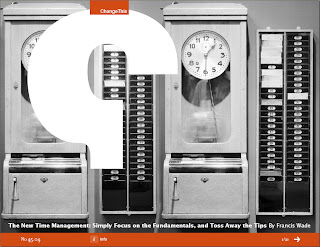
In the 21 page PDF document, entitled “The New Time Management: Simply Focus on the Fundamentals, and Toss Away the Tips”, I make the point that working professionals the world over have destroyed their productivity and peace of mind by buying gadgets, and buying-into too many tips from other people.

Instead, they should be focused on perfecting their time management skills by focusing on the fundamentals of time time management. The manifesto focuses on the first 7 fundamentals (the essentials) without getting into the 4 advanced fundamentals.

Here is the info for retrieving it:

ChangeThis Newsletter No. 45

* * * *
* * * *

45.04
The New Time Management: Simply Focus on the Fundamentals, and Toss Away the Tips
by Francis Wade

“As working professionals across the world, we all want the same things when it comes to time management. We want to feel a certain peace of mind that comes from knowing that our affairs are in order and that we’ve not forgotten something that might jump up later to give us a nasty surprise.”

http://changethis.com/45.04.NewTime
http://changethis.com/pdf/45.04.NewTime.pdf

…………….

WANT TO WRITE YOUR OWN?
We’re here to spread great ideas. Got one?

http://www.changethis.com/submit

…………….

THE MOST TALKED ABOUT MANIFESTOS
See the sorted list right here:

http://changethis.com/archives?by=email_count

…………….

WANT IT IN RSS?
Use our feed:

http://feeds.feedburner.com/ChangethisNewsletter

…………….

Please don’t be afraid.
Forward this to your friends.

ChangeThis is a vehicle, not a publisher.
We’re here to spread great ideas.
If you have any, let us know.
http://www.changethis.com/submit

If you didn’t subscribe to this,
a thousand times forgive us. Follow
the links below to unsubscribe.


Caribbean Interviews

I am in the process of conceiving a Caribbean Thought Leader Interview series to be placed on some different places — CaribHRForum.com and on this blog for example.

I would be looking for managers, executives, consultants, speakers — anyone from around the region with a unique point of view that can be shared in an interesting, informal way.

Who are some people from around the region that you would be interested in hearing from?

Francis

Executive – Culture Fit

This is quite an interesting article, “Culture Club” taken from BusinessWeek, having to do with matching the culture of the company with executives to be hired.

The best executive for the job will have an impressive résumé, but should also possess the right skills to best maneuver the organization’s culture

by Joseph Daniel McCool

Cultural Matchmaking

One reason for a poor fit is that too often executives are hired based on where they’re coming from without enough thought given to where they are going. A candidate who impresses the board or the boss with his or her credentials might get the nod because on paper he or she appears to have the right range of experience from a respected, market-leading company. Yet an impressive résumé doesn’t guarantee an individual will be able to elevate a company’s performance in a new environment and/or a new role.

Click to see the article in full: Culture Club

Email and the Exploding Inbox

An article that I wrote for the Newsday newspaper in Trinidad was recently published. The text is below.

Click on the graphic below to read the full article without squinting.

Rudeness and the Jamaican Workplace

Here in Jamaica, we put a lot of stock in manners — the worst insult that can be made about a manager is that they don’t respect people.

In a recent issue of Harvard Business Review, the following excerpt makes the point that the Jamaican worker is right — rudeness has been found to be correlated with productivity.

Rudeness and Its Noxious Effects

Grumpy managers who have a tendency to lash out are sometimes tolerated in businesses if their direct reports are thick-skinned types who don’t complain about anything. But beware of more distant effects: It’s likely that other employees are harmed by these incidents, even if they only hear about them secondhand.

The mere thought of being on the receiving end of verbal abuse hurts people’s ability to perform complex tasks requiring creativity, flexibility, and memory recall, according to Christine Porath of the University of Southern California’s Marshall School of Business and Amir Erez of the Warrington College of Business Administration at the University of Florida.

In studies involving separate groups of university students, the authors tested the effects of three forms of exposure to rudeness: In one study, the harsh words were directed at participants by a researcher (“What is it with you undergrads here?…[you] leave a lot to be desired as participants”). In another, the cutting remarks came from someone ostensibly outside the study—a professor whom the participants had to interrupt (“You preferred to disturb me…when you can clearly see that I am busy. I am not a secretary!”). In the third, the participants were asked to imagine that those incidents had happened to them.

In all three cases, participants’ ability to perform tasks such as solving anagrams and suggesting uses for a brick was impaired. As for why this happened, the researchers say their studies indicate that after exposure to rudeness, people think hard about the incident—whether just ruminating or trying to formulate a response—and those thought processes take cognitive resources away from other tasks. As the authors put it in their recent Academy of Management Journal article, verbal abuse affects more than just those who experience it directly; it apparently “can harm innocent bystanders.”

Reprint: F0803D

Creating the Customer Experience – Practice

The idea of training customer-facing personnel in the Caribbean to create specific experiences might seem like a tall order, and a highly subjective goal.

Can a company charge its front-line workers with doing whatever it takes to create experiences it decides are important for its customers?

For example, what if a bank decides to create an experience of caring, careful and creative with its customers? How would it train its employees to produce that experience reliably?

Well, they could begin by allowing the employee to internalize the definition of the experiences: caring, careful and creative. They would need to do so by looking in two places — their own experience as customers in day to day life, and their experience as employees in the company.

Surprisingly, the latter is perhaps more important than the former.

Employees who don’t look for the experience of caring, careful and creative in their experience in the workplace are going to have a difficult time delivering it to customers. Workplaces that rarely produce the experience will simply fail, and should instead look to implement a culture change programme that results in a different customer experience altogether.

Without it, employees will not have what it takes to produce the experience with their customers, as they will be too busy trying to have some of it for themselves.

Once the experience is internalized, and distinguished clearly in the experience of employees, the company can go the next step and train them to deliver it. The assumption here is that employees who are overflowing with an experience need do little at some level, because their experience will naturally overflow into the customer’s experience. In this sense, customer experience is quite a contagious phenomena.

How do employees get trained to deliver a set of experiences such as caring, careful and creative?

Do they receive a set of rules to follow? Do they follow a script?

Some companies have tried this approach, but it is imply insufficient.

In addition to guidelines, what employees need more than anything else is time to practise.

Producing a specific experience is not as simple as merely mouthing the correct words, or going through the right motions.

Instead, it requires an element of emotional intelligence, due to the need to quickly appreciate the experience that another person is having in any moment. This ability to “read experiences” can be developed through consistent practice.

“Reading the experience” can perhaps be as easy as carefully observing the changes in someone’s face. Some interesting research into couples, and their communication, has revealed that a trained observer can predict with 90% accuracy, the future of the couple’s marriage, after only a couple of minutes.

They are trained to observe the minute changes in muscle motion that we tend to overlook each day.

Perhaps the same kind of training could be given to front-line customer-service workers, so that they can discover the clues that tell them the experience that a customer is having. This of course, would take some amount of practice in order to master, but it sure seems like an interesting place to start.


There are three sources of information that I can recommend on this topic– one is the book Blink by Macolm Gladwell, and here is an excerpt from the book: http://www.hachettebookgroupusa.com/books/68/0316010669/
chapter_excerpt24301.html

In the December 2007 issue of Harvard Business Review, there is an article entitled: Making Relationships Work by John Gottman. He is the psychologist who is the originator of the University of Washington study.