An awkward silence falls over boardrooms when directors flip through a newly printed plan and instantly recognise it. To their frustration, almost nothing has changed since the last one done five years before. Despite clearly stated expectations, little has shifted. So what’s missing?
The reason the strategic logic remained unchanged (and your company didn’t move up the Businessuite Top 100 list) is usually blamed on the executive team. Not enough creativity. Not willing to challenge assumptions. Not able to rigorously examine calcified, stale doctrines.
Unfortunately, rotating C-Suiters doesn’t work. Neither does a demand for bolder thinking. Or outside experts who merely recycle known frameworks.
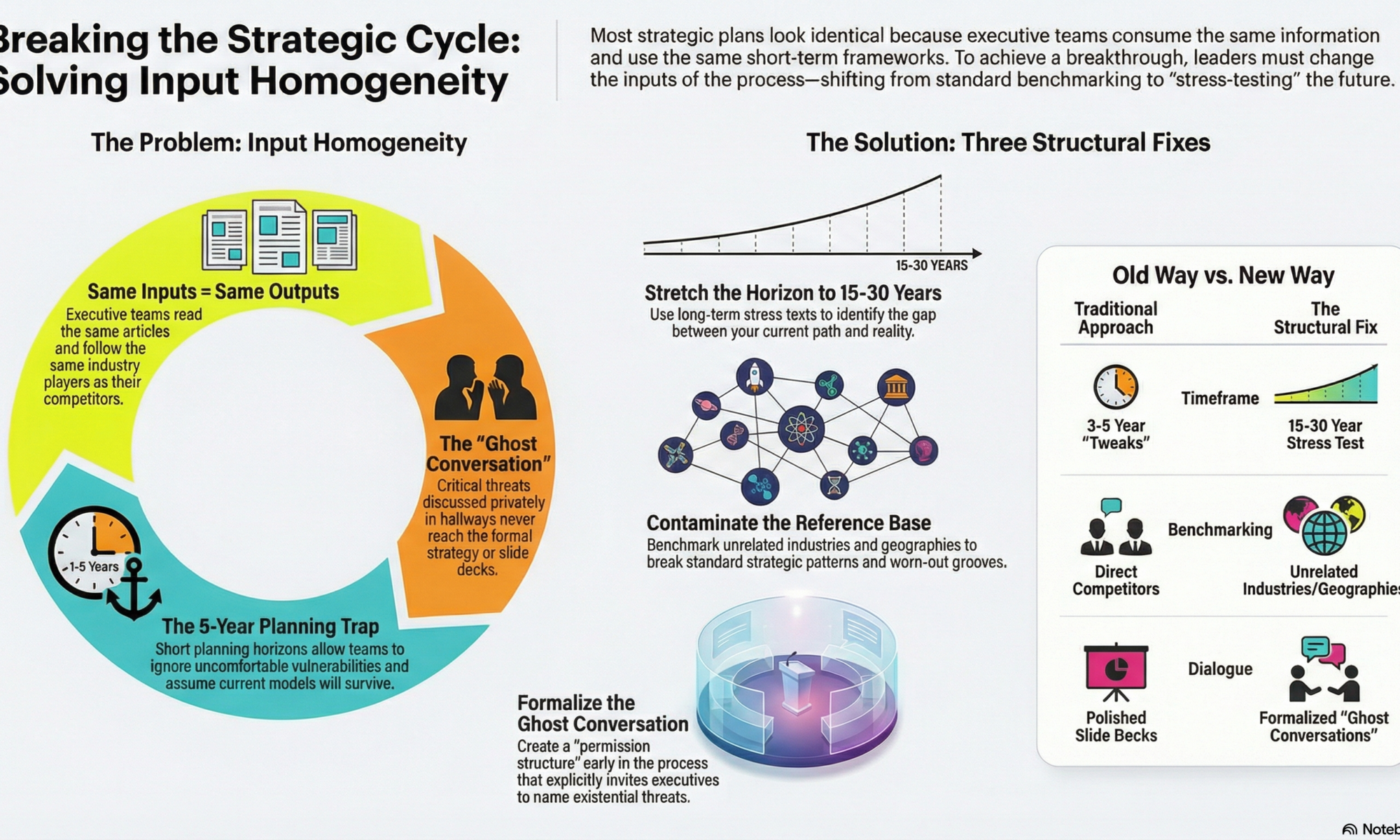
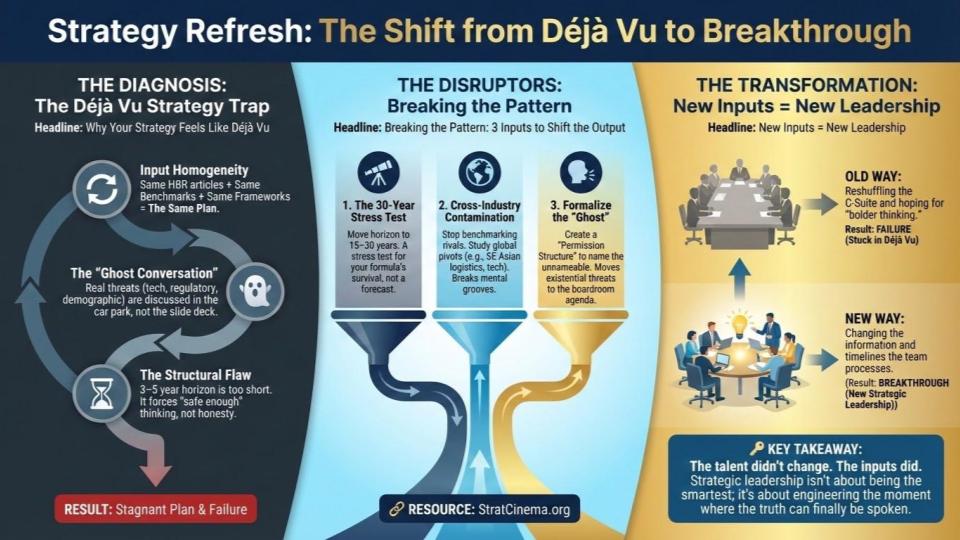
But before you intervene, consider the actual inputs which feed into the process. Your senior team reads the same Harvard Business Review articles as others in the region. They listen to the same lecturers explain the same frameworks. They follow the same big players.
And when they reach for inspiration, they draw from the same narrow pool as always. This is why regardless if you replace the entire C-Suite tomorrow, the next plan will look the same.
The condition is called “input homogeneity.” Same inputs = same outputs. Here is a way to intervene in even the most stubborn situations.
The Ghost Conversation
There is an element of the overall discussion which takes place in every company…but not in the formal process. Where does it happen? In the car park, over drinks, or in the hallway between sessions. The topic? A threat only addressed in quiet tones.
It never makes it onto a slide deck, but it keeps senior executives up at night due to its power and danger. The single-revenue dependency. The demographic shift. The regulatory change. The new technology tearing up the industry in Asia.
You know which conversation this is at your company. (And even if you belong to the public sector, you are well aware of defunded organisations which lost their way, only to be folded meekly into others.)
The reason these discussions remain informal is not cowardice.
Instead, the common three-to-five-year planning horizon is just short enough to filter out these questions. Why? Inside the usual retreat, everyone unconsciously assumes the current business model will survive… ”it only needs a few tweaks.” The industry structure is also accepted: it won’t change either.
Nobody has to challenge these assumptions because the truncated window makes them seem reasonable. Plus, your incentives reward confident planners, not the ones that point out uncomfortable vulnerabilities.
Consequently, the most strategically valuable conversation in the company remains permanently and repeatedly excluded from the corporate strategy.
Three Inputs That Change Everything
If the problem is structural, so is the fix. Forgo reshuffling the C-Suite, and craft three fresh inputs instead.
Stretch the horizon. In your next session, ask the team to select a new time frame between 15-30-years. Not to forecast, because no-one can predict that far. Consider this a stress test of your company’s “winning” formula, if it follows the current path.
The gap between the projected faraway future and your likely, default trajectory shows the reality you must confront. You will find that a longer window does not necessarily produce better predictions. But it will produce better (but uncomfortable) questions, the kind a five-year horizon conveniently avoids – but shouldn’t.
Contaminate the reference base. Stop benchmarking only your direct competitors. Introduce strategic patterns from industries and geographies your team has never studied. When a Caribbean financial services firm studies how a logistics company in Southeast Asia restructured its value chain, the specific details are irrelevant. But the unfamiliar pattern breaks the grooves worn by years of studying the usual suspects. (Recommendation: use my compilation of cases at StratCinema.org to be efficient.)
Formalise the ghost conversation. Create a structured session — early in the process, not as an afterthought — where you explicitly ask the team to name the slow-burning threats everyone discusses privately.
This is not just brainstorming.
It is a permission structure. Most executives will not raise existential concerns unless the architecture of the session boldly invites them to.
Picture the boardroom again. The directors open the new plan. They begin reading. And for the first time in a decade, no one recognises it. Not because it is reckless, but because it addresses questions, the previous plans were incapable of asking.
It names what everyone knew but nobody had been permitted to say aloud. The team sitting around the table is the same one that produced the last plan. But the talent didn’t change. The inputs did.
The CEO who engineers that moment won’t need to explain what strategic leadership looks like. The room will already know.
Picture a familiar scene in a non-profit organization. A hotel conference room. Flip charts on easels. A two-day offsite that everyone has blocked out on their calendar and quietly dreaded.
The exercises begin. Strengths, weaknesses, opportunities, threats. Stakeholder maps. Priority matrices. The team engages dutifully, filling in the boxes, generating the language that planning retreats are supposed to generate.
Then comes the afternoon slump – and it is not just fatigue from the morning’s work. Something more specific has happened. The conversation has drifted away from the reason the organisation exists. Words like “competitive positioning” and “market capture” are appearing on the sticky notes, and they feel borrowed – like wearing a suit that belongs to someone else.
Nobody says anything. Everyone is willing the process to work.
A document emerges by the final session. The board receives it at the next meeting. And within a few months, it occupies a shelf or a folder, largely untouched.
This is not a story about poor facilitation or disengaged leadership. It is a story about using the wrong instrument for the job.
Where These Frameworks Actually Come From
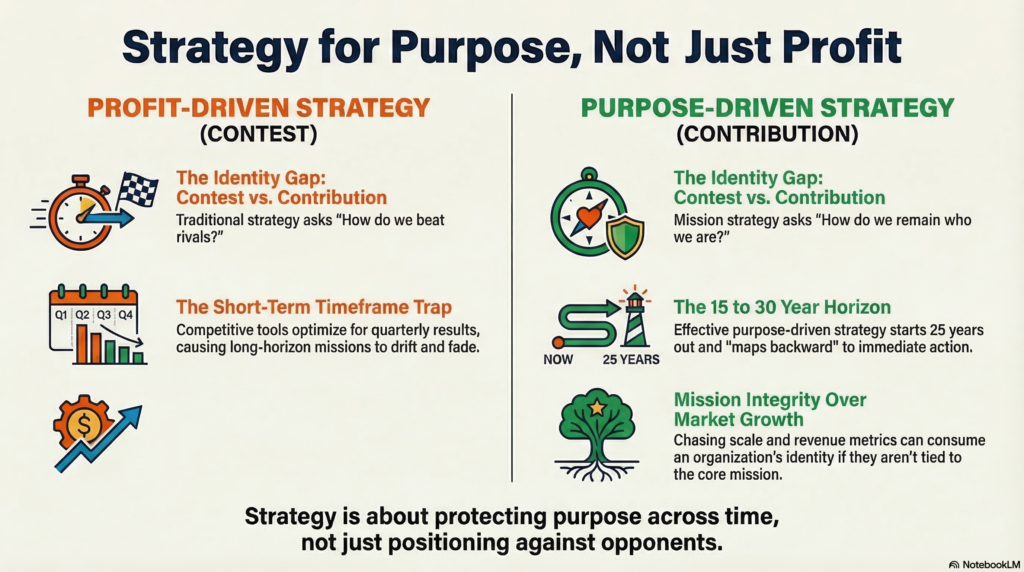
Management strategy as a discipline has a particular genealogy. The models that dominate executive education – the competitive analyses, the positioning matrices, the market share battles – were developed with a specific type of organisation in mind: businesses that survive or collapse based on their ability to outperform rivals and make profits.
The evidence is in the curriculum. Academic research suggests that the vast majority of MBA case material is drawn from industries where competition is the central organising tension. The mental model underneath most strategy training treats the world as a contest. There is a prize. There are opponents. The goal is to win more than you lose.
That framing is genuinely useful for firms operating in those conditions. The urgency of a competitor threatening your revenue is real, and tools designed around that urgency have genuine motivating power.
But take those same tools into a cooperative, a trade association, a government agency, or a development organisation, and something goes wrong almost immediately. (The same applies to a monopoly.) The animating force – the rival who might take what is yours – does not exist in the same way. Frameworks engineered around that force become awkward, like running software on a system it was never designed for.
The afternoon energy drop at your retreat was not a morale problem. It was the sound of a square peg meeting a round hole.
The Timeframe Problem Nobody Talks About
The mismatch runs deeper than vocabulary, though.
Competitive strategy is built around a particular relationship with time – specifically, a short one. The frameworks that dominate business education are oriented toward near-term results: quarterly performance, annual targets, the speed of response to a market threat.
Mission-driven organisations often operate under an entirely different time logic. A land trust working to preserve ecosystems, a credit union serving underbanked communities, a health institution building public capacity – these organisations are answerable to timescales that most competitive strategy tools cannot even see.
When a long-horizon organisation runs its strategy through a short-horizon framework, something gets quietly distorted. The institution begins optimising for the measurable and the near-term, while the foundational commitments – the ones that justify the organisation’s existence – drift into the background.
The Co-operative Group in the United Kingdom offers a sobering case study. Once among the most significant member-owned enterprises in the world, the Co-op entered the 2010s in serious trouble. An investigation into its near-collapse revealed a decade of decisions shaped by competitive growth logic: major retail acquisitions, banking mergers, rapid diversification across sectors. The goal had been scale – more market presence, more revenue streams, more assets.
What the organisation had not been tracking with the same rigour was whether any of this expansion was coherent with what a cooperative is actually for. Its governance was member-based. Its legitimacy came from community trust. Its identity was inseparable from a set of values about how business ought to be conducted.
By the time a £1.5 billion hole appeared in the banking arm, the institution had been operating with someone else’s strategy for years. The tools it had borrowed rewarded growth metrics. They had no mechanism for asking whether growth was serving the mission – or consuming it.
The same drift appears in organisations across every sector.
A humanitarian agency that chases high-visibility donor projects at the expense of quiet, unglamorous long-term work.
A professional body that adds revenue streams until its membership can no longer articulate what the body stands for.
A regional development authority that reports on outputs while the underlying social fabric it was created to strengthen continues to fray.
In each case, the damage is slow and largely invisible inside the planning documents that caused it.
Planning Built Around Purpose
What these organisations need is not a modified version of competitive planning. They need a process that begins with a different assumption — that strategy is about protecting and advancing a purpose across time, not about positioning against opponents.
Such a process starts with an honest reckoning with the present. Before any direction is set, the organisation needs to understand where it actually stands – not just financially, but in terms of mission integrity. How is trust held among the people the organisation serves? When has the institution historically drifted from its purpose, and what triggered those moments? What resources – financial, relational, reputational – are genuinely available?
From that foundation, a long horizon is established. Somewhere between fifteen and thirty years is typically productive. This might feel uncomfortably distant, but the distance is the point. It shifts the planning conversation away from quarterly anxieties and toward the questions that actually define an institution’s legacy.
With a target horizon in place, the team explores a range of possible futures rather than committing to a single premature forecast. The world in twenty-five years will be shaped by forces that cannot be predicted with precision – demographic shifts, technological change, political reconfigurations, ecological pressures. Scenario thinking does not pretend otherwise. It builds the capacity to navigate uncertainty rather than deny it, and it asks the organisation to identify which kind of future best allows its mission to flourish.
From a single chosen scenario, the planning process works backwards. If the organisation needs to be in a certain condition twenty-five years from now, what does the ten-year mark look like? The five-year mark? What must be in place, and by when? What are the big tradeoffs which need to be made? This backward mapping turns an inspiring long-term vision into a logical chain of necessary steps, each grounded in the one that follows it.
Only after that work is complete does it make sense to design a short-term action plan – because now there is a genuine strategic context for it. Immediate decisions are no longer just reactive. They serve something larger. Here, further tradeoffs must be made.
The Question Underneath the Question
The mechanics matter, but the conceptual shift matters more.
Competitive strategy is structured around the question: How do we beat them? Purpose-driven strategy is structured around a different one: How do we remain who we are, and do what we exist to do, across the years ahead?
These produce very different conversations – different discussions at leadership retreats, different criteria for investment decisions, different definitions of success that get embedded in the culture over time.
Cooperatives, civil society organisations, public institutions, and social enterprises are not inferior versions of private companies. They are different kinds of institutions altogether, built on different social contracts, accountable to different stakeholders, and serving purposes that exist precisely because markets and competitive logic have limits.
The strategy process these organisations use should reflect that – not apologise for it.
When the next retreat in your non-profit ends with a document that finally stays off the shelf, it will be because the planning process started from the right place: not how do we win, but how do we endure, and why does it matter that we do.
—————————————
P.S. Here are some LLM prompts you can use for further investigation.
Go Deeper: Five Prompts for Further Exploration
The argument in this article points to a gap — between the strategy tools most executives have been given and the organisations they are actually leading. The five prompts below are designed for use with any AI assistant (Claude, ChatGPT, Gemini, or similar). Each one picks up where the article leaves off. Copy, paste, and adapt the parts in brackets to your own context.
Prompt 1: Diagnose Your Own Organisation
For the reader who finished the article thinking — “this is us.”
I lead a [cooperative / government agency / NGO / family business / religious institution / statutory body] in [country/region]. Based on the argument that most strategy frameworks were designed for competitive, profit-first organisations, help me diagnose whether my organisation has been using the wrong strategy tools.
Ask me five diagnostic questions — one at a time, waiting for my answer before moving to the next — that will reveal whether our strategy process is genuinely built around our mission and long time horizon, or whether we have been borrowing competitive frameworks that don’t fit.
After my five answers, give me an honest assessment of where we stand, and identify the single most dangerous misfit between the tools we are using and the organisation we actually are.
Prompt 2: Rebuild the Co-op’s Strategy — Non-Competitively
For the reader who found the Co-operative Group case study instructive and wants to go deeper.
The UK Co-operative Group’s near-collapse in 2013 has been attributed to governance failure and poor management. But a different diagnosis is possible: the Co-op was a mission-first, member-owned organisation that had adopted competitive private-sector strategy logic — chasing scale, acquisitions and market presence — instead of building strategy around what a cooperative is uniquely positioned to do.
Assume you are a strategy advisor brought in to the Co-op in 2005, before the Britannia merger and the Verde pursuit. Using only non-competitive strategy tools — scenario planning, category design, mission integrity analysis, and long-horizon thinking — build the outline of the strategic conversation the Co-op’s leadership should have been having. What questions should have been on the table? What 20-year opportunity was sitting unclaimed? What slow-moving threats should have been named? What would a purpose-first Co-op strategy for 2005–2030 have looked like?
Prompt 3: Design a Purpose-First Strategy Retreat
For the reader who is planning — or dreading — their next strategic planning offsite.
I need to design a two-day strategy retreat for the leadership team of a [describe your organisation type and size]. Our previous retreats have used standard frameworks — SWOT analysis, competitive positioning, priority matrices — and the resulting plans have consistently ended up on shelves.
The core problem is that those frameworks were designed for profit-first, competitor-facing businesses. We are a mission-first organisation with a long time horizon and no direct rival whose defeat would constitute success.
Design a full two-day retreat agenda that replaces competitive frameworks with purpose-built alternatives. Include: the opening question that reframes the entire conversation; how to run a scenario planning session for a non-technical audience; how to do backward mapping from a 25-year horizon to a 90-day action plan; and how to end the retreat with commitments that will actually survive contact with the following Monday morning.
Prompt 4: Make the Internal Case for Long-Term Thinking
For the reader who agrees with the argument but now has to convince a board or senior team that doesn’t.
I have read an argument that mission-driven organisations — cooperatives, government agencies, NGOs, religious institutions, family businesses — are systematically underserved by MBA-derived strategy frameworks because those frameworks were built for competitive, profit-first firms. I agree with this argument. My organisation is [describe it briefly].
The problem is that my board and senior leadership are not yet convinced. Several members have strong private-sector or MBA backgrounds and default to competitive strategy language. Others simply don’t see the urgency of changing our planning approach.
Help me build the internal case. Give me: three concrete examples of organisations like ours that failed — or significantly underperformed — because they used competitive strategy frameworks that didn’t fit; three compelling questions I can put to the board that will expose the mismatch without triggering defensiveness; and the single most persuasive one-paragraph argument I can make for why this matters now, not eventually.
Prompt 5: Apply Category Design to a Non-Competitive Organisation
For the reader intrigued by the article’s reference to category design as an alternative strategic tool.
Category design is a strategy framework developed primarily for technology and consumer companies. Its core idea is that instead of competing within an existing market, an organisation defines and dominates an entirely new category — changing what problem it is seen to solve and becoming the obvious answer to a question that previously wasn’t being asked.
I want to explore whether category design can be applied to a non-competitive organisation. My organisation is [describe: sector, size, core mission, approximate age, geographic context].
Walk me through a category design thinking process adapted for a mission-first organisation. Specifically: What category does my organisation currently occupy in the minds of the people it serves — and is that the right one? What problem could we redefine ourselves as the unique solution to? What would it mean for us to own a category rather than compete within one? And what is the 10-year version of success if we got this right?
A note on how to use these prompts: each one is a starting point, not a single exchange. The most productive approach is to begin the conversation, push back on the AI’s first response, add specifics about your own organisation, and treat the output as a thinking partner rather than a finished answer. Prompt 3 in particular benefits from iteration — run it once, then ask the AI to make the agenda harder, more honest, or more specific to your sector.
Your company is bleeding. The tariff just hit. Your board wants answers. You have 48 hours.
But sometimes the brutal truth is that the warning signs were there 20-years ago.
In this episode, Marcel Melzer stops the scroll with his contrarian claim: strategic decisions should take 48 hours, not months.
His “decision as a service” model combines strategic foresight with AI-augmented decision intelligence—delivering what traditional consulting takes 8 weeks to produce, in 2 days. The magic?
It’s not about perfect information. It’s about deciding at 80% confidence while your competitors are still scheduling meetings. We deconstruct a fictional case live, revealing why companies confuse firefighting with strategy, why past non-decisions create present disasters, and why the future belongs to leaders who can decide fast under uncertainty.
Jamaica just got hurricane-smashed—we need this yesterday.
What a European tech giant understands about strategy that most boardrooms never will
There is a particular kind of corporate tragedy that doesn’t make headlines. No fraud. No scandal. No catastrophic product failure. Just a slow, invisible accumulation of risk — until one day, the whole structure collapses under its own weight.
It happens when a company mistakes activity for foresight.
The planning calendar is full. The board is engaged. The strategy deck is polished. And yet, somewhere in that busy, confident organisation, a quiet catastrophe is taking shape. Because nobody — not the CEO, not the board, not the executive team — has ever been asked to take serious ownership of what happens after year five.
This is not incompetence. It is a design flaw. And it is far more common than most leadership teams would care to admit.
The Company That Forgot to Ask
Picture a well-run, founder-led business. Nearly five decades of consistent growth. A charismatic patriarch who built the enterprise from nothing, understood every customer relationship personally, and carried the company’s long-term direction entirely in his own mind.
The planning process was real. The five-year cycles were taken seriously. Consultants were hired. Presentations were made. Targets were set and largely met.
Then the founder died.
Within weeks, the company’s strategic void became visible. There was no successor who understood where the business was going — because that destination had never been written down, debated, or distributed. It lived in one person’s mind, and it died with him.
A competitor saw the opening immediately. They moved quickly with a lowball acquisition offer — a fraction of what the business had taken decades to build. The leadership team, with no mandate and no map, accepted.
Fifty years of equity gone. Not because the organisation lacked talent, but because it lacked structure. Nobody had ever been asked, in any formal planning session, to imagine the business fifteen or twenty years out. The founder’s personal vision had been mistaken for a corporate strategy. They were not the same thing.
The Company That Starts in 2039
Now consider the opposite model.
ASML, headquartered in Eindhoven in the Netherlands, is Europe’s most valuable technology company. If you’ve never heard of them, that’s partly by design — they operate in the deep infrastructure of the global economy. Every advanced semiconductor chip produced on earth, inside every smartphone, data centre, and electric vehicle, depends on ASML’s machines. They hold a near-monopoly on the extreme ultraviolet lithography technology that makes modern computing possible.
What’s unusual about ASML is not their product. It’s how they think about time.
Most organisations build strategy by starting today and projecting forward. ASML reverses the sequence. Their planning begins at a future destination — currently, that horizon is 2039 — and works backwards to the present. The question driving every major strategic conversation is not “where can we realistically get to?” but “given where we need to be, what must we begin doing right now?”
Every September, ASML’s senior leadership and supervisory board gather for a structured multi-day offsite. The agenda is not a review of last year’s performance or a recalibration of near-term targets. It is a methodical examination of the gap between today’s capabilities and a specific set of technical requirements the world will demand fifteen years from now. From that gap, they derive their current priorities.
This is not vision-statement strategy. It is operational reverse-engineering.
The Detail That Should Unsettle You
But here is the part of ASML’s model that most organisations find genuinely difficult to replicate — not because it requires exceptional talent or resources, but because it requires a shift in culture that cuts against deeply held habits.
ASML does not do this alone.
Their three largest customers — Intel, Samsung, and TSMC — are active participants in the company’s long-range planning process. ASML consults them continuously, years in advance, to co-design future machines around the chips those customers will eventually need to produce. The strategic horizon is shared, not proprietary. The future is treated as a collaborative obligation rather than a competitive secret.
Think about what this means in practice. ASML’s planning process includes the voices of the organisations that will determine whether their future investments succeed or fail. They have structurally eliminated the risk of spending a decade building something their customers have quietly moved away from. Foresight is not an executive exercise conducted behind closed doors. It is a shared discipline embedded into the operating model.
Contrast this with how strategy typically works. In most organisations, long-range planning is handled by a small group, shielded from clients, suppliers, and sometimes even from the broader leadership team. The output is a document. The document is presented. The document is filed. The cycle repeats.
In that model, the future is nobody’s real responsibility.
The Excuses Are Everywhere
Ask executives why their organisations don’t plan further out, and the answers are remarkably consistent across industries and geographies.
“By the time any of this matters, I’ll have moved on.”
“We can barely manage the next quarter — asking me to think twenty years ahead feels absurd.”
“The environment changes so fast that long-range planning is just fiction.”
“That’s not what I’m measured on.”
These are not cynical responses. They are honest ones. And the honesty points directly at the problem. These executives are not failing to think long-term because they lack intelligence or ambition. They are failing because the systems around them — the incentives, the meeting structures, the planning processes, the performance frameworks — have never required them to do otherwise.
This is a design problem, not a people problem. You can replace every executive in the building, and if the planning process remains unchanged, you will get the same output.
The founder in our opening story was not surrounded by weak leaders. He was surrounded by capable people who had never been invited to take ownership of a question that extended beyond the current five-year cycle. When he died, that question died with him.
What Actually Needs to Change
ASML’s longevity and dominance are not explained by the quality of their engineers, though their engineers are excellent. They are explained by a structural decision: to build long-range thinking into the organisation’s architecture, not leave it to individual brilliance.
Over time, the planning process itself was designed to demand a different quality of thinking. The time horizon was extended. The conversation was opened to include the customers who would determine the future. The annual offsite was built around a single question that couldn’t be answered with last year’s data.
None of this is beyond the reach of organisations that are far smaller and less resourced than ASML. The barrier is not capability. It is commitment to changing the design of the conversation.
If your next planning session opens with a review of this year’s targets, ask what would change if it opened instead with a question about 2040. If your strategy is currently held by one or two senior leaders, ask what happens to it when they leave. If your longest planning horizon is five years, ask yourself honestly: is that a strategic decision, or simply the default you’ve never thought to question?
The organisations that outlast their founders, their industries, and their competitors are not the ones with the best five-year plans. They are the ones that learned, early enough, to treat the distant future as urgent.
The question is not whether you can afford to think that far ahead.
Why Your Best Team Might Be Building Your Worst Disaster
Picture this: A talented leadership team. Top-tier credentials. Flawless execution. Every metric trending green. And yet, five years later, the company is fighting for survival—or worse, gone entirely.
This isn’t a story about incompetence. It’s something far more insidious. It’s about intelligent people trapped inside a system that rewards them for making precisely the wrong choices.
The Athletic Metaphor That Explains Everything
Want to see this pattern in pure form? Look at how different sports organizations develop talent.
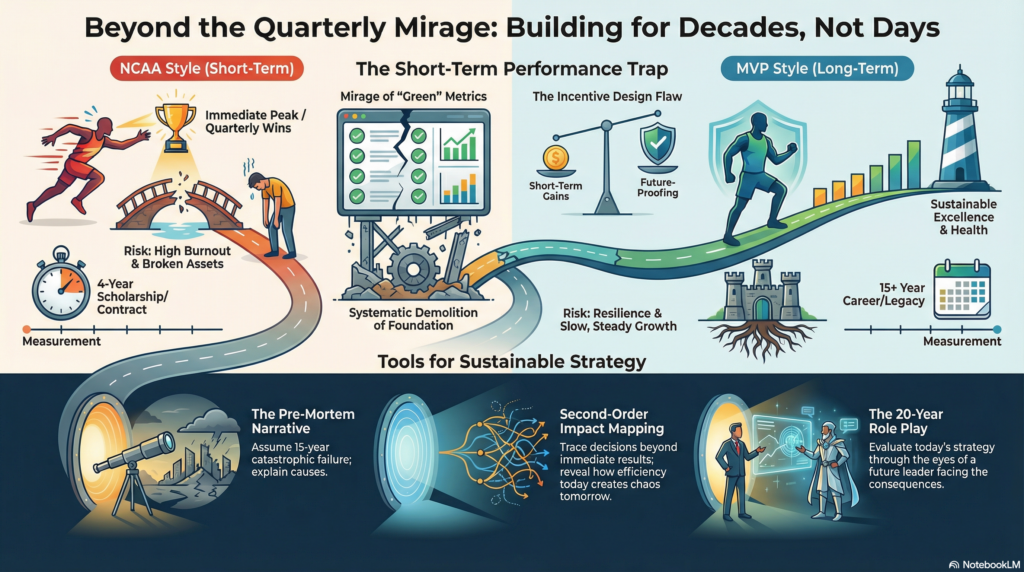
Jamaica’s MVP Track Club has produced Olympic champions and world record holders whose careers span decades. Athletes like Shelly-Ann Fraser-Pryce and Elaine Thompson-Herah didn’t just win races—they sustained excellence well into their thirties, their bodies intact, their bank accounts healthy.
Meanwhile, the American collegiate athletics system—the NCAA—operates like a different species entirely. Talented high schoolers arrive with Olympic potential. Four years later, many flame out, never to compete internationally again. Bodies broken. Dreams abandoned.
Here’s what makes this fascinating: NCAA coaches aren’t incompetent. These are world-class professionals running billion-dollar programs with access to cutting-edge sports science. They track everything—times, splits, recovery metrics, nutrition, biomechanics.
Yet they’ve built a machine designed to extract maximum performance over four years, regardless of what happens afterward. The system optimizes perfectly—for conference championships, television contracts, recruitment rankings. And in the process, it systematically destroys the very athletes who make those outcomes possible.
MVP asked a different question entirely: What does success look like measured over a fifteen-year career instead of a four-year scholarship? The answer required sacrificing immediate gratification—forgoing certain meets, accepting slower progression, resisting the pressure to peak too early.
The NCAA doesn’t fail because its people are stupid. It fails because every incentive, every measurement, every reward structure points them toward short-term glory and long-term destruction. And every dashboard they monitor confirms they’re doing exactly what they’re supposed to do—right up until the athlete graduates broken.
Now here’s the uncomfortable question: Is your company running the NCAA playbook?
The Corporate Version of Athletic Destruction
Corporate history is littered with smart people making decisions that looked brilliant on every spreadsheet while quietly demolishing the foundation beneath them.
Consider the financial sector meltdowns of recent decades. Before the 2008 crisis, before Enron, before the savings and loan disasters of the 1980s, things looked spectacular. Quarterly earnings beat expectations. Risk models showed green lights. Executives earned accolades for innovative financial engineering.
The long-term destruction was being created from day one. Not by people too stupid to see it, but by systems designed never to look for it.
Why Intelligence Doesn’t Protect You
The trap works like this: The CEO who sacrifices this quarter’s numbers to protect next decade’s foundation doesn’t get applauded at the board meeting. They get questioned. Their judgment gets doubted. Their compensation takes a hit.
Meanwhile, the executive who delivers short-term wins—even by mortgaging the future—gets promoted, celebrated, interviewed by business publications.
This isn’t a failure of intelligence, discipline, or execution. It’s a design flaw in how success gets measured.
The answer isn’t working harder within the existing framework. It’s redesigning the framework itself. That requires confronting existential questions about what you’re actually optimizing for—and having the courage to challenge metrics that everyone agrees are “obviously” correct.
Three Techniques to Surface Hidden Disasters
Here are practical methods to force your leadership team to see beyond the quarterly mirage:
The Pre-Mortem Exercise
Gather your strategy team. Give them one instruction: Assume your current initiative has failed catastrophically fifteen years from now. Write the detailed story of exactly how and why.
Not vague organizational hand-wringing like “we didn’t execute well enough.” A specific, uncomfortable narrative that traces the chain of consequences from today’s confident decision to tomorrow’s wreckage.
The discipline is in the specificity. “We lost market share” is useless. “We optimized our pricing algorithm for immediate margin expansion, which slowly trained our best customers to view us as a commodity, which eroded pricing power, which forced us into a desperate discount spiral that destroyed brand equity and made us vulnerable to a well-funded competitor who simply waited us out” is useful.
The Second-Order Impact Map
Most strategy discussions evaluate immediate effects and stop there. “This restructuring reduces overhead by 18%.” Applause. Meeting adjourned.
The second-order map refuses to stop. It forces the room to keep pulling the thread: That cost reduction eliminates redundancy. Which reduces organizational resilience. Which means the next market shock hits harder. Which forces emergency measures. Which creates exactly the kind of chaos that drives your best people to competitors. Who use them to build what you should have built.
Keep pulling until the consequences become uncomfortable enough to reconsider the decision.
The Twenty-Years-Later Role Play
Identify the youngest person in your leadership team. They become a time traveler.
It’s twenty years in the future. A new generation of leaders asks them: “What was it like in that 2026 strategy session? What did your team decide?”
They respond with two scenarios. First, the courage scenario: “We confronted the hardest questions. We acknowledged uncomfortable truths. We made decisions that hurt short-term but protected long-term. Here’s how it played out.”
Second, the cowardice scenario: “We pretended things we knew weren’t true. We optimized for looking good rather than being good. We told ourselves comfortable lies. Here’s the price we paid.”
The technique works because it makes abstract future consequences feel visceral and immediate.
The Choice That Defines Leadership
Every organization faces the same fundamental question: Are you building an MVP or running an NCAA program?
Are you optimizing for sustainable excellence or spectacular quarterly performance? Are you protecting the foundation or mining it for short-term gains?
The smartest people in the room will keep making the worst decisions until the room itself gets redesigned. Until the metrics change. Until the incentives shift. Until the questions being asked force long-term consequences into immediate view.
The techniques exist. The choice is whether you have the courage to use them.
P.S. Five Prompts for Deeper Reflection
Use these with your preferred AI to explore how these patterns might be operating in your specific context:
“I’m a [your role] at a [your industry] company. We’re currently optimizing for [your key metric]. Help me identify what long-term value we might be destroying in the process. Be brutally specific about the chain of consequences I’m not seeing.”
“Run a pre-mortem analysis: It’s 2040, and the strategy we implemented in 2025 has failed catastrophically. Write the detailed story of how our decision to [your current initiative] led to our downfall. Don’t hold back on uncomfortable specifics.”
“I need a second-order impact map. Our first-order effect from [your decision] is [immediate outcome]. Help me trace at least five levels deeper into the consequences, particularly the ones that would take years to surface but would be devastating when they do.”
“Create a dialogue between my 2025 self and my 2045 self. The older version has lived through the consequences of [current strategic choice]. What would they tell me that I’m not willing to hear right now?”
“Analyze my industry through the NCAA vs MVP lens. Who in my competitive landscape is running the short-term optimization playbook? Who’s building for decades? What specific metrics distinguish them? What would it cost me to switch approaches?”
Stop me if you’ve been in Bob’s position. Every strategist learns the frameworks. Porto five forces, blue ocean strategy, and SWAT analysis. And we assume great strategy comes from great frameworks. So how Schultz of Starbucks fame, he knew all of the frameworks, but he didn’t transform Starbucks or any of them. In 1983, Schulz visited Milan. He walked into an express bar. He saw the ritual, the community, the third place between home and work. And that experience became a story. That story became his northstar.
00:00:34
That story created a hundred billion dollar plus company. Not a framework, a story. But here’s where most strategists get stuck. Baba spent hours preparing for the strategy retreat. He had the perfect framework from his MBA and he was excited because he was going to nail it by explaining this framework. As the conversation progressed, some doubts crept in, but he prepared for hours. So when the moment came he jumped in and as he explained his framework eyes glazed over. So he tried to speed up
00:01:07
that made it worse. Phones came out people started to read and his boss gave him a dark look that was kind of like a cut it out and Bob gave up. But moments later another colleague jumped in. And in that case, she told a story. And Bob suddenly realized she was explaining the same concept that he just tried to describe using a framework. But this time, the heads were nodding. There were some new insights that were emerging as people built on her initial story. There was some buying happening. She was accomplishing the result. And he
00:01:42
thought to himself, why didn’t I try that? Well, here’s what he discovered and what Howard Schultz knew all along. that we’ve been taught that strategic thinking is about mastering frameworks. They give us the illusion of sophistication. But here’s the truth that plays out in every boardroom and every strategy retreat and every presentation given by consultants that there’s a big difference between strategic thinking and strategic fluency. Strategic thinking is all about those frameworks
00:02:09
that you learned in MBA school, ones I mentioned before. Strategic fluency teaches you stories. So when JFK committed America to go to the moon, he didn’t pull out the Gad chart. He didn’t tell a framework. Instead, he went to the future and told a story about the future. So the best strategists actually aren’t searching for which framework applies in which situation. Instead, they’re reaching out for their curated collection of signature stories. So how do you avoid that awkward moment Bob
00:02:38
found himself in? I recommend that you prepare three signature stories. One transformational stories like the one about Schulz in Milan. One about the future like Kennedy’s moonshot. And one story about strategic choice. That’s three stories. Good news is that Strat Cinema helps you to find your three.
This is a public episode. If you’d like to discuss this with other subscribers or get access to bonus episodes, visit longtermstrategy.substack.com/subscribe
Companies obsess over documenting financial controls. They create detailed procedure manuals for operations. Yet when it comes to transferring strategic thinking between executives, most organizations fail spectacularly.
The problem isn’t a lack of documentation. It’s documenting the wrong things entirely.
The Six-Month Struggle Every Incoming Executive Faces
Here’s a scenario playing out in boardrooms worldwide: A seasoned executive departs. Their replacement inherits comprehensive transition materials—market analyses, strategic frameworks, financial models, implementation roadmaps, organizational diagrams, and risk assessments.
The incoming leader dedicates weeks to reviewing everything. They schedule meetings with key stakeholders. They take copious notes. They ask intelligent questions.
Six months later, they’re still struggling to make strategic calls with the confidence their predecessor demonstrated. They hesitate where the former leader acted decisively. They miss contextual nuances that seem obvious in hindsight.
What went wrong?
Nothing and everything. The documentation was thorough. The transition process followed best practices. But the handoff materials contained polished conclusions instead of strategic thinking itself.
This represents a fundamental misunderstanding about how strategic capability actually transfers between leaders.
What Your Transition Documents Are Actually Missing
Those transition binders look impressive. They contain everything a rational person would consider important: competitive threat assessments organized by market segment, positioning frameworks with detailed differentiation matrices, three-scenario financial projections, milestone-dependent implementation schedules, and comprehensive risk mitigation plans.
The critical gap? None of these materials explain how the organization arrived at its current strategic direction.
The genesis moment goes undocumented. Was the strategic pivot triggered by nearly losing a major client? Did a competitor’s unexpected move force a rethink? Did a board member ask an uncomfortable question that wouldn’t go away?
The discovery process remains invisible. What initial research contradicted long-held assumptions? Which sacred cows got sacrificed? When did the leadership team realize their comfortable worldview was dangerously wrong?
The human drama gets erased. That intense multi-day retreat where Finance and Operations clashed over resource priorities? Forgotten. The skeptical VP who opposed the initiative before becoming its most passionate advocate? Airbrushed out. The moment someone finally said what everyone was thinking but nobody wanted to acknowledge? Lost forever.
Most leadership teams justify these omissions with variations of: “That’s just internal politics. It’s unprofessional. The new executive needs our decisions, not our dirty laundry.”
Consider two incoming executives facing the same strategic direction.
Executive A receives polished slide decks explaining the final strategic framework. Clean. Professional. Complete.
Executive B receives the full origin story: the triggering incident, the initial resistance, the data that changed minds, the fierce debates, the breakthrough moments, the implementation battles.
Three months later, both executives face pressure to abandon elements of the strategy. Market conditions have shifted. Key stakeholders are pushing for different priorities. Quick wins from alternative approaches look tempting.
Executive A, having only received conclusions, treats the strategy as inherited wisdom. They lack emotional investment. When challenged, they can recite the framework but can’t defend its foundations. They become susceptible to any argument that sounds reasonable because they never witnessed why alternative approaches were rejected.
Executive B, understanding the battle scars, responds differently. They know which assumptions were tested and survived. They understand which stakeholder concerns were addressed and how. They recognize which seductive alternatives were explicitly considered and rejected, and why. This knowledge creates conviction.
The messiness isn’t an embarrassing artifact to hide. It’s the mechanism that transforms a successor from a strategy executor into a strategy guardian.
Without origin stories, you’re handing someone a map without teaching them how to read terrain. They can follow the route you marked, but they can’t navigate when conditions change.
How Mental Models Beat Exhaustive Analysis
The second critical gap involves transferring strategic thinking patterns rather than strategic conclusions.
Your comprehensive transition documents provide analysis. What incoming executives actually need are the mental frameworks that generated that analysis.
Consider a healthcare organization undertaking strategic transformation. Traditional handoff approach: a 200-page document detailing market research, competitive positioning, customer segmentation, channel strategy, technology roadmap, and financial projections.
Alternative approach: “We’re becoming the Netflix of healthcare.”
That single sentence does more strategic work than 200 pages ever could. It instantly conveys: subscription relationships over transactional interactions, integrated digital experiences instead of fragmented touchpoints, platform thinking rather than service delivery, customer lifetime value over point-of-sale margins.
An incoming executive who internalizes this pattern can make hundreds of subsequent decisions aligned with strategic intent—without referring back to documentation. The pattern provides a mental model for evaluating new opportunities, prioritizing resources, and making trade-offs.
Analysis answers specific questions. Patterns teach strategic thinking.
Most transition documents fail here because outgoing executives don’t explicitly name the strategic patterns they’re using. These frameworks remain implicit—obvious to the departing leader but invisible to their successor.
Creating Genuine Strategic Urgency
The third missing element is the diagnostic story that explains why the current strategy became necessary.
Generic problem statements fill transition documents: “Market conditions are evolving.” “We need to maintain competitive advantage.” “Customer expectations are changing.”
These platitudes don’t create urgency. They create checkbox compliance.
Contrast that with a genuine diagnostic story: “Our analysis revealed we were Blockbuster in 2005. We had dominant market share, strong brand recognition, and profitable operations. We were also completely vulnerable. While we defended a dying business model, our industry’s Netflix equivalent was growing 40% annually. Our window for strategic response was roughly 18 months before our competitive position would become unrecoverable.”
That’s a diagnostic story with teeth. It explains why inaction represented an existential threat, not merely a missed opportunity. It creates urgency by making the stakes visceral and the timeline concrete.
Start Building Your Strategic Story Library Today
Most executives struggle to capture these three story types because they haven’t developed pattern recognition for what makes strategic stories effective. You need exposure to dozens of transformation cases before your mind identifies the underlying structures.
The solution? Deliberate practice with real business transformation narratives.
Start by studying how successful leaders explain their strategic pivots. Look for moments when executives describe “how we nearly missed this” or “why we became the [X] of our industry.” These moments contain the raw material for powerful strategic stories.
But finding quality transformation case studies scattered across YouTube and business media takes time—time most executives don’t have. That’s why platforms like StratCinema.org exist: to curate business transformation stories specifically for strategists developing this narrative fluency. Instead of algorithm-driven suggestions that keep you watching but not learning, you get carefully selected case studies that build pattern recognition.
Your next leadership transition deserves better than polished slide decks. It requires origin stories that create ownership, pattern stories that transfer mental models, and diagnostic stories that sustain urgency. Document these with the same rigor you apply to financial controls, and your successor won’t just execute your strategy—they’ll defend and evolve it.
P.S. Use AI to Capture Your Strategic Stories
Don’t have time to craft these stories from scratch? Modern AI tools can help you extract and structure the strategic narratives already in your head. Here are three sets of prompts—one for each story type—that you can use with any large language model to develop handoff materials that actually transfer strategic thinking.
Origin Story Prompts
“I need to document how our [specific strategic initiative] actually came together. Help me structure an origin story by asking me questions about: What triggered our initial concern? What was the ‘oh shit’ moment that made this urgent? Who were the initial skeptics and what convinced them? What data or insights contradicted our assumptions? What internal conflicts emerged during planning? Which alternatives did we seriously consider and reject? What breakthrough moment changed our approach? Walk me through these questions one at a time, then help me shape my answers into a compelling narrative that shows future leaders why this strategy emerged and what obstacles we overcame.”
Pattern Story Prompts
“Our strategy can be summarized as ‘[our approach]’ but I need to articulate the mental model behind it. Help me identify the pattern we’re following by asking: What successful company or strategy are we emulating? What’s our ‘[X] of [Y]’ statement? What core principle guides our decision-making? What trade-offs does this pattern naturally suggest? What does this pattern tell us to prioritize versus ignore? If someone internalized this pattern, what decisions would they make differently? Help me craft a concise pattern statement that transfers strategic intuition, not just strategic conclusions. Make it memorable enough that leaders can apply it without consulting documentation.”
Diagnostic Story Prompts
“I need to explain why our strategy was necessary—not just beneficial. Help me create a diagnostic story that conveys genuine urgency by asking: What complacent narrative were we telling ourselves before? What data revealed our vulnerability? What competitor or market shift threatened our position? What timeline were we facing? What would failure have looked like? What historical business failure does our situation resemble? Help me structure this into a narrative that makes inaction feel existential, not merely suboptimal. The goal is to transfer the visceral urgency we felt when we realized we had to transform.”
Picture two teams in your company, six months apart.
The first team is drowning. They have 47 “strategic initiatives” on their list, no clear way to prioritize, and every meeting devolves into debates about resources. Morale is terrible, and nobody can articulate what they’re really trying to accomplish.
Fast forward six months: the same team, but now they’re energized, focused, and can explain their strategy in three minutes. Projects that don’t serve their core hypothesis get killed quickly. They’re making contingency plans because they understand their strategy is a bet, not a certainty.
What happened in between?
They stopped confusing a strategic plan with actual strategy. Today, I want to walk you through that transformation, because the gap between these two states isn’t about working harder—it’s about thinking differently.
Tune into this episode to join me in tackling this wicked problem.
I’m Francis Wade and welcome to the JumpLeap Long-Term Strategy Podcast
This is a public episode. If you’d like to discuss this with other subscribers or get access to bonus episodes, visit longtermstrategy.substack.com/subscribe
Will your organization survive the next 25 years? More importantly, are the decisions you’re making today planting the seeds of future irrelevance?
The US Coast Guard wrestled with these questions and discovered something counterintuitive: to truly understand today’s challenges, you need to view them from 25 years in the future. Their Project Evergreen initiative proved this—but only after failing spectacularly for 15 years first.
The Expensive Lesson: Brilliant Strategy, Zero Implementation
Imagine pouring 15 years into strategic planning. Your organization assembles the best minds, conducts sophisticated scenario workshops, and produces detailed roadmaps. The forecasts are prescient. The analysis is sharp. The strategies are comprehensive.
Then everything hits reality and dies on impact.
This was Project Evergreen’s painful trajectory. Every strategic plan they delivered landed, in their words, “like most additional work at an office with an already full plate: dead on arrival.” Inbox after inbox received these plans. Nearly all went unimplemented.
The Coast Guard had built “isolated, independent cogs” that required “considerable effort to forcefully engage into the many turning mechanisms” of actual organizational planning. Picture trying to force a rigid gear into machinery that’s already running—that’s what executing these strategies felt like for frontline teams.
Why did meticulously crafted strategies produce such dismal results?
The Question That Poisoned 15 Years of Planning
For a decade and a half, Project Evergreen asked what seemed like a perfectly reasonable question: “What should the Coast Guard do?”
If you’ve sat through strategic planning sessions, this probably sounds familiar. It’s typically the first question on the agenda. What should we do about artificial intelligence? How should we respond to digital transformation? What’s our climate change strategy?
The problem isn’t obvious at first glance. This question appears logical, even necessary. But it creates a fatal dynamic.
When you ask “What should we do?” you’re asking workshop participants—typically senior strategists and consultants—to prescribe solutions. These prescriptions then get handed down to implementers who weren’t in the room and didn’t shape the solutions. As the Coast Guard discovered, “the ideal people to do the job might not be in the room.”
This creates what I call supply-side strategy: strategists manufacture solutions and push them onto implementers. Those solutions arrive as rigid directives disconnected from operational reality.
The fundamental flaw isn’t that strategists are separated from implementers—there are simply too many implementers to fit in a retreat. The flaw is the question itself.
Present-Forward Thinking: Perfect for Tactics, Fatal for Transformation
That innocent-sounding question—”What should we do?”—invisibly locks your thinking into a present-forward orientation.
Present-forward thinking starts with today. It analyzes current problems, extrapolates existing trends, and prescribes solutions based on incremental projections. This approach works brilliantly for everyday management. It’s ideal for hitting quarterly targets, solving operational problems, and managing predictable challenges.
But for 25-year transformation? It’s disastrous.
Why? Because present-forward thinking generates tactical responses to current conditions. It can’t account for fundamental shifts in your organization’s operating environment. It can’t help you prepare for demands that don’t yet exist. It treats the future as a slightly modified version of today.
Case in point: In 2001, Kodak had abundant, recent evidence that digital photography was no threat to traditional business. The present-forward mindset dominated the thinking of executives and blocked the possibilities.
Managers use present-forward thinking each day because it’s the default mode for problem-solving. But that’s exactly why it fails for long-range strategy. This familiar mode becomes invisible, and organizations apply it to challenges it was never designed to address.
The Cognitive Shift That Changed Everything
After 15 years of failure, the Coast Guard discovered the fundamental shift required: from present-forward to future-back thinking.
This framework, developed by strategy theorists Mark Johnson and Josh Suskewicz, represents a complete cognitive reorientation. Instead of starting with today’s problems and projecting forward, you start with 2050’s probable demands and work backward.
The new question becomes: “What demands will the organization face?”
This isn’t semantic trickery. It’s a fundamentally different way of thinking about strategy.
When the Coast Guard made this shift, they began identifying what they call “robust strategic needs”—outcomes required by specific long-term futures, each demanding particular strategic responses.
Prescriptions say “do this.” Strategic needs say “accomplish this outcome”—and then trust implementers to craft solutions suited to their specific contexts and the evolving reality they’re navigating.
How Future-Back Thinking Works in Practice
Project Evergreen now runs workshops that map multiple plausible 2050 scenarios. They explore various futures the Coast Guard might face—different geopolitical landscapes, climate conditions, technological capabilities, maritime threats.
Then something critical happens. As the project team explained: “The solution space had to be left to the people who were actually going to implement the solution.”
Instead of receiving detailed instructions, implementers receive strategic needs. They’re asked to “deconstruct and then reconstruct” these needs for their specific operational contexts.
This approach works because objectives spanning 25 years can’t be prescribed with any accuracy. The future will unfold in unexpected ways. Game-changing strategies require flexible frameworks that can adapt as conditions evolve. Strategic needs provide that framework. Rigid tactical plans don’t.
The result: Project Evergreen became what they call a “backdoor strategic contributor”—guiding organizational direction without constraining operational flexibility.
The 2025 Payoff from 2050 Thinking
Here’s where this approach delivers immediate value.
Future-back thinking reveals which of today’s “urgent” priorities are actually superfluous. When you clearly understand the demands your organization will face in 25 years, some current problems simply fade in importance. The larger perspective exposes which fires are worth fighting and which will burn out on their own.
This prevents wasting resources on solutions that won’t address actual long-term demands.
It also transforms implementer motivation. Instead of following someone else’s prescriptions, teams gain the autonomy to design solutions matched to their reality. That autonomy—the flexibility to meet strategic needs in contextually appropriate ways—creates genuine engagement and inspiration.
Applying This to Your Organization
Consider your organization’s long-range planning through this lens.
The present-forward approach asks: “What should we do about immediate challenges?” This generates aspirational goals—”become industry leader,” “achieve digital transformation,” “reach carbon neutrality”—often disconnected from implementation reality. These sound impressive in board presentations but provide little practical guidance for teams expected to deliver them.
The future-back approach asks: “What demands will our organization face in 2050?” This identifies strategic needs that divisions must customize for their contexts.
For example, rather than prescribing “implement AI across all functions, ”you might identify a strategic need for “decision-making capabilities that scale with data complexity.” Different departments can then develop solutions suited to their unique challenges—customer service might deploy conversational AI, logistics might focus on predictive routing, finance might build automated risk assessment.
A flexible framework instead of a rigid mandate.
The Counterintuitive Truth
The Coast Guard’s expensive lesson offers a counterintuitive truth: you need tomorrow’s perspective to understand today’s priorities.
Organizations that begin with present-forward thinking remain trapped in tactical responses to current conditions. They mistake busy-work for strategy. They confuse detailed plans with transformation.
Organizations that embrace future-back thinking gain something more valuable: clarity about which current actions actually matter for long-term survival.
That 25-year horizon isn’t about predicting the future perfectly. It’s about developing the perspective to distinguish signal from noise in the present.
The question isn’t whether your organization will face existential demands by 2050. It will. The question is whether you’re building the strategic foundation today to meet those demands—or whether you’re sowing the seeds of irrelevance while obsessing over quarterly results.
The answer starts with asking a different question.
Source: Project Evergreen’s Long-Range Strategic Planning, United States Naval Institute
P.S. Here are prompts for use in your faovorite LLM.
These prompts are designed to help you shift from a “present-forward” mindset to “future-back” strategic thinking based on the article’s core lessons.
1. The “Future-Back” Visioning Prompt
“Imagine it is the year 2050. Describe three major environmental, technological, or social demands my [industry/role] will face. Based on these 2050 demands, work backward to identify one ‘strategic need’ I must begin addressing today to remain relevant, focusing on outcomes rather than specific tools.”
2. Signal vs. Noise Filter
“Review my current top five professional priorities. Using the ‘future-back’ lens from the US Coast Guard’s Project Evergreen, analyze which of these are merely tactical responses to today’s ‘noise’ and which align with long-term ‘signals’ of 2050. Suggest which I should deprioritize.”
3. From Prescription to Empowerment
“I am currently planning [Project Name]. Instead of asking ‘What should I do?’, help me rephrase my goals into ‘strategic needs.’ Create a list of high-level outcomes that define success for this project while leaving the specific ‘how-to’ implementation flexible for changing future conditions.”
4. The “Anti-Kodak” Stress Test
“Identify a current success or ‘proven’ method in my business that feels indispensable today. Act as a contrarian strategist from the year 2050 and explain how over-reliance on this specific success could lead to my future irrelevance. What flexible capability should I build instead?”
5. Implementation Gap Bridge
“I have a long-term strategy to [Insert Goal], but it feels ‘dead on arrival.’ Help me deconstruct this rigid plan into ‘robust strategic needs’ that my team can actually implement. How can I shift from pushing solutions to empowering my team to solve for future demands?”
Annie’s hands trembled as she reread the email from her CEO. “Let’s talk about developing your strategic capabilities.”
She’d just earned her MBA with honors, landed a promotion to Chief Marketing Officer, and crushed her Strategic Planning course with an A-. Now, three weeks before Christmas, her boss wanted to discuss her lack of strategic thinking.
The meeting went poorly.
“You’re just not being strategic enough,” he said, arms crossed.
“Can you give me specific examples?” Annie asked, pulling out her notebook.
He waved his hand vaguely. “It’s hard to explain. I just know it when I see it.”
She pressed for details. He offered hollow phrases about “seeing the big picture” and “thinking long-term.” Nothing concrete. Nothing actionable. By the time she left his office, both were frustrated.
Now it’s January. Annie sits at her desk, surrounded by expensive textbooks and highlighted case studies, completely lost. She can recite Porter’s Five Forces backward. She built financial models that made her professors weep with joy. Yet somehow, she’s failing at the very thing her degree promised to teach.
The brutal irony? Her CEO can’t articulate what strategic thinking actually is because he developed the skill unconsciously, through years of pattern recognition. Annie can’t demonstrate it because her MBA systematically removed the very experiences that build strategic intuition.
They’re both trapped. And neither understands why.
The MBA’s Fatal Flaw
Annie isn’t alone in this predicament. Across boardrooms worldwide, formally trained managers struggle to translate their academic frameworks into real strategic insight. They possess intellectual tools but lack the deeper capability that separates strategic thinkers from strategic memorizers.
Here’s what business schools won’t tell you: becoming genuinely strategic isn’t about learning more frameworks. It’s about understanding that strategy professionals operate in three distinct seasons—and most never experience the first two.
Season 3: Creation and Mobilization This is the visible season. Senior leaders gather to craft corporate strategy over one to three months. PowerPoint decks multiply. The C-Suite debates market positioning. Consultants bill impressive hours. This is what most people imagine when they picture “strategic work.”
Season 2: Focused Skill Building Between major strategic initiatives, professionals identify capability gaps and target specific learning. They read journals, attend workshops, and study new frameworks. MBA programs excel at teaching a few basic Season 2 skills.
Season 1: Curiosity-Driven Exploration This is the secret season. The forgotten season. The season where strategic intuition actually develops.
And it’s completely absent from formal business education.
Warren Buffett’s Secret Curriculum
To understand why Season 1 matters so profoundly, consider how Warren Buffett transformed Katherine Graham from overwhelmed newspaper heiress into one of America’s most respected CEOs.
In 1963, 46-year old Graham suddenly inherited control of The Washington Post after her husband’s death. She’d been a housewife with zero business experience. Now she faced a company, competitors, and boardroom dynamics she didn’t understand. Terrified but determined, she reached out to Buffett for guidance.
What happened next reveals everything about how strategic thinking actually develops.
Buffett didn’t send her to business school. He didn’t recommend management textbooks. He didn’t even explain financial statements, despite being one of the world’s greatest investors.
Instead, according to researcher Cedric Chin, Buffett quietly assembled a curated collection of annual reports from diverse companies across multiple industries. Then he sat with Graham and walked her through them, one by one.
But here’s the crucial detail: they didn’t analyze balance sheets or scrutinize financial ratios. They discussed stories. Why did this CEO make that decision? What pattern do you notice across these three retail failures? How did this manufacturer navigate technological disruption?
Over months of discussing hundreds of these narratives, Graham developed something more valuable than financial expertise. She built a mental library of business patterns—a sixth sense for recognizing strategic situations before they fully materialized.
The result? A powerful 28-year tenure that transformed The Washington Post into a media powerhouse.
Any MBA professor would dismiss Buffett’s approach as unscientific, inefficient, and impossible to grade. Yet it produced extraordinary results. Why?
The Ill-Structured Domain Problem
Corporate strategy isn’t like chess. Chess has clearly defined rules, limited possible moves, and objective evaluation of positions. Master chess by studying enough positions and you’ll reliably improve.
Strategy operates differently. It’s what cognitive scientists call an “ill-structured domain”—a field where:
The rules constantly change
Problems arrive with incomplete information
Multiple valid solutions often exist
Varying contexts determine which frameworks apply
Pattern recognition trumps analytical rigor
In ill-structured domains, you don’t become expert by memorizing frameworks. You develop expertise through massive exposure to varied cases, gradually building intuition about what patterns matter and which don’t.
This is why Annie’s MBA, for all its rigor, failed her. Business schools teach Season 2 skills in Season 2 format: structured, analytical, framework-driven. But strategic intuition develops in Season 1, through unstructured, curiosity-driven exploration of countless business stories.
Her professors taught her to dissect strategies. Buffett’s method taught Graham to recognize them in the wild.
Annie’s Accidental Discovery
Over the Christmas holidays, Annie found herself doing something she normally avoided: falling down a YouTube rabbit hole.
It started innocently. She’d always wondered why Apple’s iPhone crushed Blackberry, Nokia, and Ericsson—giants that seemed untouchable until they weren’t. A Google search led her to a documentary video. That led to another. And another.
Four hours later, having watched 21 videos spanning mobile phone history, product launches, and CEO interviews, she emerged with a strange new capability. She could now answer a question she’d never consciously considered: “What would I have done differently as CMO at Nokia?”
But immediately, guilt set in. Had she just wasted an evening on the digital equivalent of binge-watching reality TV or TikTok? Shouldn’t she be reading the Harvard Business Review journal articles sitting in her queue?
What Annie didn’t realize: she’d accidentally stumbled into Season 1 learning.
That “wasted” evening accomplished something her expensive Strategic Planning course never could. By immersing herself in multiple failure narratives, she began building the pattern recognition library that expert strategists draw from automatically.
One case study teaches frameworks. Twenty-one interconnected stories start building intuition.
Building Your Own Season 1 Practice
The transformation Annie needs won’t come from reading one more business book or taking another certification course. She needs to deliberately create her Season 1 practice.
Here’s what that looks like:
Consume voraciously, but with purpose. Watch YouTube documentaries about business failures. Read long-form narratives about company transformations. Follow industry evolution stories across decades. The key isn’t passive consumption—it’s exposing yourself to enough varied cases that patterns start emerging naturally.
Ask the practitioner’s question. Don’t just absorb stories. Constantly ask: “What would I have done as CMO/CEO/strategist/consultant in this situation?” This active engagement transforms entertainment into training.
Seek variety over depth initially. Early in Season 1, breadth matters more than depth. Sample retail failures, tech disruptions, manufacturing transformations, and service industry evolution. Cross-industry patterns are often more valuable than industry-specific expertise.
Let curiosity lead. Unlike Season 2’s targeted learning, Season 1 works best when you follow genuine interest. That four-hour YouTube session worked for Annie because she authentically wanted to understand mobile phone competition.
Connect consumption to creation. Eventually, Season 1 exposure fuels Season 2 learning, which prepares you for Season 3 execution. But the sequence matters. Don’t rush to application before you’ve built sufficient pattern recognition.
The Real Competitive Advantage
When Annie returns to her next major strategic initiative—her next Season 3 moment—she’ll show up differently. Not because she learned new frameworks, but because she’s developed strategic peripheral vision.
She’ll recognize patterns her CEO can’t articulate but knows when he sees. She’ll spot familiar dynamics in unfamiliar situations. She’ll propose approaches that feel intuitively right, even if she can’t immediately explain why.
This is what her boss meant by “strategic thinking.” Not framework mastery. Pattern fluency.
And her company becomes the ultimate beneficiary. Now they have a CMO who brings genuine strategic intuition to every discussion—the kind of thinking that can’t be faked, purchased, or crammed before a meeting.
It just has to be grown, season by season, story by story.
———————————
P.S. You are invited to share in my compilation of strategy-related YouTube videos at StratCinema.org
P.P.S. This article is based on a column I wrote for the Jamaica Gleaner.
P.P.P.S. Here are some LLM prompts you can use for further learning.
Here are instructions and 5 prompts for readers developing strategic fluency:
Before Using These Prompts
Copy and paste this context into your LLM to get better responses:
“I’m developing strategic intuition by studying business cases, company failures, and industry transformations—an approach called Season 1 learning. Unlike traditional MBA education that focuses on frameworks, I’m building pattern recognition by exposing myself to many varied business stories. I’ll be sharing cases I’ve consumed (YouTube videos, articles, books, documentaries) and asking you to help me extract strategic insights and patterns. Your role is to help me think like a practitioner who must make decisions under uncertainty, not like an academic analyzing what already happened. Push me to identify what I would have done differently and what patterns I’m noticing across multiple cases.”
Prompt 1: The Practitioner’s Debrief
“I just watched/read [title/description of case]. Here’s what happened: [2-3 sentence summary].
Now help me process this as a strategist-in-training:
What was the critical decision point where things could have gone differently?
If I were [specific role: CMO/CEO/Head of Product] at that moment, what information would I have lacked that seems obvious in hindsight?
What would I have needed to believe or notice to make a better choice?
What’s one pattern here that might appear in completely different industries?”
Prompt 2: Cross-Case Pattern Recognition
“I’ve now consumed [number] cases about [general theme: tech disruption/retail transformation/product failures/etc.]. Here are brief descriptions of 3-5 of them: [list cases with 1-sentence descriptions].
Help me identify:
What strategic pattern appears in at least 3 of these cases?
What does this pattern look like in its early stages, before the outcome is obvious?
When this pattern appears, what are the hard-to-see warning signs?
What would ‘seeing this pattern early’ have enabled in each case?
In what completely different context might I encounter this same pattern?”
Prompt 3: The Mental Library Builder
“I want to add this case to my ‘mental library’ of strategic patterns: [describe case].
Help me catalog it effectively:
What’s the one-sentence ‘pattern name’ I should remember this case by?
What are the 2-3 specific details that make this pattern recognizable in real-time?
Which other cases in my library does this connect to or contradict?
If I’m in a strategy meeting and this pattern is emerging, what question should I ask to test if it’s really present?
What’s the ‘inverse’ of this pattern—what does success look like when someone navigates this well?”
Prompt 4: The Scenario Transfer
“I just studied how [Company X] failed at [situation]. Now help me practice transferring this insight:
Imagine I’m [specific role] at a company in a completely different industry—say [name specific industry]—and I’m seeing these three signals: [describe 3 current business signals].
Could the pattern from [Company X]’s failure be emerging here?
What would I need to investigate to confirm or rule out this pattern?
If it IS the same pattern, what would I do in the next 30/90/180 days?
What would cause me to be wrong about this pattern applying?
What other patterns from my library might explain these signals better?”
Prompt 5: The Strategic Intuition Audit
“I’ve been doing Season 1 learning for [time period]. I’ve consumed approximately [number] cases covering [list topic areas].
Help me audit what strategic intuition I’m actually building:
Based on what I’ve described, what are the 3-4 patterns I seem to be recognizing most readily?
What types of strategic situations am I probably still blind to?
Where are the gaps in my mental library? (What industries, failure modes, or strategic contexts am I under-exposed to?)
Given my role as [your actual role], which 5 specific case types should I prioritize consuming next to build practical pattern recognition?
How would I know if I’m moving from ‘consuming cases’ to ‘recognizing patterns in real-time’?”
How to Use These Prompts
Start with Prompt 1 after every case you consume. Use Prompt 2 weekly after you’ve accumulated several cases. Deploy Prompt 3 when a case feels particularly instructive. Use Prompt 4 monthly to practice transferring insights to your actual work context. Run Prompt 5 quarterly to ensure your Season 1 practice is building genuine strategic intuition, not just entertainment consumption.
Note – this article is based on a column written for the Jamaica Gleaner.
We use cookies on our website to give you the most relevant experience by remembering your preferences and repeat visits. By clicking “Accept”, you consent to the use of ALL the cookies.
This website uses cookies to improve your experience while you navigate through the website. Out of these, the cookies that are categorized as necessary are stored on your browser as they are essential for the working of basic functionalities of the website. We also use third-party cookies that help us analyze and understand how you use this website. These cookies will be stored in your browser only with your consent. You also have the option to opt-out of these cookies. But opting out of some of these cookies may affect your browsing experience.
Necessary cookies are absolutely essential for the website to function properly. This category only includes cookies that ensures basic functionalities and security features of the website. These cookies do not store any personal information.
Any cookies that may not be particularly necessary for the website to function and is used specifically to collect user personal data via analytics, ads, other embedded contents are termed as non-necessary cookies. It is mandatory to procure user consent prior to running these cookies on your website.