Most top executives can generate urgency around a quarterly target. The mechanisms are familiar: dashboards, deadlines, compensation levers. People move.
But ask those same executives to build genuine momentum toward a grand aspiration which needs a fifteen-year horizon, and something strange happens. They show up. They nod. They wait for the pressure to pass.
This isn’t insubordination. It’s a rational response to a broken process. And if you’ve ever led a strategic planning cycle that produced a polished document nobody touched again, you already know the symptom. The question is whether you’ve correctly diagnosed the cause.
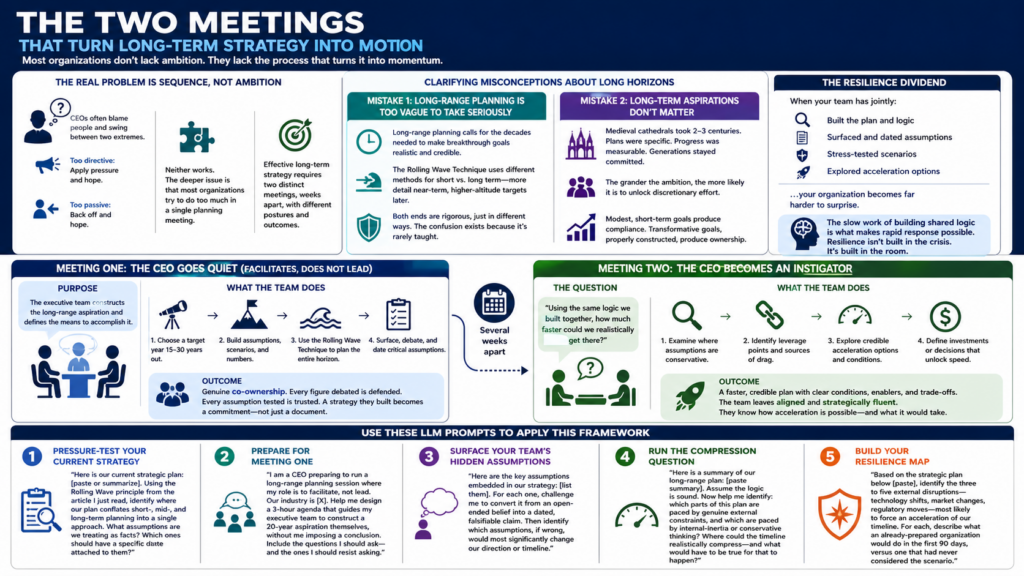
The Real Problem Is Sequence, Not Ambition
CEOs who struggle to activate major aspirations or breakthrough results typically frame it as a people problem — their teams aren’t bold enough, disciplined enough, or strategically literate enough. Frequently, they apply pressure to fix the problem and become too directive. They hope their personal energy fills the void.
Perhaps just as often, they do the opposite and become too passive. In this mode they back off, hoping organic energy fills the void. It rarely does.
Neither framing is quite right. In the end, CEO’s migrate towards short-term goals because they don’t have a reliable way to maintain both short-, mid-, and long-term momentum.
The deeper issue is that most organizations try to do too much in a single planning meeting.
Effective accomplishment of all three phases at the same time requires two distinct meetings, held weeks apart, each demanding a different posture from the leader. Getting the sequence right changes what the plan is, who owns it, and how fast it can move.
Clarifying Misconceptions About Long Horizons
Before the two meetings make sense, two widespread beliefs need to be addressed:
the first is that long-range planning is inherently vague, and therefore not worth taking seriously.
Mistake 1) This is a problem for CEOs who truly have big aspirations, because long-range planning calls for the decades needed to make breakthrough goals realistic and credible to stakeholders. Without adequate time, executives play the game mentioned before. They show up, nod, and wait for the pressure to disappear.
This view of long-range planning being vague is understandable but technically wrong.
The planning tools appropriate for year one of a strategy are genuinely different from those suited to year twenty-five — but that doesn’t mean the far end of the horizon is a guess. It just needs to be equipped in the right way.
For example, the Rolling Wave Technique leads to the use of different methods, mindsets and discussions for short- and long-term phases. It provides operational details in the short term, and higher-altitude targets and milestones in the long term.
Neither end is more rigorous than the other. They are rigorous in different ways. The confusion exists because precious few use the technique. It’s just not taught in most business schools as a component of corporate strategy.
Mistake 2) The second faulty belief is that long-term aspirations don’t matter. To explain why this is so wrong, consider a historical example.
Medieval cathedral builders routinely committed to projects spanning two to three centuries. No individual craftsman who broke ground would see the finished nave. Yet construction continued across generations, through plagues and political upheaval, because the aspiration was large enough to give the work meaning — and specific enough to give it credible direction. Floor plans existed. Proportions were specified. Progress was measurable even when the endpoint was a lifetime away.
This points to a counterintuitive truth: the grander the ambition, the more likely it is to unlock discretionary effort — the creativity and energy people typically reserve for pursuits they actually care about.
Modest, short-term goals produce compliance. In corporate life, these tend to be overwhelmingly financial.
Transformative goals, properly constructed, produce ownership. The audacity of a well-chosen endpoint is itself a management tool, one that most corporations never pick up.
With these misconceptions cleared up, here are the details of both meetings and how they are conducted.
Meeting One: The CEO Goes Quiet
The first meeting has one non-negotiable design principle: the CEO sponsors but does not lead. Or facilitate.
This is harder than it sounds. Most executives who have reached the top of an organization have done so partly through the force of their vision. They arrive at planning sessions having already formed views about where the company should go. The instinct is to share those views early — to inspire the team with a compelling picture of the future and let the session fill in the details.
Resist it. Completely.
The goals of this first meeting are for the executive team to construct the long-range aspiration themselves and define the means to accomplish it. That means choosing a target year — somewhere between fifteen and thirty years out — and then building the assumptions, scenarios, and numbers required to define what success looks like at that point.
It’s followed by the use of the Rolling Wave Technique to lay out a plan for the entire horizon, with more details in closer than later years.
Facilitators can guide the process. The CEO’s role is to hold the space while that process unfolds, tolerating the discomfort of an outcome they did not pre-select and cannot entirely predict.
What makes this worthwhile is what it produces: genuine co-ownership. Every figure the team debated, they will later defend. Every scenario they stress-tested, they trust because they built it. A strategic target and plan defined by the CEO and handed to the team is a document. A strategy the team constructed is a commitment — and the difference shows up in execution, not in the planning room.
For example, one team member assumes a technology shift in five years. Another assumes fifteen. Both assumptions are driving their instincts about investment and timing, silently, in every meeting they attend. Naming those beliefs, debating them, and converting them into dated claims is one of the most underrated outputs of a well-run long-range planning session. It also reveals where the team’s consensus is genuine and where it is merely polite.
Meeting Two: The CEO Becomes an Instigator
Several weeks after the first meeting — long enough for the plan to feel real, not so long that momentum fades — the CEO calls a second session. It has a single agenda item, framed as a question:
“Using the same logic we built together, how much faster could we realistically get there?”
The phrasing matters more than it might appear. This is not a demand for “twice the output in half the time” — the kind of arbitrary stretch target that produces creative accounting and quiet cynicism. It is an invitation to apply the team’s own reasoning to a compression problem. They set the destination and the pathway. Now they are being asked whether the chosen route is as efficient as it could be.
And because the team built the original logic, they are the only people positioned to answer the question credibly. They know which assumptions were conservative. They know where interdependencies between units create natural leverage — and where they create drag. They know which technologies on the industry’s horizon could compress a transition the plan assumed would take a decade. They know where the plan padded timelines because of organizational inertia rather than genuine constraint.
That collective intelligence almost never gets activated, because the question that unlocks it is almost never asked. Unfortunately, leaders tend to apply pressure before the team has built the logic, which means compression becomes a negotiation rather than an analysis. The two-meeting sequence reverses that order — and the difference in what the team produces is striking.
The best version of this second meeting doesn’t only produce a revised plan. It produces a set of credible acceleration options: specific conditions under which the timeline compresses, specific investments or decisions that could trigger those conditions, and an honest accounting of what would have to be true for the faster scenario to hold. The team leaves not just aligned, but strategically fluent in a way that one-off retreats almost never achieve.
Case in point: Before 2017, one of my clients in the Jamaican financial sector had never put a date to an assumption: “the average local customer is not ready for online services.”
When I challenged them to place a date on the moment when 50% of the population would reach that threshold, they predicted: 2028. They wove that date into their plan.
Three years later when the COVID-19 pandemic arrived, that plan was simply accelerated (i.e. compressed) to be implemented within months rather than a decade. They were lucky.
The Resilience Dividend
There is a benefit to this process that rarely appears in planning frameworks: the organization becomes significantly harder to surprise.
An executive team that has jointly built a long-range plan, surfaced its embedded assumptions, dated them, stress-tested scenarios, and explored acceleration options has essentially pre-thought a wide range of futures.
When the external environment forces their hand — a market disruption, a technology shift, a crisis that compresses years into months — they are not improvising. They are activating a version of something they already worked through. The decisions feel fast because they had already built the internal logic needed to respond.
This is not a theoretical benefit. Organizations routinely discover, under pressure, that their plans contained a faster path they simply hadn’t chosen to pursue yet. The companies best positioned to accelerate in a crisis are the ones that already knew, in principle, how acceleration was possible — because they had asked themselves exactly that question before one was forced on them.
The slow work of building shared logic, it turns out, is what makes rapid response possible. Resilience isn’t built in the crisis. It’s built in the room, in the meeting before the meeting, when the CEO is quiet enough to let the team think.
Why This Rarely Happens — and What to Do About It
The reason most aspirations which require long-term strategies end up stalling is that the people accountable for executing them never felt genuinely accountable for creating them. The CEO’s vision, however compelling, remains the CEO’s vision. Rollout becomes performance. Compliance replaces conviction. And when conditions change, there is no one in the room who feels responsible for updating the logic — because the logic was never theirs.
The two-meeting structure addresses this not through a motivational technique but through a structural one. Ownership is built in at the design stage. The compression question in the second meeting then activates that ownership, rather than challenging it.
The process asks something genuinely difficult of the CEO: to be quiet and patient at the moment when they most want to speak, and to ask a question — rather than issue an instruction — at the moment when they most want to apply pressure. Both moves feel counterintuitive. Both, consistently, work.
Begin with the meeting where you say less than you ever have before. What comes next will surprise you.
Use These LLM Prompts to Apply This Framework
Copy any of the following into an AI assistant to put the ideas in this article to work for your organization.
- Pressure-test your current strategy “Here is our current strategic plan: [paste or summarize]. Using the Rolling Wave principle from the article I just read, identify where our plan conflates short-, mid-, and long-term planning into a single approach. What assumptions are we treating as facts? Which ones should have a specific date attached to them?”
- Prepare for Meeting One “I am a CEO preparing to run a long-range planning session where my role is to facilitate, not lead. Our industry is [X]. Help me design a 3-hour agenda that guides my executive team to construct a 20-year aspiration themselves, without me imposing a conclusion. Include the questions I should ask — and the ones I should resist asking.”
- Surface your team’s hidden assumptions “Here are the key assumptions embedded in our strategy: [list them]. For each one, challenge me to convert it from an open-ended belief into a dated, falsifiable claim. Then identify which assumptions, if wrong, would most significantly change our direction or timeline.”
- Run the compression question “Here is a summary of our long-range plan: [paste summary]. Assume the logic is sound. Now help me identify: which parts of this plan are paced by genuine external constraints, and which are paced by internal inertia or conservative thinking? Where could the timeline realistically compress — and what would have to be true for that to happen?”
- Build your resilience map “Based on the strategic plan below [paste], identify the three to five external disruptions — technology shifts, market changes, regulatory moves — most likely to force an acceleration of our timeline. For each, describe what an already-prepared organization would do in the first 90 days, versus one that had never considered the scenario.”