
Picture a familiar scene in a non-profit organization. A hotel conference room. Flip charts on easels. A two-day offsite that everyone has blocked out on their calendar and quietly dreaded.
The exercises begin. Strengths, weaknesses, opportunities, threats. Stakeholder maps. Priority matrices. The team engages dutifully, filling in the boxes, generating the language that planning retreats are supposed to generate.
Then comes the afternoon slump – and it is not just fatigue from the morning’s work. Something more specific has happened. The conversation has drifted away from the reason the organisation exists. Words like “competitive positioning” and “market capture” are appearing on the sticky notes, and they feel borrowed – like wearing a suit that belongs to someone else.
Nobody says anything. Everyone is willing the process to work.
A document emerges by the final session. The board receives it at the next meeting. And within a few months, it occupies a shelf or a folder, largely untouched.
This is not a story about poor facilitation or disengaged leadership. It is a story about using the wrong instrument for the job.
Where These Frameworks Actually Come From
Management strategy as a discipline has a particular genealogy. The models that dominate executive education – the competitive analyses, the positioning matrices, the market share battles – were developed with a specific type of organisation in mind: businesses that survive or collapse based on their ability to outperform rivals and make profits.
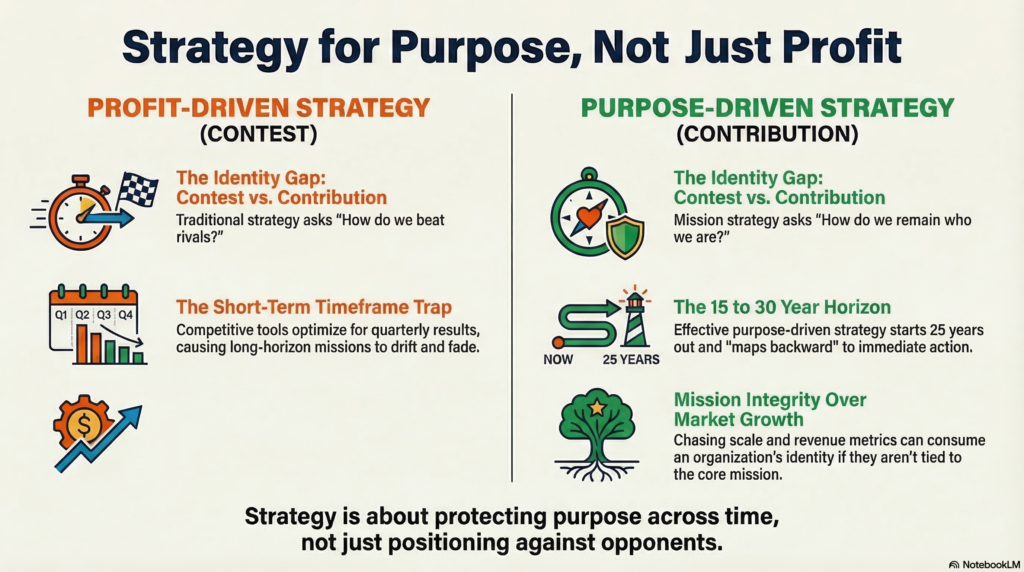
The evidence is in the curriculum. Academic research suggests that the vast majority of MBA case material is drawn from industries where competition is the central organising tension. The mental model underneath most strategy training treats the world as a contest. There is a prize. There are opponents. The goal is to win more than you lose.
That framing is genuinely useful for firms operating in those conditions. The urgency of a competitor threatening your revenue is real, and tools designed around that urgency have genuine motivating power.
But take those same tools into a cooperative, a trade association, a government agency, or a development organisation, and something goes wrong almost immediately. (The same applies to a monopoly.) The animating force – the rival who might take what is yours – does not exist in the same way. Frameworks engineered around that force become awkward, like running software on a system it was never designed for.
The afternoon energy drop at your retreat was not a morale problem. It was the sound of a square peg meeting a round hole.
The Timeframe Problem Nobody Talks About
The mismatch runs deeper than vocabulary, though.
Competitive strategy is built around a particular relationship with time – specifically, a short one. The frameworks that dominate business education are oriented toward near-term results: quarterly performance, annual targets, the speed of response to a market threat.
Mission-driven organisations often operate under an entirely different time logic. A land trust working to preserve ecosystems, a credit union serving underbanked communities, a health institution building public capacity – these organisations are answerable to timescales that most competitive strategy tools cannot even see.
When a long-horizon organisation runs its strategy through a short-horizon framework, something gets quietly distorted. The institution begins optimising for the measurable and the near-term, while the foundational commitments – the ones that justify the organisation’s existence – drift into the background.
The Co-operative Group in the United Kingdom offers a sobering case study. Once among the most significant member-owned enterprises in the world, the Co-op entered the 2010s in serious trouble. An investigation into its near-collapse revealed a decade of decisions shaped by competitive growth logic: major retail acquisitions, banking mergers, rapid diversification across sectors. The goal had been scale – more market presence, more revenue streams, more assets.
What the organisation had not been tracking with the same rigour was whether any of this expansion was coherent with what a cooperative is actually for. Its governance was member-based. Its legitimacy came from community trust. Its identity was inseparable from a set of values about how business ought to be conducted.
By the time a £1.5 billion hole appeared in the banking arm, the institution had been operating with someone else’s strategy for years. The tools it had borrowed rewarded growth metrics. They had no mechanism for asking whether growth was serving the mission – or consuming it.
The same drift appears in organisations across every sector.
- A humanitarian agency that chases high-visibility donor projects at the expense of quiet, unglamorous long-term work.
- A professional body that adds revenue streams until its membership can no longer articulate what the body stands for.
- A regional development authority that reports on outputs while the underlying social fabric it was created to strengthen continues to fray.
In each case, the damage is slow and largely invisible inside the planning documents that caused it.
Planning Built Around Purpose
What these organisations need is not a modified version of competitive planning. They need a process that begins with a different assumption — that strategy is about protecting and advancing a purpose across time, not about positioning against opponents.
- Such a process starts with an honest reckoning with the present. Before any direction is set, the organisation needs to understand where it actually stands – not just financially, but in terms of mission integrity. How is trust held among the people the organisation serves? When has the institution historically drifted from its purpose, and what triggered those moments? What resources – financial, relational, reputational – are genuinely available?
- From that foundation, a long horizon is established. Somewhere between fifteen and thirty years is typically productive. This might feel uncomfortably distant, but the distance is the point. It shifts the planning conversation away from quarterly anxieties and toward the questions that actually define an institution’s legacy.
- With a target horizon in place, the team explores a range of possible futures rather than committing to a single premature forecast. The world in twenty-five years will be shaped by forces that cannot be predicted with precision – demographic shifts, technological change, political reconfigurations, ecological pressures. Scenario thinking does not pretend otherwise. It builds the capacity to navigate uncertainty rather than deny it, and it asks the organisation to identify which kind of future best allows its mission to flourish.
- From a single chosen scenario, the planning process works backwards. If the organisation needs to be in a certain condition twenty-five years from now, what does the ten-year mark look like? The five-year mark? What must be in place, and by when? What are the big tradeoffs which need to be made? This backward mapping turns an inspiring long-term vision into a logical chain of necessary steps, each grounded in the one that follows it.
- Only after that work is complete does it make sense to design a short-term action plan – because now there is a genuine strategic context for it. Immediate decisions are no longer just reactive. They serve something larger. Here, further tradeoffs must be made.
The Question Underneath the Question
The mechanics matter, but the conceptual shift matters more.
Competitive strategy is structured around the question: How do we beat them? Purpose-driven strategy is structured around a different one: How do we remain who we are, and do what we exist to do, across the years ahead?
These produce very different conversations – different discussions at leadership retreats, different criteria for investment decisions, different definitions of success that get embedded in the culture over time.
Cooperatives, civil society organisations, public institutions, and social enterprises are not inferior versions of private companies. They are different kinds of institutions altogether, built on different social contracts, accountable to different stakeholders, and serving purposes that exist precisely because markets and competitive logic have limits.
The strategy process these organisations use should reflect that – not apologise for it.
When the next retreat in your non-profit ends with a document that finally stays off the shelf, it will be because the planning process started from the right place: not how do we win, but how do we endure, and why does it matter that we do.
—————————————
P.S. Here are some LLM prompts you can use for further investigation.
Go Deeper: Five Prompts for Further Exploration
The argument in this article points to a gap — between the strategy tools most executives have been given and the organisations they are actually leading. The five prompts below are designed for use with any AI assistant (Claude, ChatGPT, Gemini, or similar). Each one picks up where the article leaves off. Copy, paste, and adapt the parts in brackets to your own context.
Prompt 1: Diagnose Your Own Organisation
For the reader who finished the article thinking — “this is us.”
I lead a [cooperative / government agency / NGO / family business / religious institution / statutory body] in [country/region]. Based on the argument that most strategy frameworks were designed for competitive, profit-first organisations, help me diagnose whether my organisation has been using the wrong strategy tools.
Ask me five diagnostic questions — one at a time, waiting for my answer before moving to the next — that will reveal whether our strategy process is genuinely built around our mission and long time horizon, or whether we have been borrowing competitive frameworks that don’t fit.
After my five answers, give me an honest assessment of where we stand, and identify the single most dangerous misfit between the tools we are using and the organisation we actually are.
Prompt 2: Rebuild the Co-op’s Strategy — Non-Competitively
For the reader who found the Co-operative Group case study instructive and wants to go deeper.
The UK Co-operative Group’s near-collapse in 2013 has been attributed to governance failure and poor management. But a different diagnosis is possible: the Co-op was a mission-first, member-owned organisation that had adopted competitive private-sector strategy logic — chasing scale, acquisitions and market presence — instead of building strategy around what a cooperative is uniquely positioned to do.
Assume you are a strategy advisor brought in to the Co-op in 2005, before the Britannia merger and the Verde pursuit. Using only non-competitive strategy tools — scenario planning, category design, mission integrity analysis, and long-horizon thinking — build the outline of the strategic conversation the Co-op’s leadership should have been having. What questions should have been on the table? What 20-year opportunity was sitting unclaimed? What slow-moving threats should have been named? What would a purpose-first Co-op strategy for 2005–2030 have looked like?
Prompt 3: Design a Purpose-First Strategy Retreat
For the reader who is planning — or dreading — their next strategic planning offsite.
I need to design a two-day strategy retreat for the leadership team of a [describe your organisation type and size]. Our previous retreats have used standard frameworks — SWOT analysis, competitive positioning, priority matrices — and the resulting plans have consistently ended up on shelves.
The core problem is that those frameworks were designed for profit-first, competitor-facing businesses. We are a mission-first organisation with a long time horizon and no direct rival whose defeat would constitute success.
Design a full two-day retreat agenda that replaces competitive frameworks with purpose-built alternatives. Include: the opening question that reframes the entire conversation; how to run a scenario planning session for a non-technical audience; how to do backward mapping from a 25-year horizon to a 90-day action plan; and how to end the retreat with commitments that will actually survive contact with the following Monday morning.
Prompt 4: Make the Internal Case for Long-Term Thinking
For the reader who agrees with the argument but now has to convince a board or senior team that doesn’t.
I have read an argument that mission-driven organisations — cooperatives, government agencies, NGOs, religious institutions, family businesses — are systematically underserved by MBA-derived strategy frameworks because those frameworks were built for competitive, profit-first firms. I agree with this argument. My organisation is [describe it briefly].
The problem is that my board and senior leadership are not yet convinced. Several members have strong private-sector or MBA backgrounds and default to competitive strategy language. Others simply don’t see the urgency of changing our planning approach.
Help me build the internal case. Give me: three concrete examples of organisations like ours that failed — or significantly underperformed — because they used competitive strategy frameworks that didn’t fit; three compelling questions I can put to the board that will expose the mismatch without triggering defensiveness; and the single most persuasive one-paragraph argument I can make for why this matters now, not eventually.
Prompt 5: Apply Category Design to a Non-Competitive Organisation
For the reader intrigued by the article’s reference to category design as an alternative strategic tool.
Category design is a strategy framework developed primarily for technology and consumer companies. Its core idea is that instead of competing within an existing market, an organisation defines and dominates an entirely new category — changing what problem it is seen to solve and becoming the obvious answer to a question that previously wasn’t being asked.
I want to explore whether category design can be applied to a non-competitive organisation. My organisation is [describe: sector, size, core mission, approximate age, geographic context].
Walk me through a category design thinking process adapted for a mission-first organisation. Specifically: What category does my organisation currently occupy in the minds of the people it serves — and is that the right one? What problem could we redefine ourselves as the unique solution to? What would it mean for us to own a category rather than compete within one? And what is the 10-year version of success if we got this right?
A note on how to use these prompts: each one is a starting point, not a single exchange. The most productive approach is to begin the conversation, push back on the AI’s first response, add specifics about your own organisation, and treat the output as a thinking partner rather than a finished answer. Prompt 3 in particular benefits from iteration — run it once, then ask the AI to make the agenda harder, more honest, or more specific to your sector.