
What a European tech giant understands about strategy that most boardrooms never will
There is a particular kind of corporate tragedy that doesn’t make headlines. No fraud. No scandal. No catastrophic product failure. Just a slow, invisible accumulation of risk — until one day, the whole structure collapses under its own weight.
It happens when a company mistakes activity for foresight.
The planning calendar is full. The board is engaged. The strategy deck is polished. And yet, somewhere in that busy, confident organisation, a quiet catastrophe is taking shape. Because nobody — not the CEO, not the board, not the executive team — has ever been asked to take serious ownership of what happens after year five.
This is not incompetence. It is a design flaw. And it is far more common than most leadership teams would care to admit.
The Company That Forgot to Ask
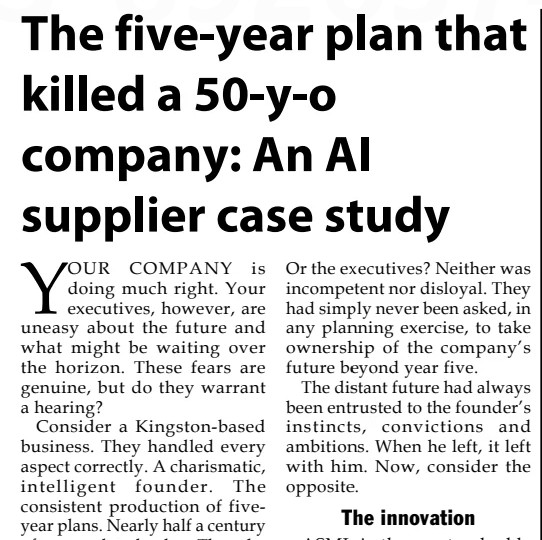
Picture a well-run, founder-led business. Nearly five decades of consistent growth. A charismatic patriarch who built the enterprise from nothing, understood every customer relationship personally, and carried the company’s long-term direction entirely in his own mind.
The planning process was real. The five-year cycles were taken seriously. Consultants were hired. Presentations were made. Targets were set and largely met.
Then the founder died.
Within weeks, the company’s strategic void became visible. There was no successor who understood where the business was going — because that destination had never been written down, debated, or distributed. It lived in one person’s mind, and it died with him.
A competitor saw the opening immediately. They moved quickly with a lowball acquisition offer — a fraction of what the business had taken decades to build. The leadership team, with no mandate and no map, accepted.
Fifty years of equity gone. Not because the organisation lacked talent, but because it lacked structure. Nobody had ever been asked, in any formal planning session, to imagine the business fifteen or twenty years out. The founder’s personal vision had been mistaken for a corporate strategy. They were not the same thing.
The Company That Starts in 2039
Now consider the opposite model.
ASML, headquartered in Eindhoven in the Netherlands, is Europe’s most valuable technology company. If you’ve never heard of them, that’s partly by design — they operate in the deep infrastructure of the global economy. Every advanced semiconductor chip produced on earth, inside every smartphone, data centre, and electric vehicle, depends on ASML’s machines. They hold a near-monopoly on the extreme ultraviolet lithography technology that makes modern computing possible.
What’s unusual about ASML is not their product. It’s how they think about time.
Most organisations build strategy by starting today and projecting forward. ASML reverses the sequence. Their planning begins at a future destination — currently, that horizon is 2039 — and works backwards to the present. The question driving every major strategic conversation is not “where can we realistically get to?” but “given where we need to be, what must we begin doing right now?”
Every September, ASML’s senior leadership and supervisory board gather for a structured multi-day offsite. The agenda is not a review of last year’s performance or a recalibration of near-term targets. It is a methodical examination of the gap between today’s capabilities and a specific set of technical requirements the world will demand fifteen years from now. From that gap, they derive their current priorities.
This is not vision-statement strategy. It is operational reverse-engineering.
The Detail That Should Unsettle You
But here is the part of ASML’s model that most organisations find genuinely difficult to replicate — not because it requires exceptional talent or resources, but because it requires a shift in culture that cuts against deeply held habits.
ASML does not do this alone.
Their three largest customers — Intel, Samsung, and TSMC — are active participants in the company’s long-range planning process. ASML consults them continuously, years in advance, to co-design future machines around the chips those customers will eventually need to produce. The strategic horizon is shared, not proprietary. The future is treated as a collaborative obligation rather than a competitive secret.
Think about what this means in practice. ASML’s planning process includes the voices of the organisations that will determine whether their future investments succeed or fail. They have structurally eliminated the risk of spending a decade building something their customers have quietly moved away from. Foresight is not an executive exercise conducted behind closed doors. It is a shared discipline embedded into the operating model.
Contrast this with how strategy typically works. In most organisations, long-range planning is handled by a small group, shielded from clients, suppliers, and sometimes even from the broader leadership team. The output is a document. The document is presented. The document is filed. The cycle repeats.
In that model, the future is nobody’s real responsibility.
The Excuses Are Everywhere
Ask executives why their organisations don’t plan further out, and the answers are remarkably consistent across industries and geographies.
“By the time any of this matters, I’ll have moved on.”
“We can barely manage the next quarter — asking me to think twenty years ahead feels absurd.”
“The environment changes so fast that long-range planning is just fiction.”
“That’s not what I’m measured on.”
These are not cynical responses. They are honest ones. And the honesty points directly at the problem. These executives are not failing to think long-term because they lack intelligence or ambition. They are failing because the systems around them — the incentives, the meeting structures, the planning processes, the performance frameworks — have never required them to do otherwise.
This is a design problem, not a people problem. You can replace every executive in the building, and if the planning process remains unchanged, you will get the same output.
The founder in our opening story was not surrounded by weak leaders. He was surrounded by capable people who had never been invited to take ownership of a question that extended beyond the current five-year cycle. When he died, that question died with him.
What Actually Needs to Change
ASML’s longevity and dominance are not explained by the quality of their engineers, though their engineers are excellent. They are explained by a structural decision: to build long-range thinking into the organisation’s architecture, not leave it to individual brilliance.
Over time, the planning process itself was designed to demand a different quality of thinking. The time horizon was extended. The conversation was opened to include the customers who would determine the future. The annual offsite was built around a single question that couldn’t be answered with last year’s data.
None of this is beyond the reach of organisations that are far smaller and less resourced than ASML. The barrier is not capability. It is commitment to changing the design of the conversation.
If your next planning session opens with a review of this year’s targets, ask what would change if it opened instead with a question about 2040. If your strategy is currently held by one or two senior leaders, ask what happens to it when they leave. If your longest planning horizon is five years, ask yourself honestly: is that a strategic decision, or simply the default you’ve never thought to question?
The organisations that outlast their founders, their industries, and their competitors are not the ones with the best five-year plans. They are the ones that learned, early enough, to treat the distant future as urgent.
The question is not whether you can afford to think that far ahead.
The question is whether you can afford not to.