

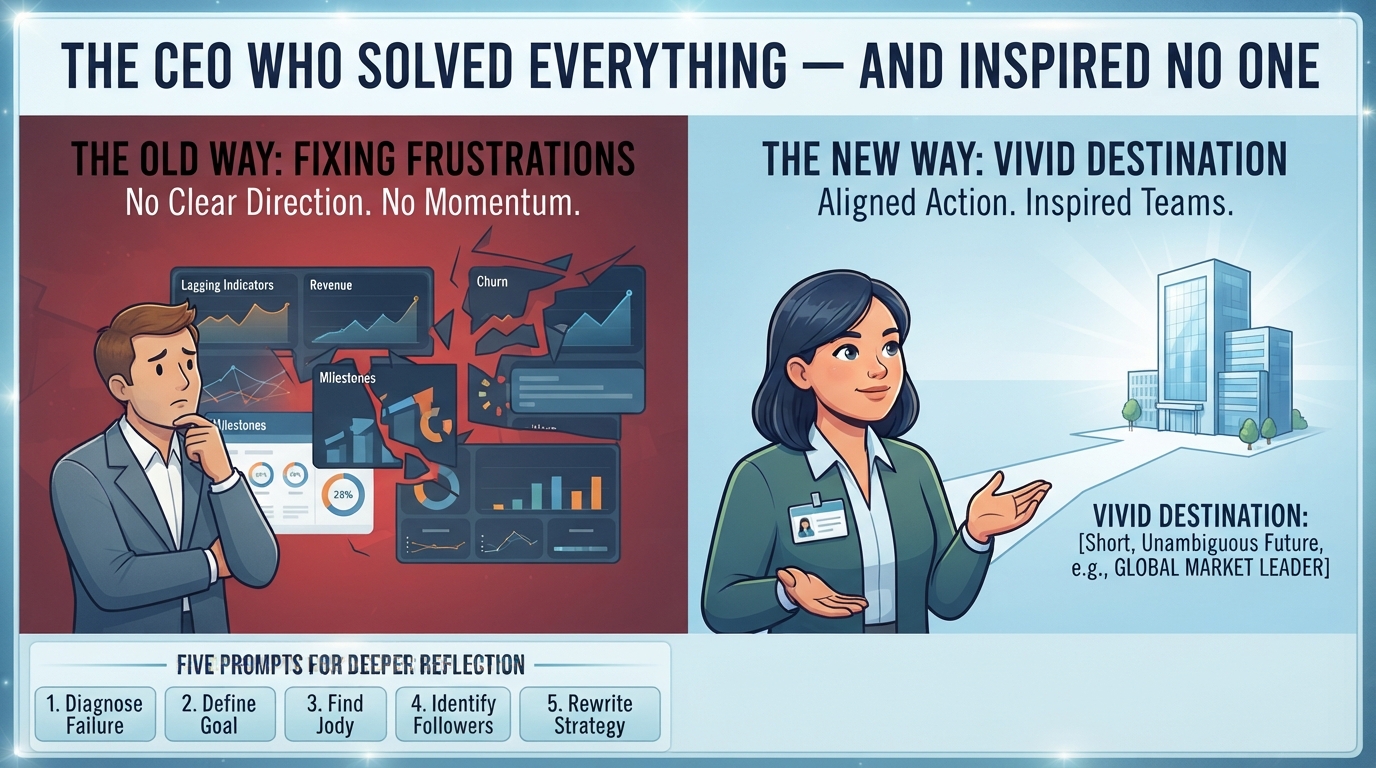
You are putting in serious effort to motivate your team — and it still isn’t working. The hours are long, the intent is genuine, and the results are stubbornly flat. Before you blame your communication strategy, your budget, or your personality, consider a different diagnosis entirely.
Two fictional CEOs illustrate the problem.
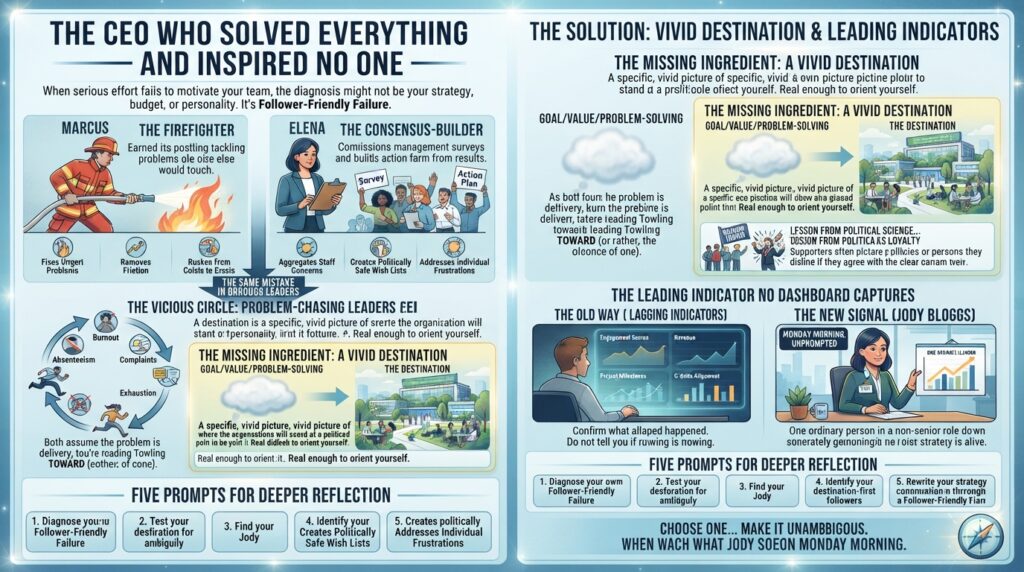
Marcus is a decisive firefighter. He earned his position by tackling the problems nobody else would touch, and he has been doing the same thing ever since. Elena takes a more consultative path. She commissions engagement surveys, listens carefully to what staff say, and builds action plans from the results.
Yet both are looking at the same uncomfortable numbers: absenteeism climbing, burnout reports rising, and employees quietly asking each other, “Where exactly are we headed?” Both assume the problem is in the delivery — the messaging, the resources, the rollout. They are looking in the wrong place.
The actual diagnosis is a pattern called “Follower-Friendly Failure.”
The Same Mistake in Different Clothes
Follower-Friendly Failure is the attempt to build organisational momentum by removing friction. Fix the complaints. Address the survey results. Solve the urgent problems. The instinct is generous — leaders genuinely want to make things better for their people — but the strategy is structurally flawed.
Marcus and Elena look like opposites: urgent problem-solver versus consensus-builder. But they are making the same error in different packaging. Their failure is not in how they lead. It is in what they are leading toward — or rather, the absence of any clear answer to that question.
Elena’s approach is particularly instructive. Aggregating staff concerns produces a politically safe wish list, not a strategy. It assumes that resolving individual frustrations will compound into collective motivation. It won’t. Addressing one round of complaints simply surfaces the next round. The circle is vicious, and staff eventually exhaust themselves chasing problems that regenerate faster than they are solved.
The missing ingredient is not smarter problem-solving. It is a destination.
In this context, a destination is not a goal, a value, or a problem to be solved. It is a specific, vivid picture of where the organisation will stand at a defined point in the future — real enough that an ordinary person can orient themselves toward it.
What Political Science Reveals About Leadership
Research on voter behaviour offers an unexpected window into how destination-clarity functions as a loyalty mechanism. Studies of Donald Trump’s coalition have consistently found that roughly 25–35% of his supporters privately dislike specific policies, find aspects of his persona difficult, and disagree with particular decisions. They back him anyway.
The reason is not charisma, party loyalty, or agreement with the plan. It is agreement with the destination. These voters know where he says the country is going, and that clarity holds them even when the specific steps, or personal foibles do not.
The organisational parallel is direct. Every leadership group contains a subset of destination-first followers — people who will tolerate management friction, imperfect policies, and even a leader they find personally disagreeable, provided they can see clearly where the organisation is headed. Marcus and Elena have no mechanism for reaching this group because neither has named a destination unambiguous enough to reach them.
This is what Dr. Riel Miller, a UNESCO senior adviser, calls Futures Literacy: the capacity to use the future as a resource for acting in the present. It requires holding the future genuinely open — treating several possible destinations as real — until a single, unambiguous endpoint is chosen. Once that commitment is made, something shifts. Inspiration and discretionary effort are not manufactured through communication techniques. They are released.
This distinction matters more than most leadership development programmes acknowledge. Charisma, communication skill, and policy competence are all useful. But none of them substitute for a destination that employees can inhabit in their imagination before they inhabit it in reality
The Leading Indicator No Dashboard Captures
Executives searching for evidence that a strategy is working typically reach for lagging indicators: engagement scores, C-suite alignment, project milestones, revenue shifts. These confirm what has already happened. They do not tell you whether the organisation is actually moving.
There is a better signal, and it costs nothing to detect.
Consider an employee — call her Jody — who works in a mid-level, non-senior role. Her department has been identified as high-leverage: it sits in the 20% of organisational effort that drives 80% of strategic results, directly connected to a 15-year destination the company has committed to.
Without a clear destination, that leverage is invisible to Jody. She spends Monday doing what she did the Monday before. This is not apathy. It is a rational response to ambiguity. When no clear endpoint exists, the safest professional behaviour is to replicate what worked yesterday. Jody is not the problem. The missing destination is.
With one — a specific, unambiguous endpoint she can picture and act toward — something different happens. On Monday morning, unprompted by her manager, she spends three hours doing something she has never done before: taking deliberate actions aligned with where the organisation says it is going. Not because she was told to. Because she can see the destination and has decided to move toward it.
Notice what did not cause this shift: not a town hall, not a revised KPI framework, not a team-building exercise. The destination did the work. Her manager’s job, once the destination is clear, is largely to stay out of the way.
That behaviour — one ordinary person in a non-senior role doing something genuinely novel in alignment with the stated direction — is the leading indicator that a strategy is alive. Engagement surveys can score well while this signal is completely absent. The signal’s presence means the destination has landed. Its absence means it has not, regardless of what the dashboard reads.
When enough Jodys emerge across an organisation, the needle moves. Not because leadership pushed harder, communicated more cleverly, or solved one more urgent problem. But because ordinary people with real jobs decided, on their own initiative, that the destination was worth moving toward.
The practical implication is uncomfortable for leaders trained in comprehensive planning: resist the pressure to make the destination inclusive. A destination designed not to alienate anyone ends up directing no one. Choose one. Make it unambiguous. Then watch what Jody does on Monday morning.
Five Prompts for Deeper Reflection
Use these with any AI assistant (or as journaling prompts) to apply the ideas in this article to your own leadership context.
Prompt 1 — Diagnose your own Follower-Friendly Failure
“Here is how I currently try to motivate my team: [describe your approach]. Based on the distinction between problem-fixing and destination-setting, identify where my current approach might be producing Follower-Friendly Failure. What am I likely missing, and what would a clearer destination look like in my specific context?”
Prompt 2 — Test your destination for ambiguity
“Here is our current strategic vision or mission statement: [paste it]. Assess whether this constitutes a genuine, unambiguous destination that an ordinary employee could act toward on Monday morning — or whether it is a wish list, a values statement, or a problem-solving agenda in disguise. Then suggest what a sharper destination might say instead.”
Prompt 3 — Find your Jody
“Our organisation has articulated the following strategic direction: [describe it]. Help me identify what a ‘Jody Bloggs’ signal would look like in our context — that is, what specific, observable, novel behaviour by a non-senior employee would indicate that our destination has genuinely landed, rather than merely been communicated.”
Prompt 4 — Identify your destination-first followers
“The article describes a subset of followers who are loyal to a destination rather than to a leader’s personality or specific policies. Thinking about my own team or organisation, help me profile what this group might look like: how would I identify them, what do they need from a destination to engage, and how might I be inadvertently failing to reach them with my current communication?”
Prompt 5 — Rewrite your strategy communication through a Futures Literacy lens
“Here is how I typically communicate our strategy to staff: [paste an example — a town hall script, an all-staff email, a strategic summary]. Rewrite this using Futures Literacy principles: remove problem-solving language, eliminate wishlist elements, and replace them with a single unambiguous destination that an ordinary employee could picture and act toward. Show me the before and after side by side.”
P.S. Remember that registration is open for the Long-Term Strategy Conference 2026 – click here.