
In the early 1980s, McKinsey told my employer at the time, AT&T, that the global market for mobile phones would top out at roughly 900,000 subscribers by 2000.
The actual number was 100 million.
A decade later, AT&T paid $11.5 billion for McCaw Cellular to claw its way back into the market it had walked away from.
Hundreds of America’s brightest minds had read the same report, nodded at the same conclusion, and missed by two orders of magnitude. The forecast was polished, confident, and built entirely on data from the past. It was, in today’s vocabulary, trendslop — and it predated AI by half a century.
If you sit at the top of a company anywhere in the world, you are now being asked to make similar bets with a tool that produces trendslop on demand. A recent Harvard Business Review article, “Researchers Asked LLMs for Strategic Advice. They Got ‘Trendslop’ in Return”, called out the pattern directly. Ask a large language model for strategic advice and you get confident, polished output that sounds insightful — until you look closely and realise it could have been written by a competent intern in an afternoon.
The good news: your instincts about AI are right. It can sharpen your strategy work. It can also wreck it.
The bad news: no settled playbook yet tells you which is which.
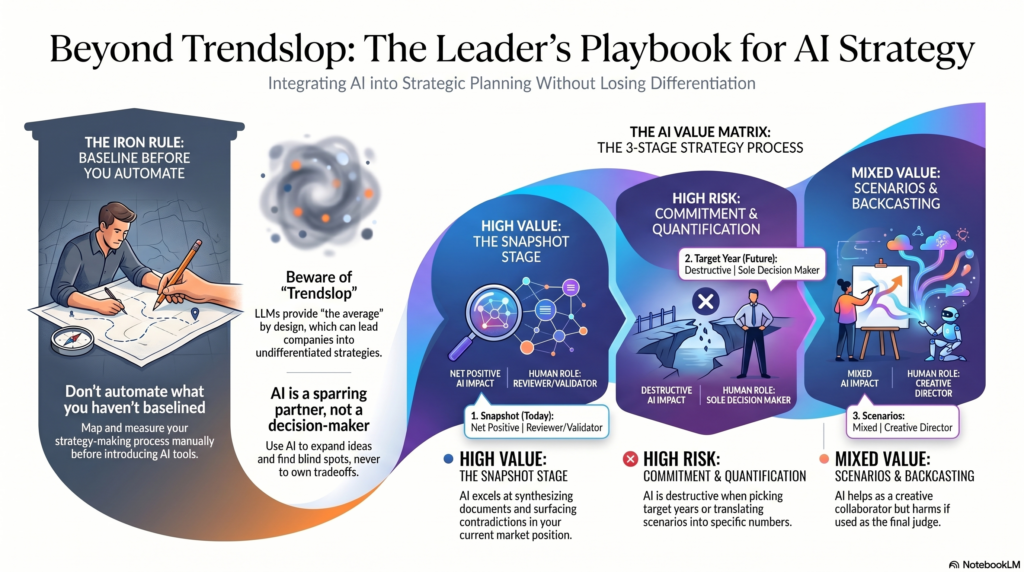
The Iron Rule You Already Know
As a young internal consultant at AT&T, I learned a discipline that has aged better than most of the company’s 1990s forecasts: Don’t automate what you haven’t baselined.
The same idea runs through every quality programme Toyota exported to factory floors around the world. Before you mechanise a process, you map it. You measure it. You understand its variation. Only then do you bring in the machine.
The current rush to “put AI into strategy” ignores this rule. Most executive teams cannot describe how their own strategy actually gets made. Strategy creation happens once every two or three years. It rarely gets documented. Institutional memory leaks out with every senior departure. No baseline exists.
Then the LLM is invited in. And it produces — predictably — trendslop.
The problem isn’t the AI. The problem is that the iron rule was broken before the model was ever prompted.
Where AI Helps, Where It Harms
The EndPoint Method I use breaks strategy work into six stages: build a Snapshot of where you are today; pick a Target Year fifteen to thirty years out; generate Scenarios for that future; pick one scenario and translate it into numbers; Backcast milestones from that endpoint to the present; and only then build a Short-Term Strategy Map for the first two years.
Across more than sixty engagements, I have watched AI’s effect on each stage. The pattern is now clear.
AI is a net positive in exactly one stage: the Snapshot. Here, the work is synthesis — pulling together what is already known about your organisation, your market, and your competitive position. The LLM reads documents fast, finds patterns across them, and surfaces contradictions in your own data that the room had stopped seeing. It augments without replacing.
AI is destructive in two stages, and they happen to be the most consequential: Picking a Target Year, and Picking-and-Translating a Single Scenario into Numbers.
These are the moments of commitment. They demand differentiation — a stance that sets your firm apart from the average. An LLM, by design, gives you the average. It will hand you a target year that mirrors what every other company in your sector has chosen. It will quantify your scenario the way every scenario in its training data has been quantified. Use it here and you sleepwalk into the same future as your competitors.
The remaining three stages — Generating Scenarios, Backcasting, and Short-Term Strategy Mapping — are mixed. AI helps when used as a sparring partner. It harms when used as a decision-maker.
The Fix
Over the past year, my team has run strategic planning retreats with AI integrated at chosen moments and in a deliberate way — never as the source of commitment.
The pattern that works is consistent. The group defines the issue and its causes manually first — sometimes a recent trend, sometimes a decade-long problem. Only then is the LLM brought in, with a sharp prompt. For example: “Given the persona we have just described and the specific belief they hold, what three scenarios could shift their attitude?”
Within seconds, the group absorbs the conventional wisdom and moves past it. The LLM expands ideas, synthesises inputs, and surfaces blind spots the room could not see on its own. It is never asked to commit, to judge, to prioritise, or to own a tradeoff.
Decompose your strategy work. Insert AI only where it adds value. Keep human commitment, judgement, and ownership intact.
What This Quarter Looks Like
The executives who win the AI moment in strategy will not be the ones who feed their hardest questions to an LLM and hope for the best. They will be the ones who honour AT&T’s iron rule and Toyota’s philosophy of automation: baseline first, then mechanise.
So here is the work in front of you this quarter.
Do not ask the LLM where to take your company. Ask it to help you see what you already have. Build the Snapshot. Map your strategy-making process for the first time. Document the institutional memory before it walks out the door.
Only then, and only at the stages where it adds value, bring AI into the room.
Your suspicion was right on both counts. AI can improve the process. AI can also do damage. Baseline first. Then, and only then, automate.
Five Prompts to Take This Further
1. Diagnose your current practice. “Describe how strategy actually gets made in our company today — who initiates it, what inputs feed it, how decisions get committed to, and where the process is undocumented. Then identify three places where we are currently asking AI to do work we have never baselined.”
2. Audit your strategy document for trendslop. “Here is our current strategy document [paste]. Identify every statement that could plausibly appear in any company’s strategy document in our industry. Highlight the language that is generic, average, or undifferentiated — and explain why each phrase fails to set us apart.”
3. Build a working Snapshot. “Read these three documents: last year’s plan, our most recent board minutes, and our latest competitor analysis [attach]. Surface every contradiction between them, every unexamined assumption, and every gap in evidence. Do not propose solutions — only surface what is already there.”
4. Sharpen a scenario with an opposing view. “We are considering [X scenario] as the future our strategy is built around. Argue against it. Give me the five strongest reasons a sceptical board member would push back on this scenario, and the historical analogies they might cite.”
5. Pressure-test your commitment. “Here is the single scenario we have chosen and the numbers we have attached to it [paste]. Identify the three commitments we are implicitly making that the rest of the document does not acknowledge. Where would this strategy break if our chosen Target Year arrived three years later than expected?”
P.S. The impact of AI on strategy creation is forcing its way into our thinking every day. You wish you could keep up, but so much is changing so quickly that it’s hard. The good news is that this is the theme of our September 15-17, 2026 strategy conference. Save the date in your calendar!