The Productivity Trap No Election Can Fix

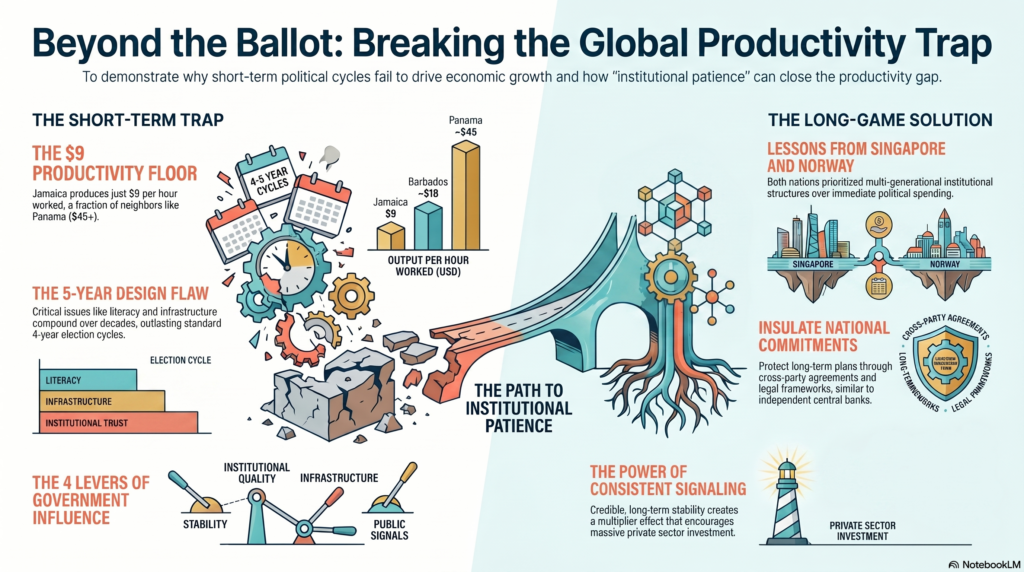
There’s a number most government leaders would rather not think about. For Jamaica, it’s nine dollars.

That’s the country’s productivity measured as output per hour worked — US$9. Barbados, a neighboring island economy, produces more than twice that. Panama produces five times as much. Most strikingly, Jamaica’s hourly output is only marginally ahead of Haiti’s — a country that has experienced decades of political collapse and natural disaster.

The numbers are sobering. But they are not unique to Jamaica. Across the developing world, governments face a version of the same arithmetic: their economies are generating far less per hour of human effort than they should, the gap is wide, and it has been wide for decades.

What is less often discussed is the role that government itself plays in perpetuating that gap.

The Largest Economic Actor in the Room

In many developing economies, government directly produces somewhere between 15 and 20 percent of GDP through goods and services. That makes it the single largest economic actor in the country — larger than any company, sector or industry.

But its true influence extends much further. Government shapes the entire environment in which the other 80-plus percent of economic activity takes place, through four distinct levers: macroeconomic stability, institutional quality, infrastructure and public goods, and the signals and expectations it sends to investors, businesses and citizens about the future.

That fourth lever is the most underestimated. When a government is unpredictable, inconsistent or widely distrusted, it suppresses private investment and enterprise far beyond anything that shows up in its own budget. Conversely, a government that signals credible, long-term commitment to stability and growth creates a multiplier effect on every dollar the private sector deploys.

Jamaica has made genuine, internationally recognized progress on the first lever. Its fiscal turnaround since 2013 has been studied by other nations as a model of discipline. Debt ratios have fallen. Inflation has been tamed. And yet GDP growth has not followed at the pace the data might suggest it should. The reason is that macroeconomic stability, while necessary, is not sufficient. The other three levers matter just as much — and progress on those fronts is slower and harder to sustain across electoral cycles.

Why Elections Are the Wrong Unit of Time

The deeper problem is structural. Governments, by design, operate on four- or five-year cycles. The problems that most constrain developing economies — workforce quality, institutional trust, infrastructure, behavioral norms — compound over decades. They cannot be fixed within a single term. Often they cannot be fixed within a generation.

Take literacy. Jamaica’s literacy rate trails comparable peer countries by five or more percentage points — a gap that has been building since the 1960s. That gap is a direct and stubborn drag on workforce productivity. Closing it requires sustained investment and policy consistency across twenty or thirty years, not one budget cycle.

The same logic applies to institutional quality, infrastructure and public trust. These are slow variables. They respond to patient, consistent effort — not to whoever won the last election.

This is not pessimism. It is arithmetic.

The Countries That Played the Long Game

Two examples are instructive, and they have been cited often precisely because they are so striking.

Singapore in the early 1960s had a GDP per capita comparable to Jamaica’s. It was a small, resource-poor island with a mixed population, uncertain regional relationships and no obvious competitive advantages. Today it is among the wealthiest and most productive nations on earth.

Norway had oil. So did Nigeria, Angola, and Venezuela. The difference was that Norway resisted the temptation to spend its resource windfall immediately and instead built institutional structures — including a sovereign wealth fund now worth over a trillion dollars — designed to distribute wealth across generations rather than electoral cycles.

Both Norway and Singapore have populations of around five to six million — comparable in scale to many Caribbean and Central American nations. Scale was not destiny. What separated them was institutional patience: the willingness to make commitments that no single government could unilaterally reverse.

The Design Flaw in Most Development Plans

Many developing nations have tried long-term national development planning. The typical failure mode is nearly always the same: the plan belongs to one party. When the government changes, the plan either changes with it or quietly fades from view.

Jamaica’s Vision 2030 — an ambitious plan built around the aspiration to become “the place of choice to live, work, raise families and do business” — started with a bipartisan commitment, but has largely followed this pattern in recent years. It is rarely invoked by either major political party today. Its successes have not been studied. Its failures have not been honestly diagnosed.

Trinidad and Tobago offers a cautionary parallel. Multiple governments there have attempted national development plans under single-party mandates. Without cross-party commitment, each plan has been vulnerable to revision or abandonment when power changed hands. The structural challenges — growth, productivity, crime — remain largely unresolved.

The evidence from countries that have succeeded suggests a different architecture is required. Long-term national commitments need to be insulated from ordinary political interference — protected by cross-party agreement, legal frameworks and institutional norms in the same way that independent central banks or electoral commissions are protected. The goal is not to remove politics from policy. It is to place the most consequential long-horizon commitments beyond the reach of short-term political calculation.

This is not a utopian idea. It has been done — in countries that once looked very much like Jamaica does today.

The Immediate Return on Patient Thinking

There is a paradox worth naming. Patient, long-horizon thinking doesn’t only produce results over decades. It produces its first results immediately — in the minds of the leaders who adopt it.

The moment a government leader genuinely shifts from “what can I deliver before the next election?” to “what structural commitment can I make that a successor will be bound to honor?” — that shift is itself a form of progress. It changes which conversations happen, which trade-offs get made, which investments get prioritized. Institutional culture changes before the metrics do.

For any leader in the public sector who recognizes the structural arithmetic above, the question is not whether to think long. It is whether to do so quietly or loudly.

Either way, the calculus is the same. The countries that changed their trajectories did not do it in four years. They did it by making four-year decisions that pointed consistently in the same direction for forty.

Only the nations — and the institutions — willing to make and protect patient commitments have a realistic chance of closing the gaps that actually matter.

5 Prompts to Put These Ideas to Work

The arguments in this article become more useful when applied to your own institution. These prompts are designed for use with any AI assistant (Claude, ChatGPT, Gemini, etc.). Work through them in order — each builds on the last.

Prompt 1 — Reflect “I lead [describe your ministry, agency or department] in Jamaica. The article I just read argues that government influences GDP through four levers: macroeconomic stability, institutional quality, infrastructure and public goods, and public signals and expectations. Ask me a series of questions to help me identify which of these levers my organization influences most directly — and where the biggest performance gaps are.”

Prompt 2 — Reflect “Here is my organization’s current strategic plan: [paste it]. Review it against this standard: which commitments are genuinely structural — meaning they require ten or more years to fully realize — and which are short-term fixes unlikely to outlast the current administration? Then identify what is missing from the long-term column.”

Prompt 3 — Apply “Jamaica’s literacy gap has been building since the 1960s and is described as a ‘stubborn contributor’ to low productivity. Help me identify the equivalent stubborn contributors in my sector — the slow-moving structural gaps that no single government can fix alone. What data would I need to make this diagnosis rigorously, and what would a credible 20-year improvement trajectory look like?”

Prompt 4 — Create “Using Singapore and Norway as reference points — both small nations that made long-horizon institutional commitments that outlasted individual governments — help me draft a one-page strategic hypothesis for my organization. It should answer: what is the single most important structural commitment my institution could make today that would still be bearing fruit in 2040? Start by asking me three questions about my organization’s current situation.”

Prompt 5 — Master “The article argues that Jamaica’s Vision 2030 failed partly because it lacked cross-party commitment — and that durable long-term plans must be insulated from political interference the way electoral commissions are. Help me design a cross-party commitment framework for one specific policy priority in my sector. What institutional mechanisms would make it durable enough to survive a change of government? What would have to be true politically, legally and culturally for this to hold?”

P.S. The impact of AI on strategy creation is forcing its way into our thinking every day. You wish you could keep up, but so much is changing so quickly that it’s hard. The good news is that this is the theme of our September 15-17, 2026 strategy conference. Save the date in your calendar!
Growing the Economy with a Grand Strategy: Four Unavoidable Truths

As a business leader, you’re tired of hearing about countries with stagnant economies. Perhaps your own nation is among them — stuck in low-growth mode, with seemingly no way out. Yet, you’re committed to finding answers. You’re ready for bold ideas, not short-term gimmicks.

Here’s one worth your time.

A few weeks ago, I watched a YouTube video from a university research day featuring Michael Lopez, a BioPharma innovator with ties to Canada and South Korea. He’s also my cousin, so I thought I knew his backstory. But this presentation hit differently.

Lopez has a bold vision: establish a BioPharma manufacturing industry in the Caribbean. He’s not talking about theory — he’s proposing a proven model, grounded in global best practices. And while the facility could go anywhere in the region, he believes Jamaica is the natural leader. It has the infrastructure, location, and skilled talent pool to outcompete neighbours like Barbados or Guyana.

But this isn’t a weekend project. The investment? Around US$80 million over five years. The potential return? A sustainable 5–10% annual GDP boost. Not bad for a “wicked” problem — one that looks impossible until it’s solved.

Facing the Facts

Other Caribbean nations have had growth spurts, thanks to fossil fuels. Trinidad and Tobago and Guyana both tapped into oil and gas to ignite rapid development. Jamaica, on the other hand, leans heavily on tourism — and not especially well.

For example, the average tourist visiting the Bahamas spends about 120% more than one visiting Jamaica. And the Bahamian economy is far better structured to support the tourism sector end-to-end.

This hard truth makes one thing clear: there’s no quick win for Jamaica or countries like it. There’s no magic bullet. No five-year plan will cut it. What’s needed is a Grand Industrial Strategy — a long-term, focused commitment to economic transformation.

A Vision Beyond 2030

You might recall Jamaica’s Vision 2030

— a national roadmap launched to transition the country to developed status. While it didn’t dive deep into industrial policy, it offered a framework for change. But now, it’s become fashionable to be cynical about such visions.

That’s a mistake.

If we take a longer view — what Apple CEO Tim Cook calls “the long arc of time” — we may be closer to breakthrough than it appears. This is not the moment to give up. It’s the moment to double down.

Let’s look at four unavoidable truths, informed by history and grounded in realism.


Truth #1: Transformations Take Decades

Major economic wins don’t happen overnight. Consider the Jamaican company GraceKennedy and its “GK 2020” plan. It took 25 years of disciplined execution to turn vision into results. Real change takes long-term thinking — and staying the course.


Truth #2: Politics Can Get in the Way

As another election cycle looms, many countries face the same problem: political battles overshadow growth strategies. Even when elections are peaceful, short-term thinking often trumps long-term policy. That’s a structural challenge.


Truth #3: We Can Achieve Great Things Together

History shows we can come together to achieve national milestones — from winning independence to dramatically reducing debt-to-GDP ratios. When we align across sectors and silos, we move mountains.


Truth #4: Some Goals Must Transcend Politics

Big ideas — like a regional BioPharma industry — can’t be reduced to partisan talking points. Political leaders may be tempted to take credit, but nation-building requires collective ownership. No single party or figure should be at the centre.


If these truths resonate, then support those who aim to build cross-sector alliances — across political parties, businesses, civil society, churches, and everyday citizens. This collaborative approach is how Vision 2030 was born: through six years of engagement with thousands of Jamaicans from all walks of life.

It wasn’t perfect, but it created lasting alignment. Now we must take what we learned, let go of our cynicism, and aim higher.

Time to Build Again

As elections approach, we have a unique opportunity. Why not use this moment to begin drafting the next grand vision — one that spans 2030 to 2040 and beyond? A plan bigger than any single government, industry, or company.

BioPharma is just one example. But it shows what’s possible when we focus on innovation and long-term investment instead of short-term survival.

You may never see your name etched in history books. But like Dr. Martin Luther King Jr. said, “You may not get there with them.” Still, the sacrifice of planting the seeds — of thinking long-term, of putting country above self — could be the difference between stagnation and transformation.

You may not be called a hero.

But your effort as a business leader may just help rewrite the future.


Interested in more ideas like this explored in more detail? Visit https://longtermstrategy.info for more content.

From Vision to Victory: 8 Steps to Deliver Game-Changing Corporate Results

Imagine this: You’re the CEO of a growing company. You’ve gathered your executive team, ready to rally them around a bold, breakthrough ambition. But there’s a moment of hesitation—you know someone will ask, “What’s the next move?” and you’re not quite sure how to respond.

You’re not alone. Many leaders find themselves in this exact spot—excited about what could be, yet uncertain about how to turn ambition into action.

The good news? You’re right to believe something extraordinary is within reach. The bad news? Big ideas often fail—not because they’re unworthy, but because there’s no clear pathway to success.

Grand visions don’t collapse from lack of enthusiasm. They collapse from lack of structure.

So, what’s the fix? Is there a proven approach that balances vision and execution?

Let’s start with three critical foundations you need in place, followed by an eight-step formula used by transformative leaders across sectors and continents.


Three Conditions for Large-Scale Success

If your organization includes dozens—or even hundreds—of team members, these conditions are non-negotiable:

  1. It can’t depend on luck. You must actively lead the charge. Passivity and wishful thinking kill progress equally.
  2. You need full-team engagement. Your board, leadership, and staff must help shape—and implement—the goal.
  3. The outcomes must be measurable. Tie the aspiration to clear data points, deadlines, and accountability.

Take public health as an example. Japan, for instance, has one of the lowest obesity rates among developed nations—just 4.3%, compared to 38.2% in the United States and 27.8% in the United Kingdom. This achievement translates into longer life expectancy, reduced healthcare costs, and a more productive workforce.

Was this a cultural accident? A genetic advantage?

Not at all. Beginning in the 1960s, Japan implemented a national strategy focused on nutrition education. By 2005, they had passed legislation making food literacy a formal part of the curriculum, with licensed educators delivering it across schools.

This didn’t happen by chance. It was a deliberate, long-term plan backed by consistent investment and engagement.

Contrast that with wishful thinking: “All we need is the right cabinet member,” or “A good grant will solve this.” That’s magical thinking—not strategy.

So, what does work? Here’s an eight-step framework used by CEOs, policymakers, and change agents to turn bold goals into tangible success.


8 Steps to Making Your Vision Real

1. Set a bold, measurable aspiration.
Think big. Define what success looks like with real metrics—even if the roadmap isn’t clear yet.

2. Make it a shared journey.
Today’s complex challenges can’t be tackled alone. Engage your executive team, board, and frontline staff in the process, from vision to execution.

3. Commit to a long-term horizon.
You might prefer results that land before your contract ends—but transformational outcomes often take years. Invest anyway. Legacy is built over time.

4. Plan with precision.
Vague goals invite vague actions. Use methods like backcasting—starting from the end goal and working backward—to make trade-offs early and shape a viable path.

5. Have the hard conversations.
Not everything fits. To focus, you’ll need to let go of good ideas in favor of great ones. Leadership demands discernment.

6. Translate ideas into structured projects.
Break down the strategy into concrete initiatives. Then, create a Project Management Office (PMO) with the teeth to hold teams accountable.

7. Inspire through clarity.
If the goal doesn’t energize people, revisit it. Maybe it’s too cautious, too abstract, or too internally focused.

8. Embrace risk.
If your vision doesn’t make you a bit nervous, it probably isn’t bold enough. Great leadership involves pushing past comfort zones.


As Machiavelli warned, “There is nothing more difficult to take in hand, more perilous to conduct, or more uncertain in its success, than to take the lead in the introduction of a new order of things.”

Leaders who use this eight-step playbook don’t depend on luck. They take calculated risks, stay grounded in measurable outcomes, and engage others deeply.

The payoff? Not just short-term wins, but long-lasting impact. Their names may fade, but their legacy endures. The secret isn’t genius—it’s structured, disciplined action guided by principle and purpose.


P.S. These results are not uncommon. Just check out the Made in China 2025 vision crafted in 2015. In part, this article was inspired by the approach used and its reported 86% success rate.

For more, see articles and discussions on my site – www.longtermstrategy.info

The World’s Obsessed with Drama | Wise Leaders Leverage It for Long-Term Wins

Recently, I noticed two positive trends in Jamaica that haven’t exactly made the headlines. One is economic, the other social — and both are significant. Yet, they’ve flown under the radar. Why?

It turns out, there’s a powerful leadership insight here.

Let’s start with a quick story. On a recent trip to Trinidad — my first in nearly ten years — I was surprised by how well the country was doing. This wasn’t what I expected. Why? Because my impression had been shaped by dramatic, click-bait headlines in their local media. I’d unconsciously absorbed a picture of decline that wasn’t real.

But it’s not just a Trinidadian problem. We’re seeing the same disconnect in Jamaica.

Two Quiet Wins in Jamaica

Consider these two major wins for our country:

  • Our debt-to-GDP ratio has fallen significantly over the past decade — a shift hailed internationally as a fiscal miracle.
  • The murder rate is down by around 35%, a change that’s more immediate and tangible for everyday Jamaicans.

And yet, if you scan the average conversation — or the comments section of any local article — you’d think things are only getting worse.

So what’s going on? More importantly, what can you, as a leader, learn from this mismatch between reality and perception?

1. The Media’s Built-In “Bad News Bias”

Humans are wired to notice threats. It’s a survival instinct. That’s why bad news spreads faster and sticks longer. The media — and our internal company “grapevines” — amplify this.

In contrast, good news usually unfolds gradually. It doesn’t grab us by the collar.

Think about it: a new sprint world record makes headlines. A steady decline in national debt? Not so much.

Inside your organisation, the same dynamic plays out. Rumours of misconduct, layoffs, or resignations make the rounds in minutes. Meanwhile, the months of quiet progress you’ve led? They barely register.

And if you try to highlight those wins? You risk being seen as defensive, or worse — out of touch.

Don’t take it personally. This isn’t about you. It’s just how attention works. But it does mean that to lead effectively, you need to do more than deliver results. You need to frame them within a bigger, ongoing story.

2. Use Disruption as Strategic Leverage

We live in a time of continuous surprise. Global politics, economic shocks, social unrest — there’s no shortage of daily drama.

Instead of fighting it, smart leaders use this volatility as a strategic tool.

Take Tim Cook at Apple. According to the Wall Street Journal, he’s mastered the art of staying focused on the “long arc of time.” When short-term crises like tariffs threaten Apple’s operations, he zooms out, reminding his team of their long-term goals. This mindset gives Apple a major edge over reactive competitors.

Closer to home: imagine you run a T-shirt company. Most businesses dread election season — it’s disruptive, unpredictable. But you? You see a recurring opportunity to provide campaign merchandise. You plan ahead, lean in, and make election cycles work for you.

In other words, you turn chaos into competitive advantage.

3. Disruptions Are Inevitable — Welcome Them!

The late Brazilian F1 legend Ayrton Senna was known for excelling in wet conditions. While others grumbled, he thrived. He trained specifically for rainy races and saw bad weather as an edge — not a setback.

That mindset can apply to your organisation, too.

Imagine treating every disruption — economic, political, internal — as rocket fuel. Not “good” or “bad,” just a source of energy to be redirected.

This doesn’t happen by accident. It requires two big shifts:

  • A 15-30-year strategic vision that anchors your organisation in long-term goals.
  • Ongoing internal communication that reinforces this perspective, even (especially) when things get tough.

Your people won’t get this balance from the news. Or social media. Or even their coworkers. It has to come from you.

But here’s the catch: most managers aren’t trained for this. They’re too caught up in firefighting. They’ve never seen the “big picture,” let alone been asked to communicate it.

So when breakdowns happen — and they will — teams spiral into fear. But with a shared long-term narrative in place, even big shocks can become breakthroughs.


Final Thought:
Being a leader in 2025 isn’t just about managing performance or hitting KPIs. It’s about building a team that can hold two ideas at once: slow, silent progress and sudden, sharp change. That’s the real skill — and the edge — of tomorrow’s most effective leaders.