
Your leadership team has announced a new ambition: be number one.
You nod along, but something nags at you. The goal is clear. It’s easy to repeat. Nobody could call it vague.
So why the unease?
Because a goal this simple hides more than it shows. In the next few minutes, I’ll cover what it hides, a case from the heavy-equipment industry, and three questions you can take into your next leadership meeting.
Seven Outcomes, One Phrase
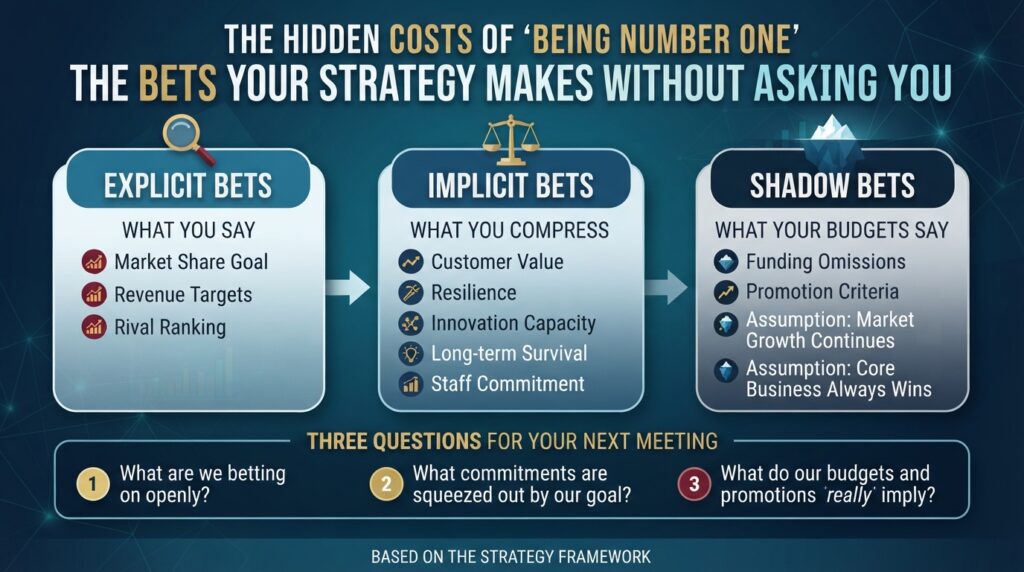
Every organization answers to a long list of outcomes:
– Profit (or surplus, for a nonprofit)
– Customer value
– Staff commitment
– Resilience
– Innovation
– Social impact
– Long-term survival
“Be number one” keeps one line from that list: a ranking against rivals, usually measured in money or market share.
The other six stay in the business but drop out of the conversation. Nobody votes to give them up. They just aren’t in the room when the goal gets written.
Supporters of the single goal say people need something simple to rally around, and they’re right about clarity. The cost is what the simplicity conceals. The commitments you stop discussing are still commitments.
What One Famous Rivalry Cost
From the 1960s into the 1980s, Japanese equipment maker Komatsu pursued a stated intent: “Encircle Caterpillar.” Gary Hamel and C.K. Prahalad made the phrase famous, and business schools still teach it as a model of bold goal-setting.
It was more than a slogan. Komatsu’s yearly priorities and projects were measured against Caterpillar’s results.
For a long time it worked, because the global market for heavy equipment was growing. Then growth slowed. By the late 1980s, Komatsu’s own growth and profits had stalled. Its dependence on construction equipment and on its home market had become a weakness.
In 1989, a new president, Tetsuya Katada, spotted the deeper problem. Years of chasing a rival had narrowed how his managers thought. They knew how to track a competitor. They didn’t know how to find a new direction once the chase stopped paying off.
He replaced the old goal with a deliberately wide one: “Growth, Global, Groupwide.” Then he pushed managers to turn those words into specific new opportunities.
Look at what happened. Komatsu placed one bet in the open. When it ran out, the company placed a second. Between them, a number of bets went unnamed.
Three Kinds of Bets
Every strategy is a set of wagers. Sorting them into three types makes them easier to see.
Explicit bet. An outcome the company states out loud. For Komatsu: “Encircle Caterpillar.”
Implicit bet. A commitment squeezed out by the stated goal, such as customer value or resilience. The company trades it away without a decision. At Komatsu, one casualty was the managers’ habit of questioning direction. After years of single-target discipline, they had lost the skill.
Shadow bet. An outcome the company commits to through repeated choices, omissions and budget lines, without ever stating it.
Shadow bets are the dangerous ones. They never appear in a plan, and nobody can be polled on them.
Where Shadow Bets Hide
You find implicit bets by asking what a goal leaves out. Shadow bets slip past that question because nobody knows they’re making them. You find them by watching behavior: what gets funded, who gets promoted, what never receives a budget line.
Komatsu’s priorities were pegged to a rival’s results. That arrangement assumed the market would keep growing. Nobody wrote the assumption down. The budget stated it anyway.
Climate offers a current example. Many companies act as if climate change will leave their operations alone. That may hold for a few years. Behind it sits a second shadow bet: that future leaders will cope when the effects arrive. Neither bet appears in any strategy deck.
Consider a common arrangement: a company busy chasing a ranking sets up a small innovation unit “to explore new categories.” Look at the budget and you’ll find the shadow bet, that the core business will keep winning and the lab will stay a sideshow. This matters because a ranking only exists inside a category that already exists. A culture built around the ranking has little reason to invent a new one.
Short planning horizons make all of this worse. When a company plans five years out and no further, assumptions pile up unexamined. In the failed strategies I’ve studied, one pattern keeps recurring: short-term plans that led to disastrous long-term consequences. Firms that practice rigorous foresight make fewer shadow bets, and the ones they do make carry less risk.
Why the Usual Fixes Miss
Executives who sense the problem often try one of these:
– A softer slogan. “Market leader” or “first choice” instead of “number one.” Same bet, gentler words.
– A longer race. “Number one by 2040.” Longer horizon, same single outcome.
– A balanced scorecard. More metrics, all still rolling up to the ranking.
– A sustainability report. Run beside the strategy, not inside it. Climate becomes compliance instead of a bet.
– A listening tour. Stakeholders share what they care about. No budget changes.
Each adds activity. None puts a bet on the table where it can be examined.
The Executive Who Counts
Picture Maria, a composite character. Newly promoted into the C-suite, she’s startled by how much of the room’s time goes to the competition. In the last strategy update, she counted: 45 percent of the discussion was about beating the market leader from their position at number two.
She raised it afterward with the founder, a former Olympian and self-described hypercompetitive type. “You’d best become accustomed to us winning if you want to be a team player!” he barked, and cut the discussion short.
She never reached her real news. A new technology will reshape the industry in six or seven years. The two people who understand it have left to start their own firm, and the third is being courted by two competitors. Catching up would take about ten researchers and $10 million in new technology.
Maria has worked at the company for twenty years and doesn’t want to leave. That night, she updates her LinkedIn profile anyway.
Her story shows the social cost. When the conventional wisdom is simple and your peers stay quiet, a lone concern gets overridden. You need language that others can pick up and use. Without it, you’re one person with an unease.
Three Questions for Your Next Meeting
Take these into the room.
1. Explicit bets: What are we betting on?
2. Implicit bets: What does this goal compress, and what does the compression cost us?
3. Shadow bets: What do our budgets, promotions and omissions say we’re betting on?
An outside facilitator or an AI assistant can help with the third question, because neither is invested in your stated intentions.
Start with your own “be number one” goal. List what it says, what it compresses and what your budgets imply. The gaps between the three lists show where your unexamined risk sits.
Then try Maria’s method. Count the minutes your last strategy meeting spent on rivals, versus customers, staff, regulators and the world you’ll operate in a decade from now. That ratio is a bet too.
A company places bets every year through what it funds, whom it promotes and what it leaves unfunded. Ask the three questions. You may find bets nobody decided to make.
—-
This article is based on a column written for the Jamaica Gleaner. It’s first draft was AI-based.
P.S. Five prompts to put these ideas to work
Paste any of these into your AI assistant. Replace the [bracketed text] with your own details, and leave out names or figures you wouldn’t share outside your organization.
**1. Unpack your goal**
My organization’s stated ambition is: [paste your “be number one” or “be the best” goal]. A goal like this can compress seven outcomes into one: profit or surplus, customer value, staff commitment, resilience, innovation, social impact and long-term survival. Ask me, one question at a time, how my organization treats each of these in practice. Then show me which ones get airtime in leadership discussions and which have dropped out. Do not guess about my organization. Ask when you don’t know.
**2. Count the minutes**
Below are the agenda or notes from our last strategy meeting: [paste]. Estimate how much time went to rivals and competitor comparisons, and how much went to customers, staff, regulators and the future we will operate in. Show your reasoning. Then name the outcomes the discussion left out, and what it could cost us if they stay out. Mark clearly what you counted from my notes and what you are inferring.
**3. Hunt for shadow bets**
Here is what I know about where my organization puts its resources: what we fund, whom we promote, and what we leave unfunded or delay: [paste]. Act as a skeptical outsider with no stake in our stated strategy. Infer the bets these behaviors imply, including unwritten assumptions about growth, our market, climate or leadership succession. List up to five. For each, give the evidence from my notes and one question I could ask my team to test it. Say so when the evidence is thin.
**4. Test the category**
Imagine that in fifteen years the category we compete in has shrunk sharply or been replaced. Ask me five questions, one at a time, about our technology, talent, customers and funding. Then describe what a number-one ranking would be worth in that world, and list which of our current projects and budgets assume the category survives. Separate what I told you from what you assume. If you need facts about my industry, ask me.
**5. Rehearse the room**
Role-play a senior executive who believes “be number one” is the right goal. Raise objections such as: the market rewards leaders, simple goals motivate people, nobody can plan fifteen years out, and new categories are for startups. I will argue for naming our explicit, implicit and shadow bets. Push back realistically but fairly. After five exchanges, step out of character and tell me which of my arguments landed, which did not, and what language I could use to win allies instead of raising concerns alone.