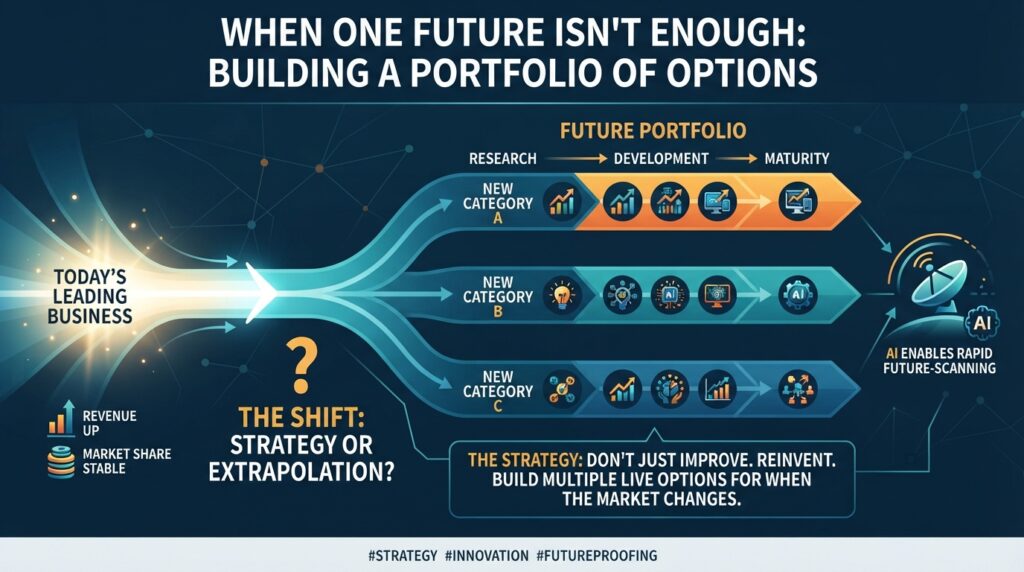

Your company is winning. Revenue is up, market share is stable, and the board likes what it sees. But look past the numbers and a real question is waiting: is this a strategy, or just an extrapolation of what’s worked so far?
That distinction matters more than it sounds like it should. Extrapolation works fine right up until the market shifts. By then, it’s too late to build an alternative.
Take Kodak and Fujifilm. Both companies had digital photography technology decades before it upended their industry. Kodak’s version of the story gets told the most: brilliant engineers, a dominant brand, and a board that shelved the innovation rather than risk film sales. When digital cameras finally took over, Kodak had no second act ready.
Fujifilm had the same technology and the same warning signs. Its leadership drew a different conclusion: photographic film would not pay the bills forever. So it went looking through its own laboratories for technologies that could become something else entirely. Two bets came out of that search, developed side by side. One was Instax, an instant-camera category built on Fujifilm’s imaging chemistry. The other was Astalift, a cosmetics line built on collagen and nanotechnology the company had originally developed for film. Neither was a better camera. Both answered a customer question film photography never asked.
That’s the real lesson. Improving a product and reinventing a category are not the same move. One extends an answer. The other asks a new question.
Kodak’s failure has company. Blockbuster stayed anchored to the physical rental store while Netflix built a fundamentally different way to watch movies, and filed for bankruptcy in 2010. Nokia kept optimizing handsets while Apple and Google moved the competition to software and app ecosystems, and eventually sold its phone business to Microsoft. Borders kept investing in the physical bookstore, outsourced its own online sales to Amazon in 2001, and liquidated a decade later.
Look closely at those three and you’ll notice they didn’t fail the way Kodak did. Kodak’s category disappeared: film photography became structurally unattractive, and there was nothing to pivot back into. Blockbuster, Nokia, and Borders had it worse in one sense. The underlying customer need never went away — people still wanted to watch movies, communicate on the go, and read books. What disappeared was their claim on it, because somebody else built a new category to serve that same need. A strong core business can keep performing right up to the moment a competitor creates the category that makes it irrelevant.
That’s what makes a portfolio of candidate futures worth the trouble. Amazon didn’t wait for online retail to plateau before placing its next bet. It launched S3 in 2006 and EC2 not long after, building the cloud-computing category while its retail business was still scaling. Alphabet does something similar on purpose: it runs a set of “Other Bets” — Waymo, Verily, and several others — deliberately kept at different stages of development, some barely past the research stage, so the company always has more than one shot at the future in play at once.
None of this is really new. IBM ran something similar in the early 2000s under a formal program that tracked what it called emerging business opportunities. Within three years, the portfolio had grown to seventeen candidates, spanning life sciences, Linux, pervasive computing, and business-process integration, each one tracked against its own milestones rather than forced through the existing business’s metrics.
Samsung did something comparable in 2010, naming five future growth businesses — including solar cells, batteries, and biopharmaceuticals — and committing serious capital to develop them in parallel. Some of the five went nowhere. A few became genuinely important. That’s not a coincidence, and it’s not a weakness in the approach. It’s the approach working as intended: the value isn’t in a high hit rate, it’s in having more than one live option when the environment shifts.
Naming that pattern is the easy part. Committing real resources to a future that might not happen is much harder, especially while the current category is still paying the bills. Few leadership teams even attempt to plan fifteen or thirty years out. Fewer still try to hold multiple long-range futures at the same time.
Until recently, that kind of work belonged to consultants and academics, who produced dense reports that ended up on a shelf. AI changes what’s possible now. It took the launch of ChatGPT to reveal what GPT-3 had only hinted at a year earlier, and most organizations planning long-term in 2021 missed that shift entirely, because nobody was scanning for it. Tools like Preempt.live can now surface thousands of plausible futures for an industry in an afternoon, which lowers the cost of asking “what else might happen” close to zero.
If your organization already has a few candidate categories in mind, the next steps aren’t complicated:
- Name a handful of candidate categories, with input from AI and your board.
- Assign each one to a champion who wants to see it succeed, not a department that inherits it as a side project.
- Teach each champion to use AI to track the faint signals that would tell you a candidate is starting to matter.
None of this requires certainty. It requires candidates, champions, and the discipline to keep watching for the next fifteen to thirty years.
Your current strategy is paying the bills today. Start building the one that will pay them next.
[This article is a longer, AI-generated version of an original Gleaner column.]
P.S. — Five prompts to run through your own AI tool
1. “List every product or service my organization sells today. For each one, tell me: if this disappeared entirely in the next ten years, would our underlying customer need disappear with it, or would someone else just be serving that need in a different way?”
2. “Based on what you know about my industry, name five to ten emerging categories that don’t exist yet but plausibly could within the next 15 years. Don’t filter for feasibility — I want the raw list first.”
3. “Play devil’s advocate: what is the single strongest argument that my current category will keep paying the bills for the next 15 years, with no need for a backup? Then tell me what would have to be true for that argument to be wrong.”
4. “If I had to hand one candidate future to a named person on my team — not a department — and ask them to genuinely champion it, who on my team already has the curiosity or skills to do that well, based on what I tell you about them?”
5. “Help me design a simple, low-effort way to monitor faint signals for [insert one candidate category]. What sources, search terms, or data points should someone check monthly to catch early movement?”