

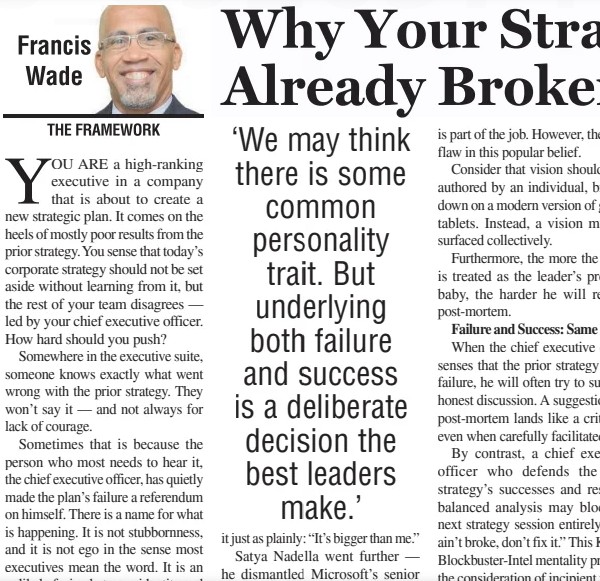
Picture a boardroom anywhere in the world. A new strategic plan is about to be built, and it follows a stretch of disappointing results. Someone at the table believes the old plan deserves an honest look before anyone writes a new one. The rest of the room disagrees, and the person leading that resistance is the chief executive.
This scene repeats itself constantly, across industries and continents, in companies large and small. And it repeats for a reason that has surprisingly little to do with the numbers on the page.
Somewhere in that room, someone already knows what went wrong. They stay quiet, and not because they lack nerve. Often the silence exists because the one person who most needs to hear the diagnosis has quietly turned the plan’s failure into a verdict on himself.
This has a name, though it is rarely the name people reach for. It isn’t stubbornness, and it isn’t ego in the casual sense most people mean when they use the word. It’s something closer to fusion: the CEO’s sense of identity has welded itself to the authorship of the plan. Criticizing the plan starts to feel indistinguishable from criticizing the man.
The Instinct to Diagnose the Leader
The common response to a struggling CEO is to assume he needs more self-reflection. That diagnosis feels intuitive, and it is usually wrong.
Executive coaches who work with senior leaders will tell you something consistent: top performers tend to run high on confidence, and sometimes on narcissism. Wins get filed under personal skill. Losses get filed under bad luck, timing, or a market nobody could have predicted. Which means owning a failure takes real effort, precisely because nothing in the leader’s usual operating system asks him to.
So what actually moves a confident leader to let go of a plan he built?
Three well-documented cases suggest an answer, and it isn’t introspection triggered by failure. It’s something closer to a deliberate choice, made from strength rather than crisis.
Garry Ridge spent over two decades running WD-40, and built one of the most studied culture turnarounds in modern business on a simple, command-driven mantra: be brilliant, be brief, be gone. At some point that mantra stopped fitting the company he wanted to build. He later described the shift in five plain words: he couldn’t do it alone.
Alan Mulally took over a struggling Ford and steered it through the 2008 financial crisis without the government bailout its competitors needed. About the plan that made that possible, he said something equally direct: it was bigger than him.
Satya Nadella went a step further at Microsoft. Rather than simply saying the company’s direction wasn’t his alone, he dismantled the senior leadership structure built to run things that way, on the theory that no single person, including the CEO, should hold that much of the answer.
None of these three men were failing when they made that call. Each was already succeeding, with every reason to keep doing exactly what had gotten him there. Yet each one gave up sole ownership of his company’s direction anyway, voluntarily, before a board or a crisis forced the issue.
That timing matters more than it first appears. It suggests the shift isn’t a symptom of failure, something a leader is forced into once the results turn bad. It’s a decision available to any leader, in good times or bad, and the best ones make it deliberately, long before anyone hands them a reason to.
Rejecting a Popular Premise
Ridge, Mulally, and Nadella weren’t managing their egos more skillfully than other executives. They were rejecting an assumption most organizations never examine: that a company’s direction is supposed to be authored by one person at the top, the way a founder might write a mission statement on a napkin and hand it down as scripture.
That assumption carries a flaw most boardrooms never name out loud. A company’s direction isn’t handed down from a single mind, however talented that mind happens to be. It gets surfaced collectively, through the accumulated judgment of the people running the business day to day, closest to the customers and the friction points a CEO rarely sees firsthand. The more a leader treats that direction as personal property, something he built and therefore owns, the more fiercely he will defend it against the one exercise that could actually improve it: an honest post-mortem.
The Same Reflex, Wearing Two Faces
This reflex shows up differently depending on how the last plan went, which is part of why it goes unrecognized so often.
When a leader senses the prior strategy failed, he tends to suppress honest discussion about it. Even a carefully facilitated review can land like an accusation rather than an exercise, and the room adjusts accordingly, softening its language until the review says almost nothing useful at all.
When a leader believes the prior strategy succeeded, the resistance shows up dressed differently, but the underlying mechanism is identical. Success gets defended as proof that nothing needs to change. This is the same instinct that kept a dominant film company comfortable with film long after digital cameras arrived, kept a video rental giant comfortable with physical stores while streaming quietly took over living rooms, and has repeated itself across a long list of once-dominant firms convinced that what worked before would keep working. Confidence in past results becomes the very thing that blocks an organization from spotting the threat forming just outside its field of view.
Failure resists a post-mortem out of self-protection. Success resists it out of certainty. Both come from the same place: a leader who has made the plan’s outcome personal, whichever direction that outcome happened to run.
There is a third variation worth naming, quieter than the other two. Some leaders resist not because the result was clearly good or bad, but because it was ambiguous, and ambiguity is harder to defend than either extreme. A mixed result invites the most debate, and debate is exactly what identity fusion is built to avoid.
What a Colleague Can Actually Do
If you aren’t the top leader, and you sense your CEO is standing in the way of an honest review, pressure rarely works. Direct confrontation tends to trigger the very defensiveness you’re trying to move past, and most people who have tried it once rarely try it the same way twice.
A better move is reframing the role itself. Help your CEO see himself less as the sole author of the company’s direction and more as its chief learner, or its lead experimenter, someone whose job is to keep testing the plan rather than defend it. That single shift in self-perception does more work than any argument about specific numbers ever will.
Ridge, Mulally, and Nadella are useful here, not as inspiration but as evidence. Each one answered the same question at the height of his influence, when nothing outside forced the admission: whose plan is this supposed to be?
Now picture your own CEO hearing that question, in your own boardroom, this week. He is still resisting the post-mortem, and you are still deciding how hard to push. The better question isn’t how hard. It’s which question you ask.
Not a challenge to his judgment. An invitation to a role he likely never chose for himself, and one he remains entirely free to choose now, at whatever stage his company’s story happens to be in.
——————————————-
PS: Five prompts to take this further with an AI assistant
- “I lead a team where a senior leader seems to be personalizing a past strategic failure. Help me identify three signs this is happening, based on the psychological pattern described in this article.”
- “Using the Ridge, Mulally, and Nadella examples, help me draft a short, low-pressure way to raise the idea of a strategy post-mortem with my own leader, without it sounding like a criticism.”
- “Walk me through the difference between a leader resisting a post-mortem out of failure versus resisting one out of past success. Which pattern sounds more like what I’m seeing in my own organization?”
- “Help me design a simple post-mortem process for my team’s last strategic plan that treats the findings as collective, not as an evaluation of any one person.”
- “If I wanted to reframe my own role from ‘owner of the vision’ to ‘chief learner,’ what would that change about how I lead the next planning cycle? Help me think through three concrete differences.”