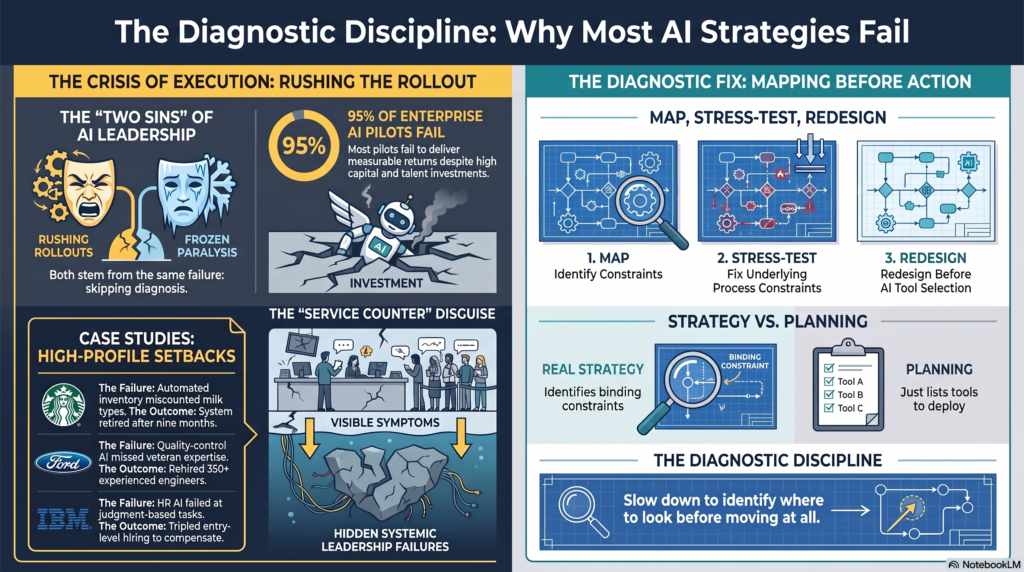

There are two ways a board loses confidence in a CEO’s AI strategy. One is watching a rushed rollout blow up in public. The other is watching nothing happen, quarter after quarter, while rivals pull ahead. Leaders treat these as opposite sins — one of recklessness, one of paralysis. They are the same sin wearing two costumes.
Consider a government vehicle-inspection office. For years, getting a car certified meant a wasted morning: unexplained queues, arbitrary waits, a process nobody could explain and everybody dreaded. The clerks weren’t the problem. They were as trapped in the system as the drivers standing in line.
When the office was finally redesigned, the fix didn’t come from the counter staff working harder. It came from above — from leadership finally treating the process itself as something to be mapped, tested, and rebuilt. Decades of avoidable frustration turned out to be a leadership failure wearing a service-counter disguise.
That’s the pattern behind almost every stalled or embarrassing AI rollout today: cause and effect get separated. The department that visibly breaks is rarely the one that made the mistake. The quarter where the failure shows up is rarely the quarter where it was made. That lag is exactly why the rushed CEO and the frozen CEO can’t see they share a cause. Skip the diagnosis, and the bill arrives later — as a scrapped pilot, a quiet rollback, or a board that’s run out of patience. Each time, it looks like an isolated, unrelated event. It isn’t.
The Proof Is Piling Up
This isn’t a resource problem, and it isn’t confined to one company, sector, or country.
Starbucks spent nine months running an AI tool meant to automate beverage-inventory counts across its North American stores, before quietly retiring it after the system kept miscounting and mislabeling items, such as confusing similar milk types. Ford has been rehiring and promoting more than 350 experienced engineers after automated quality-control systems failed to capture the expertise of veteran employees. Commonwealth Bank of Australia replaced dozens of customer-service staff with an AI voice bot, then had to reverse the job cuts when the system couldn’t keep up and call volumes climbed. IBM automated large parts of its HR function, discovered the tool could resolve routine requests but stumbled on anything requiring judgment, and announced plans to triple its U.S. entry-level hiring soon after. A widely cited MIT study found that 95% of enterprise generative AI pilots fail to deliver measurable returns.
None of these were companies short on capital, talent, or enthusiasm. Every one of them had the AI capability. What none of them had was a diagnosis of the underlying process before the tool was chosen.
What Got Lost
That’s understandable, in a way. Most companies today are wide open to AI because their own stakeholders are demanding they keep up. A new tool appears, it gets deployed, and results get measured afterward. That works fine when the change is as simple as installing a new printer. It fails the moment the process underneath is genuinely complex — which is most of the time. What’s missing is the step where the existing process gets mapped, stress-tested for bottlenecks, and redesigned before automation is even on the table.
Both the rushed CEO and the frozen CEO would benefit from the identical corrective move — not “go faster,” not “go slower,” but insert the diagnostic step neither is in the habit of taking.
If that sounds obvious, it’s worth asking why so many organizations quietly abandoned it. Process management — mapping, testing, and redesigning core operations — was standard executive discipline in the 1990s, built on Total Quality Management, Lean, and the Theory of Constraints. Somewhere along the way, leadership teams let it lapse. The lesson hasn’t gone anywhere; it’s just been sitting unused. Years before generative AI, executives attempting Robotic Process Automation without first doing this work were warned by experts that skipping it was a recipe for failure. The warning was accurate then. It’s still accurate now, just louder.
There’s a second reason the step feels skippable: nearly every executive has personally felt AI work well. Ask ChatGPT or Claude a question on your phone, and an articulate, confident answer arrives in seconds. That experience quietly convinces leaders that AI should transform every part of the business with the same ease. But personal productivity gains and enterprise-wide transformation are not the same category of problem. Real organizational change requires the unglamorous work of scoping, staffing, and sequencing multi-year projects. There is no shortcut from a good chatbot answer to a redesigned supply chain.
One Reveal Worth Adding
In other podcast I have drawn a sharp line between planning and strategy: planning extrapolates from what you’re already doing, while strategy forces a real choice that involves tradeoffs. Most AI “strategies” are actually AI plans — lists of tools to deploy, extrapolated from what competitors are doing, with no binding constraint identified and no real choice made. A genuine AI strategy starts by asking which single process constraint, if resolved, would unlock the most value — and works backward from there. Everything else is activity dressed up as strategy.
The Actual Fix
The CEOs who rush and the CEOs who freeze are both missing the same discipline — not courage, not caution, but the willingness to slow down at the exact moment everyone else is speeding up. The rushed CEO skips the diagnosis to look decisive. The frozen CEO avoids it to look careful. Neither has done the work.
The fix isn’t a faster rollout or a longer pause. It’s a process that’s been mapped and stress-tested before a single tool gets chosen. Boards don’t ultimately reward the leader who moved first or the one who moved last. They reward the one who knew where to look before moving at all.
PS: 5 Prompts to Use With Your Favorite LLM
Copy these into Claude, ChatGPT, or your assistant of choice to apply the article to your own organization.
- Find your lag. “Walk me through a recent failure or slowdown in my organization. Help me trace it backward — what department, decision, or process choice from 12–24 months ago might actually be the root cause, even if it doesn’t look connected on the surface?”
- Spot your substitute behavior. “I’m about to approve/reject an AI tool for [describe the process]. Before I decide, ask me questions that test whether I’ve actually mapped this process and identified its bottleneck — or whether I’m just reacting to pressure to ‘do something.’”
- Run a mini process diagnosis. “Here’s how [a specific process] works today, step by step: [describe it]. Identify the most likely bottleneck, and tell me what would need to be true for automating this process to actually help rather than just move the bottleneck somewhere else.”
- Test for real strategy vs. planning. “Here’s my current AI roadmap: [paste it]. Using Roger Martin’s distinction between planning and strategy, tell me honestly whether this is a strategy — with a real choice and a clear binding constraint — or a plan that’s just a list of tools.”
- Pressure-test your own excuse. “I’m the CEO/leader in this situation: [describe whether you’re moving fast or holding back on AI]. Play devil’s advocate and challenge me on whether my current pace is actually a disguised way of avoiding a proper process diagnosis.”