
You have heard of CSRD (the Corporate Sustainability Reporting Directive), at least in passing. As a new reporting requirement, it calls for your company to submit annual non-financial information, starting in just a few years’ time.
As someone who cares about long-term environmental and social impacts, you like where this is going.
But you are concerned that it will turn into a bureaucratic slog, in which laudable goals are lost in a tsunami of reporting requirements. Far from inspiring staff to do the right thing, you imagine it becoming a war of attrition between staff and some faceless regulators.
After all, you have seen this happen before. So, you have every right to expect that the same thing will happen again.
In this article, we’ll look at concrete ways for your firm to benefit from CSRD and its impact on strategy. There are many early actions to take to prepare, but they have something in common. They all rely on your understanding of the intent behind the framers of the standard – The European Financial Reporting Advisory Group (EFRAG).
In this article I’ll suggest the standard is a “nudge” in a positive direction which can empower your leadership team, strategic planning staff and all stakeholders.
The article is available as a written newsletter on the JumpLeap Newsletter.
You have heard of CSRD (the Corporate Sustainability Reporting Directive), at least in passing. As a new reporting requirement, it calls for your company to submit annual non-financial information, starting in just a few years’ time.
As someone who cares about long-term environmental and social impacts, you like where this is going.
But you are concerned that it will turn into a bureaucratic slog, in which laudable goals are lost in a tsunami of reporting requirements. Far from inspiring staff to do the right thing, you imagine it becoming a war of attrition between staff and some faceless regulators.
This is a public episode. If you’d like to discuss this with other subscribers or get access to bonus episodes, visit longtermstrategy.substack.com/subscribe
You have heard of CSRD (the Corporate Sustainability Reporting Directive), at least in passing. As a new reporting requirement, it calls for your company to submit annual non-financial information, starting in just a few years’ time.
As someone who cares about long-term environmental and social impacts, you like where this is going.
But you are concerned that it will turn into a bureaucratic slog, in which laudable goals are lost in a tsunami of reporting requirements. Far from inspiring staff to do the right thing, you imagine it becoming a war of attrition between staff and some faceless regulators.
After all, you have seen this happen before. So, you have every right to expect that the same thing will happen again.
In this article, we’ll look at concrete ways for your firm to benefit from CSRD and its impact on strategy. There are many early actions to take to prepare, but they have something in common. They all rely on your understanding of the intent behind the framers of the standard – The European Financial Reporting Advisory Group (EFRAG).
In this article I’ll suggest the standard is a “nudge” in a positive direction which can empower your leadership team, strategic planning staff and all stakeholders.
The article is published in full here.
This is a public episode. If you’d like to discuss this with other subscribers or get access to bonus episodes, visit longtermstrategy.substack.com/subscribe
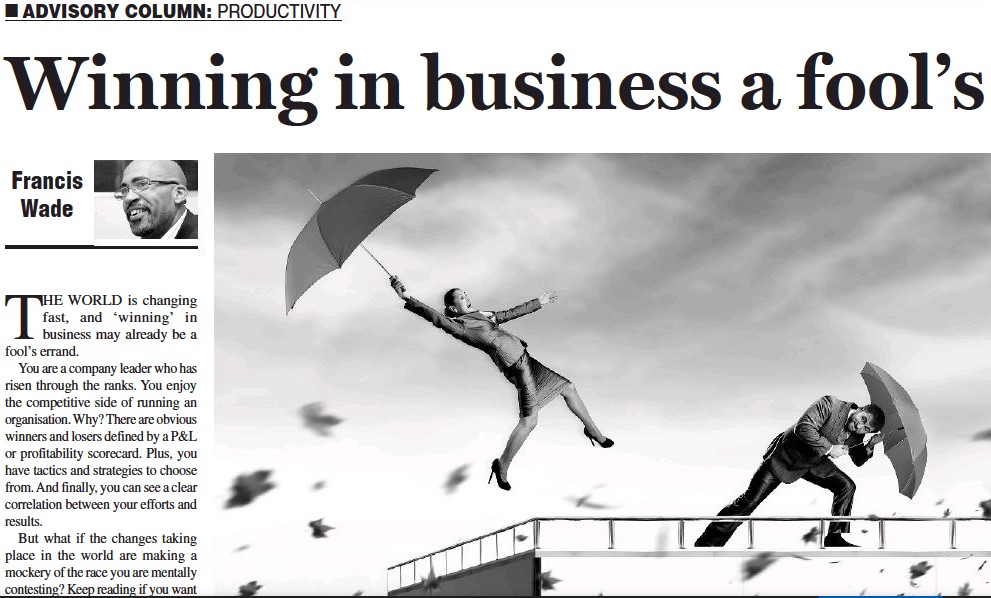
The world is changing fast, and “winning” in business may already be a fool’s errand.
You are a company leader who has risen through the ranks. You enjoy the competitive side of running an organization. Why? There are obvious winners and losers defined by a P&L scorecard. Plus, you have tactics and strategies to choose from. And finally, you can see a clear correlation between your efforts and results.
But what if the changes taking place in the world are making a mockery of the race you are mentally contesting? Keep reading if you want to stay ahead.
Why You Are Like Usain Bolt
The 100m dash is undoubtedly one of the purest forms of gamified athletics ever witnessed.
But before the Olympics were invented, people just ran. There were no medals,
or clocks, or heats, sponsorships, television appearances, etc. Over time, these elements were added in and made this human invention appear real.
Is the game of business also fabricated? If you are a CEO, you are probably immersed in it, without question. Let’s take a step back, and outside of it, for a moment. Maybe we can discern its outline and see some shortfalls.
Ask yourself the following: Who are you competing against? Who are the winners? The losers? The middle-of-the-packers?
What do you use to measure the score? How long is the timeframe? When do you feel pangs of jealousy as opponents pass you by? Do you enjoy the intellectual, social and emotional challenges?
Notice your reaction and write them down. You might become a bit nervous as you draw this picture. Why? Because you may uncover the motivation behind your accomplishments and believe that too much insight is bad.
These feelings are natural. Most hard-driving, over-achieving, Type-A’s who tend to lead organizations don’t spend time reflecting on their competitive nature. It’s taken as a given.
Here, I speak from experience. When I finally came first in my class at Wolmers after five years of effort, I saw myself as the winner…the one who crossed the line ahead of others when it counted the most. I didn’t question it for a moment, even though I gave up playing Sunlight Cup cricket for a year to achieve the goal. Today, I wouldn’t.
Why You Are Not Usain Bolt
But the truth is that business is not an actual game. While this mental construct can be energizing, there are definite limits to seeing it this way.
Just ask Amazon.com. Reports have emerged that Jeff Bezos’ empire is about to be dismantled by the FTC. Why? Apparently, they have determined that the company is taking its winnings from one area and using it in another. Unfairly.
Consequently, the US Government may use antitrust laws to redefine the game Bezos has been playing. Remember, they did just that to Microsoft and AT&T, among others.
If you have a strong competitive streak, it could be time to step away to re-imagine the game you have been unconsciously and unwittingly engaged in. Here are some strategic reasons to revisit this construct now.
Reason #1 – You Become Blind
When a fresh substitute enters your environment but doesn’t look like a competitor, you miss seeing them. C&W dismissed the arrival of Digicel because the new entrant was playing a different game top leaders didn’t recognize.
Reason #2 – You Become Short-Sighted
If you study your current competitors too closely, you end up following their every move. And stop being creative.
Reason #3 – You Live in Short-Termism and Endanger the Planet
Your imaginary game is probably more of a sprint than a marathon. If so, long-term planning may be repeatedly delayed.
As such, Europe’s Corporate Sustainability Reporting Directive (CSRD) requires companies to pay attention to their carbon footprint. Indirectly, they are pulling organizations into their Green Deal objective of climate neutrality by 2050.
This move implies that corporations have been playing winner-take-all games for decades, which now endanger our well-being.
As you enter this new game (by choice or by necessity), you may find that it’s not the zero-sum contests you have been enjoying. Instead, you’ll be joining companies which are focused on the triple P bottom-line – Profits, Planet and People.
Unfortunately, this is not the kind of “competitive strategy” taught in business schools. By contrast, it’s more a function of high-quality collaboration and cooperative outcomes.
In this context, it may look foolish to persist in the old game of massive profits or personal wealth. On a globe threatened by global warming, who cares?
Fortunately, you can “re-gamify” yourself and go in a different direction. You could still “win”, but so could everyone else in the entire world.
The world is changing fast, and “winning” in business may already be a fool’s errand.
You are a company leader who has risen through the ranks. You enjoy the competitive side of running an organization. Why? There are obvious winners and losers defined by a P&L scorecard. Plus, you have tactics and strategies to choose from. And finally, you can see a clear correlation between your efforts and results.
But what if the changes taking place in the world are making a mockery of the race you are mentally contesting? Keep reading if you want to stay ahead.
This is a public episode. If you’d like to discuss this with other subscribers or get access to bonus episodes, visit longtermstrategy.substack.com/subscribe
Your company has come up with a bright idea. From now on, the announcement states, everyone will share the same task management software. It’s sold as a win-win for everyone.
But you quickly realize that this is a problem. Your favorite task management software will now be a side-show as you are forced to change your practices.
Gone are some things you like to do using your software’s new features. Also, there will be some shared tasks that everyone can see.
You’re not sure if this is a good thing or bad, or what you should do about it.
Tune into this episode to hear from me and my special guest, Renee Clair, as we solve this wicked problem together.
You have heard of the Corporate Sustainability Reporting Directive or its acronym, CSRD. You know that it has something to do with the EU which means that you haven’t paid it much attention. It’s far away.
However, this could be a mistake. This new standard for disclosure reaches into some unlikely places for all companies who do business with the continent. In this article, we’ll look at the impact on your corporate strategy.
This is a public episode. If you’d like to discuss this with other subscribers or get access to bonus episodes, visit longtermstrategy.substack.com/subscribe
You have heard of the Corporate Sustainability Reporting Directive or its acronym, CSRD. You know that it has something to do with the EU which means that you haven’t paid it much attention. It’s far away.
However, this could be a mistake. This new standard for disclosure reaches into some unlikely places for all companies who do business with the continent. In this article, we’ll look at the impact on your corporate strategy.
Recently, the European Commission reaffirmed its commitment to “Net Zero 2050.” Inspired by the Paris Agreement, their goal is to be climate-neutral by 2050 – an economy with net zero greenhouse gas emissions. Lest the world relax, an interim target was set to reduce emissions by at least 55% by 2030.
CSRD makes it plain that big companies must play their part in accomplishing these goals. As such, they are required to report their progress annually via certain templates. But what does this have to do with a large company in Jamaica?
Well, your firm may not have a European subsidiary. And it might never reach the E40m turnover or 250 employee lower limit for inclusion. However, it may have wholesale customers on the continent. If so, it will probably be required by them to report on your conduct as a member of its supply chain.
But this is already happening.
Last week, I browsed Booking.com for a holiday stay in Ocho Rios. Now, there’s a new badge for each property to earn: a “Travel Sustainable Level”. According to the website, the programme was “introduced in 2021 to provide travelers with transparent and credible information to make more mindful choices for their trips.”
In other words, the intent of CSRD is already being realized. It seeks to give stakeholders knowledge about each large company’s progress on goals such as Net Zero 2050.
This new standard is likely to be seen by some as a nuisance. But for others, particularly in the area of strategic planning, there lies an opportunity.
How CSRD Can Help Shape Your Strategy
Essentially, the new standard mandates your company to tell the world how its strategy for topics related to Environment, Social and Governance (ESG) are faring. It expects you to address this explicitly in your short, mid and long-term strategic plans.
However, if you are like most companies, you don’t have anything more than a five-year list of tactics. But you aren’t alone. As a result of upheavals since the 9/11 Terrorist Attack, firms have argued that they don’t have time for long-term thinking.
Instead, their energies have focused on basic survival…short-termism.
CSRD says that if you continue to indulge in this dangerous practice, you will be required to highlight this fact to your stakeholders in your ESG disclosures.
While this sounds like a threat, some are seeing it as an opportunity, or at least an excuse to do the right thing.
The Optimal Response
In essence, your company has two choices to meet the directive.
1) The Compliant Low Road consists of sticking to an approach of only keeping short-term business tactics. This means that you will need a separate strategic plan for all matters ESG-related.
While some firms have hired sustainability professionals to do this very task, some are calling it out as a form of greenwashing. Said differently, it’s probably just a way to be compliant without making fundamental changes.
2) The Transformational High Road means crafting mid and long-term strategic plans for your business, if they don’t currently exist. Ideally, they should reach as far as 2050 to be completely aligned with the Net Zero aspiration.
If your company already has a written long-term strategic plan, then this may just be an exercise in adding a few different dimensions. The CSRD is actually developed for companies like yours. The adjustment should be easy.
However, if it’s never had an interwoven short/long-term strategic plan, this might be the perfect moment to begin. You do have some time before this becomes a requirement.
But your free paper is being burned up. The SEC in the United States and the IFRS are expected to recommend similar reporting standards, in line with existing requirements for financial disclosure.
It’s not too late to start getting your company ready. Schedule time to prepare the right kind of interwoven short/long-term strategic plans.
As you do so, be prepared to answer the questions raised by CSRD. Even if the process you follow is sound, these may not be central concerns. But they will fit in with the thinking the EU Commission wants you to do.
When the time comes to complete the forms required for your CSRD reporting, you’ll be ready.
Your business offers a product or service. Regardless of how well your offer sells, you wonder whether or not you are leaving money on the table. In other words, are you charging the best price possible?
This question is often left to opinions, chance, or comparisons with competitors. These choices unfortunately indicate the lack of a defined philosophy.
Alex Hormozi’s book, $100m Offers, provides a simple way to think about the challenge of setting prices. If you have a sense that your company should reconsider its thinking, keep reading.
This is a public episode. If you’d like to discuss this with other subscribers or get access to bonus episodes, visit longtermstrategy.substack.com/subscribe
We use cookies on our website to give you the most relevant experience by remembering your preferences and repeat visits. By clicking “Accept”, you consent to the use of ALL the cookies.
This website uses cookies to improve your experience while you navigate through the website. Out of these, the cookies that are categorized as necessary are stored on your browser as they are essential for the working of basic functionalities of the website. We also use third-party cookies that help us analyze and understand how you use this website. These cookies will be stored in your browser only with your consent. You also have the option to opt-out of these cookies. But opting out of some of these cookies may affect your browsing experience.
Necessary cookies are absolutely essential for the website to function properly. This category only includes cookies that ensures basic functionalities and security features of the website. These cookies do not store any personal information.
Any cookies that may not be particularly necessary for the website to function and is used specifically to collect user personal data via analytics, ads, other embedded contents are termed as non-necessary cookies. It is mandatory to procure user consent prior to running these cookies on your website.