You’ve started leaning on AI for your strategy work. ChatGPT, Claude, Gemini — pick your favorite. You’ve fed it your hardest question, the one that’s been on your desk for weeks. And the answer came back in seconds. Polished. Balanced. Articulate. It mentioned differentiation. It mentioned long-term thinking. It suggested you augment your team rather than automate them. It read like advice from a Harvard Business School case writer.
And it sounded like good advice.
But something is off. Because last week, a colleague at a different firm — different industry, different size, different problem — mentioned over coffee that she’d been doing the same thing. And when she described what her AI told her, it sounded suspiciously like what yours told you.
So now you’re sitting with a question you didn’t expect to be asking. If everyone is getting roughly the same advice, in roughly the same shape, dressed in roughly the same words — is anyone actually getting strategy at all?
Tune into this episode to join me in tackling this wicked problem which I first heard of in the famous Harvard Trendslop article from April 2026. It’s why AI keeps handing strategists the same answers — and what’s really going on underneath that has very little to do with AI.
AI in Strategy Creation | Beyond “Trendslop”
Theme of the Long-Term Strategy Conference Sep 15-17 2026
If you’re listening to this podcast just after its release, join us at the the LTSP26 conference. If you are seeing this after the date, then we’ll have replays for purchase.
This is a public episode. If you’d like to discuss this with other subscribers or get access to bonus episodes, visit longtermstrategy.substack.com/subscribe
Your company knows that it needs to move quickly once a corporate strategy has been developed, to get the document in the hands of the staff.
But what does it mean to “get it into their hands?” Send them a pdf? Get them to watch a video? Attend a town hall? Attend a briefing from their manager, after she has received her briefing?
This is a massive problem and here today to apply an AI-driven solution is Amie Devero. Tune into this episode to hear from us as we tackle the issue of strategy activation together.
Amie and Contextuum will be featured at the Long-Term Strategy Conference 2026. This year’s theme is AI in Strategy Creation | Beyond Trendslop – https://strategyconf.fwconsulting.com
This is a public episode. If you’d like to discuss this with other subscribers or get access to bonus episodes, visit longtermstrategy.substack.com/subscribe
Today, your executive team fills SWOT boxes in 90 minutes and calls it strategy.
Tomorrow’s competitive landscape will punish that superficiality mercilessly. Chris Fox predicts the emerging standard: double-barreled insight generation that combines intellectual analysis with visceral pattern recognition.
The companies that master this before 2027 will spot their Kodak moments early enough to pivot. The rest will wonder why their strategy sessions produced such weak insights while competitors transformed entire business models. This conversation reveals the magnitude gap that will separate strategic survivors from casualties.
Tune in to hear from me and my special guest, Chris Fox, as we tackle and try to solve this wicked problem together. We’ll be putting our heads together to find new ways of discussing strengths, weaknesses opportunities and threats – SWOT – that go beyond the usual thinking.
I’m Francis Wade and welcome to the JumpLeap Long-Term Strategy Podcast
Chris Fox is a strategy consultant and founder of StratNav, the collaborative platform for business strategy development and execution. With over 26 years’ experience, Chris helps leaders replace guesswork with evidence and execution. He also runs Chris C Fox Consulting, advising C‑suite teams on strategy that delivers
You’re in a strategy retreat. You see an opening to shift the conversation—a strategic insight you know could change the trajectory. You speak up with confidence. And then… blank looks. Awkward silence. The room moves on as if you hadn’t spoken.
It doesn’t matter if you’re the CEO, the board chair, or an ambitious director. The frustration is identical: you have strategic clarity, you know the frameworks, yet your interventions land with a thud while others command the room effortlessly. Most executives diagnose this as needing sharper frameworks or better presentation skills. Wrong problem.
This episode exposes what elite strategists do differently: they’ve built pattern libraries from accumulated case exposure that allow them to deploy diagnostic stories, pattern stories, and origin stories in the moment—not in PowerPoint decks afterward. You’ll discover why Julius Yego’s YouTube-driven Olympic medal validates cognitive science research on tacit knowledge, how Samuel Berger’s “intellectual dark matter” explains the gap between knowing frameworks and commanding strategic conversations, and why the three-season development model transforms in-the-room impact when executive programs don’t.
For global executives who’ve exhausted conventional development paths, this reveals the hidden capability that separates persuasive pattern recognition from forgettable framework recitation—and the deliberate practice method that builds it.
Enjoy the full video of this episode below for all subscribers.
This is a public episode. If you’d like to discuss this with other subscribers or get access to bonus episodes, visit longtermstrategy.substack.com/subscribe
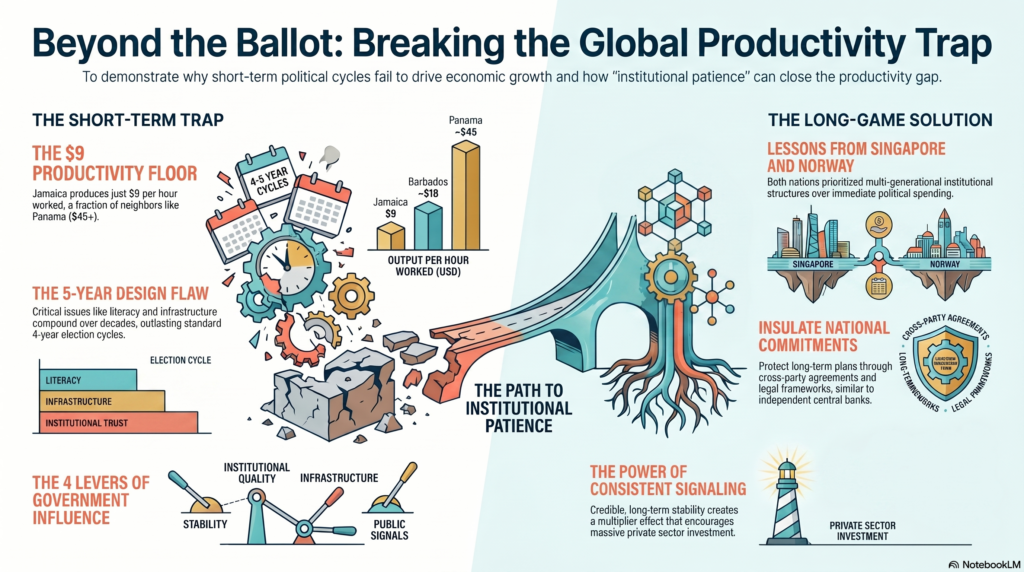
There’s a number most government leaders would rather not think about. For Jamaica, it’s nine dollars.
That’s the country’s productivity measured as output per hour worked — US$9. Barbados, a neighboring island economy, produces more than twice that. Panama produces five times as much. Most strikingly, Jamaica’s hourly output is only marginally ahead of Haiti’s — a country that has experienced decades of political collapse and natural disaster.
The numbers are sobering. But they are not unique to Jamaica. Across the developing world, governments face a version of the same arithmetic: their economies are generating far less per hour of human effort than they should, the gap is wide, and it has been wide for decades.
What is less often discussed is the role that government itself plays in perpetuating that gap.
The Largest Economic Actor in the Room
In many developing economies, government directly produces somewhere between 15 and 20 percent of GDP through goods and services. That makes it the single largest economic actor in the country — larger than any company, sector or industry.
But its true influence extends much further. Government shapes the entire environment in which the other 80-plus percent of economic activity takes place, through four distinct levers: macroeconomic stability, institutional quality, infrastructure and public goods, and the signals and expectations it sends to investors, businesses and citizens about the future.
That fourth lever is the most underestimated. When a government is unpredictable, inconsistent or widely distrusted, it suppresses private investment and enterprise far beyond anything that shows up in its own budget. Conversely, a government that signals credible, long-term commitment to stability and growth creates a multiplier effect on every dollar the private sector deploys.
Jamaica has made genuine, internationally recognized progress on the first lever. Its fiscal turnaround since 2013 has been studied by other nations as a model of discipline. Debt ratios have fallen. Inflation has been tamed. And yet GDP growth has not followed at the pace the data might suggest it should. The reason is that macroeconomic stability, while necessary, is not sufficient. The other three levers matter just as much — and progress on those fronts is slower and harder to sustain across electoral cycles.
Why Elections Are the Wrong Unit of Time
The deeper problem is structural. Governments, by design, operate on four- or five-year cycles. The problems that most constrain developing economies — workforce quality, institutional trust, infrastructure, behavioral norms — compound over decades. They cannot be fixed within a single term. Often they cannot be fixed within a generation.
Take literacy. Jamaica’s literacy rate trails comparable peer countries by five or more percentage points — a gap that has been building since the 1960s. That gap is a direct and stubborn drag on workforce productivity. Closing it requires sustained investment and policy consistency across twenty or thirty years, not one budget cycle.
The same logic applies to institutional quality, infrastructure and public trust. These are slow variables. They respond to patient, consistent effort — not to whoever won the last election.
This is not pessimism. It is arithmetic.
The Countries That Played the Long Game
Two examples are instructive, and they have been cited often precisely because they are so striking.
Singapore in the early 1960s had a GDP per capita comparable to Jamaica’s. It was a small, resource-poor island with a mixed population, uncertain regional relationships and no obvious competitive advantages. Today it is among the wealthiest and most productive nations on earth.
Norway had oil. So did Nigeria, Angola, and Venezuela. The difference was that Norway resisted the temptation to spend its resource windfall immediately and instead built institutional structures — including a sovereign wealth fund now worth over a trillion dollars — designed to distribute wealth across generations rather than electoral cycles.
Both Norway and Singapore have populations of around five to six million — comparable in scale to many Caribbean and Central American nations. Scale was not destiny. What separated them was institutional patience: the willingness to make commitments that no single government could unilaterally reverse.
The Design Flaw in Most Development Plans
Many developing nations have tried long-term national development planning. The typical failure mode is nearly always the same: the plan belongs to one party. When the government changes, the plan either changes with it or quietly fades from view.
Jamaica’s Vision 2030 — an ambitious plan built around the aspiration to become “the place of choice to live, work, raise families and do business” — started with a bipartisan commitment, but has largely followed this pattern in recent years. It is rarely invoked by either major political party today. Its successes have not been studied. Its failures have not been honestly diagnosed.
Trinidad and Tobago offers a cautionary parallel. Multiple governments there have attempted national development plans under single-party mandates. Without cross-party commitment, each plan has been vulnerable to revision or abandonment when power changed hands. The structural challenges — growth, productivity, crime — remain largely unresolved.
The evidence from countries that have succeeded suggests a different architecture is required. Long-term national commitments need to be insulated from ordinary political interference — protected by cross-party agreement, legal frameworks and institutional norms in the same way that independent central banks or electoral commissions are protected. The goal is not to remove politics from policy. It is to place the most consequential long-horizon commitments beyond the reach of short-term political calculation.
This is not a utopian idea. It has been done — in countries that once looked very much like Jamaica does today.
The Immediate Return on Patient Thinking
There is a paradox worth naming. Patient, long-horizon thinking doesn’t only produce results over decades. It produces its first results immediately — in the minds of the leaders who adopt it.
The moment a government leader genuinely shifts from “what can I deliver before the next election?” to “what structural commitment can I make that a successor will be bound to honor?” — that shift is itself a form of progress. It changes which conversations happen, which trade-offs get made, which investments get prioritized. Institutional culture changes before the metrics do.
For any leader in the public sector who recognizes the structural arithmetic above, the question is not whether to think long. It is whether to do so quietly or loudly.
Either way, the calculus is the same. The countries that changed their trajectories did not do it in four years. They did it by making four-year decisions that pointed consistently in the same direction for forty.
Only the nations — and the institutions — willing to make and protect patient commitments have a realistic chance of closing the gaps that actually matter.
5 Prompts to Put These Ideas to Work
The arguments in this article become more useful when applied to your own institution. These prompts are designed for use with any AI assistant (Claude, ChatGPT, Gemini, etc.). Work through them in order — each builds on the last.
Prompt 1 — Reflect “I lead [describe your ministry, agency or department] in Jamaica. The article I just read argues that government influences GDP through four levers: macroeconomic stability, institutional quality, infrastructure and public goods, and public signals and expectations. Ask me a series of questions to help me identify which of these levers my organization influences most directly — and where the biggest performance gaps are.”
Prompt 2 — Reflect “Here is my organization’s current strategic plan: [paste it]. Review it against this standard: which commitments are genuinely structural — meaning they require ten or more years to fully realize — and which are short-term fixes unlikely to outlast the current administration? Then identify what is missing from the long-term column.”
Prompt 3 — Apply “Jamaica’s literacy gap has been building since the 1960s and is described as a ‘stubborn contributor’ to low productivity. Help me identify the equivalent stubborn contributors in my sector — the slow-moving structural gaps that no single government can fix alone. What data would I need to make this diagnosis rigorously, and what would a credible 20-year improvement trajectory look like?”
Prompt 4 — Create “Using Singapore and Norway as reference points — both small nations that made long-horizon institutional commitments that outlasted individual governments — help me draft a one-page strategic hypothesis for my organization. It should answer: what is the single most important structural commitment my institution could make today that would still be bearing fruit in 2040? Start by asking me three questions about my organization’s current situation.”
Prompt 5 — Master “The article argues that Jamaica’s Vision 2030 failed partly because it lacked cross-party commitment — and that durable long-term plans must be insulated from political interference the way electoral commissions are. Help me design a cross-party commitment framework for one specific policy priority in my sector. What institutional mechanisms would make it durable enough to survive a change of government? What would have to be true politically, legally and culturally for this to hold?”
P.S. The impact of AI on strategy creation is forcing its way into our thinking every day. You wish you could keep up, but so much is changing so quickly that it’s hard. The good news is that this is the theme of our September 15-17, 2026 strategy conference. Save the date in your calendar!
As a productivity enthusiast, you want to start each day on the right foot. You believe it’s the key to having a great day.
However, you are confused by the advice you have heard from experts. Some say start slowly, others start small, a few counsel you to “eat the frog” and do the most difficult task first.
Perhaps you have tried them all! But you want to be efficient, which means using an approach that works best for you.
How do you figure out the best approach to take?
Tune into this episode to hear from me and my special guest, Steven Puri, we tackle and even try to solve this wicked problem together.
00:00 – Opening & The Cold Start Problem
05:07 – Why Mornings Go Wrong
15:26 – Insight #1: A Great Morning Starts with a Great Evening
16:49 – Insight #2: You Lose the Morning Because You Lost the Evening
54:00 – Insight #3: Happiness Is a Function of What You Do in the Morning
Stop me if you’ve been in Bob’s position. Every strategist learns the frameworks. Porto five forces, blue ocean strategy, and SWAT analysis. And we assume great strategy comes from great frameworks. So how Schultz of Starbucks fame, he knew all of the frameworks, but he didn’t transform Starbucks or any of them. In 1983, Schulz visited Milan. He walked into an express bar. He saw the ritual, the community, the third place between home and work. And that experience became a story. That story became his northstar.
00:00:34
That story created a hundred billion dollar plus company. Not a framework, a story. But here’s where most strategists get stuck. Baba spent hours preparing for the strategy retreat. He had the perfect framework from his MBA and he was excited because he was going to nail it by explaining this framework. As the conversation progressed, some doubts crept in, but he prepared for hours. So when the moment came he jumped in and as he explained his framework eyes glazed over. So he tried to speed up
00:01:07
that made it worse. Phones came out people started to read and his boss gave him a dark look that was kind of like a cut it out and Bob gave up. But moments later another colleague jumped in. And in that case, she told a story. And Bob suddenly realized she was explaining the same concept that he just tried to describe using a framework. But this time, the heads were nodding. There were some new insights that were emerging as people built on her initial story. There was some buying happening. She was accomplishing the result. And he
00:01:42
thought to himself, why didn’t I try that? Well, here’s what he discovered and what Howard Schultz knew all along. that we’ve been taught that strategic thinking is about mastering frameworks. They give us the illusion of sophistication. But here’s the truth that plays out in every boardroom and every strategy retreat and every presentation given by consultants that there’s a big difference between strategic thinking and strategic fluency. Strategic thinking is all about those frameworks
00:02:09
that you learned in MBA school, ones I mentioned before. Strategic fluency teaches you stories. So when JFK committed America to go to the moon, he didn’t pull out the Gad chart. He didn’t tell a framework. Instead, he went to the future and told a story about the future. So the best strategists actually aren’t searching for which framework applies in which situation. Instead, they’re reaching out for their curated collection of signature stories. So how do you avoid that awkward moment Bob
00:02:38
found himself in? I recommend that you prepare three signature stories. One transformational stories like the one about Schulz in Milan. One about the future like Kennedy’s moonshot. And one story about strategic choice. That’s three stories. Good news is that Strat Cinema helps you to find your three.
This is a public episode. If you’d like to discuss this with other subscribers or get access to bonus episodes, visit longtermstrategy.substack.com/subscribe
Picture two teams in your company, six months apart.
The first team is drowning. They have 47 “strategic initiatives” on their list, no clear way to prioritize, and every meeting devolves into debates about resources. Morale is terrible, and nobody can articulate what they’re really trying to accomplish.
Fast forward six months: the same team, but now they’re energized, focused, and can explain their strategy in three minutes. Projects that don’t serve their core hypothesis get killed quickly. They’re making contingency plans because they understand their strategy is a bet, not a certainty.
What happened in between?
They stopped confusing a strategic plan with actual strategy. Today, I want to walk you through that transformation, because the gap between these two states isn’t about working harder—it’s about thinking differently.
Tune into this episode to join me in tackling this wicked problem.
I’m Francis Wade and welcome to the JumpLeap Long-Term Strategy Podcast
This is a public episode. If you’d like to discuss this with other subscribers or get access to bonus episodes, visit longtermstrategy.substack.com/subscribe
Unmasking the Strategy Success Trap: Why Booms Lead to Busts!
How should your company react to amazing success? Join us for a spirited conversation diagnosing the fatal strategic missteps of companies that went through unearned booms during COVID-19.
We reveal why giants like Peloton and Fiverr abandoned their profitable, long-term business models to chase massive, temporary demand.
We explore how this pursuit of tactical success led to impulsive, nearsighted decisions—such as Peloton becoming a capital-intensive manufacturing/logistics operation—which guaranteed a crash and painful layoffs. Discover the critical difference between “structural change” (permanent) and “cyclical noise” (temporary).
Learn the essential discipline of long-term strategy. A sound strategy must act as a risk-management tool during good times, allowing companies like Amazon and Uber to leverage windfalls to build a lasting, sustainable advantage.
True success is measured not by the peak of a boom, but by the depth of a normalization the company can survive. Prepare your company for the threat of a disruption brought about by success beyond its wildest dreams.
This is a public episode. If you’d like to discuss this with other subscribers or get access to bonus episodes, visit longtermstrategy.substack.com/subscribe
You have a hunger for game-changing results. As a CEO, board member, or strategic planner, you aspire to produce big results. While you know methods that work, you still find yourself drifting back into short-term thinking in these tumultuous days. Without daily activities guiding you toward a True North—a preferred long-term destination—you run the risk of being sucked into the 24-hour news cycle or latest drama.
How do you build the strategic muscles necessary to withstand even daily shocks and surprises?
The opposite of conventional strategy is true. Stop chasing short-term survival; outsiders and technology cannot save you from constant disruption. Conventional wisdom demanding “twice the results in half the time” is fundamentally flawed. Real game-changing success requires robust long-term strategic muscle.
We expose the 25 fatal obstacles infecting C-suites with short-term thinking, providing definitive ‘obstacle knowledge’ so you can become a robust, different kind of strategist who can preemptively design for disruption.
Tune in to join me in tackling this wicked problem. I’ll share the approach we took to designing the Long-Term Strategy Conference 2025 held in June.
I’m Francis Wade and welcome to the JumpLeap Long-Term Strategy Podcast.
P.S. Here’s a LLM prompt you can copy and paste into an LLM to deepen your understanding:
Act as a strategic planning consultant. I just listened to a podcast about long-term strategic planning. Here’s the core insight I learned: “Big results need years. Long time frame and big results go together. If you try to commit to big goals on short time frames, it doesn’t work.”
My current strategic planning challenge is: [DESCRIBE IN ONE SENTENCE YOUR BIGGEST STRUGGLE WITH LONG-TERM THINKING IN YOUR ORGANIZATION].
Based on this insight, identify three specific symptoms in my organization that indicate we’re stuck in short-term thinking. Then suggest one concrete conversation starter I can use this week to begin reframing our strategic discussions.
P.P.S. Want more? For subscribers, I have generated at least 5 more prompts, available below the paywall.
We use cookies on our website to give you the most relevant experience by remembering your preferences and repeat visits. By clicking “Accept”, you consent to the use of ALL the cookies.
This website uses cookies to improve your experience while you navigate through the website. Out of these, the cookies that are categorized as necessary are stored on your browser as they are essential for the working of basic functionalities of the website. We also use third-party cookies that help us analyze and understand how you use this website. These cookies will be stored in your browser only with your consent. You also have the option to opt-out of these cookies. But opting out of some of these cookies may affect your browsing experience.
Necessary cookies are absolutely essential for the website to function properly. This category only includes cookies that ensures basic functionalities and security features of the website. These cookies do not store any personal information.
Any cookies that may not be particularly necessary for the website to function and is used specifically to collect user personal data via analytics, ads, other embedded contents are termed as non-necessary cookies. It is mandatory to procure user consent prior to running these cookies on your website.