Your company prides itself on its long-term thinking, planning and acting. But now that times are difficult due to the outbreak of a war, you are wary of what might happen given your experience of COVID, supply chain breakdowns and sudden tariffs.
During these extreme events, you saw C-Suite executives delve into the weeds, doing the work of managers. As their time horizons shortened, they ignored the big picture until well after the crisis passed. This meant lost opportunities, and a lack of preparation for future threats.
How should you intervene given that it appears as if the roots of long-term thinking are weaker and shallower than you thought?
In this episode we look at your leadership system and where it lacks disciplined practices for long-term focus.
This is a public episode. If you’d like to discuss this with other subscribers or get access to bonus episodes, visit longtermstrategy.substack.com/subscribe
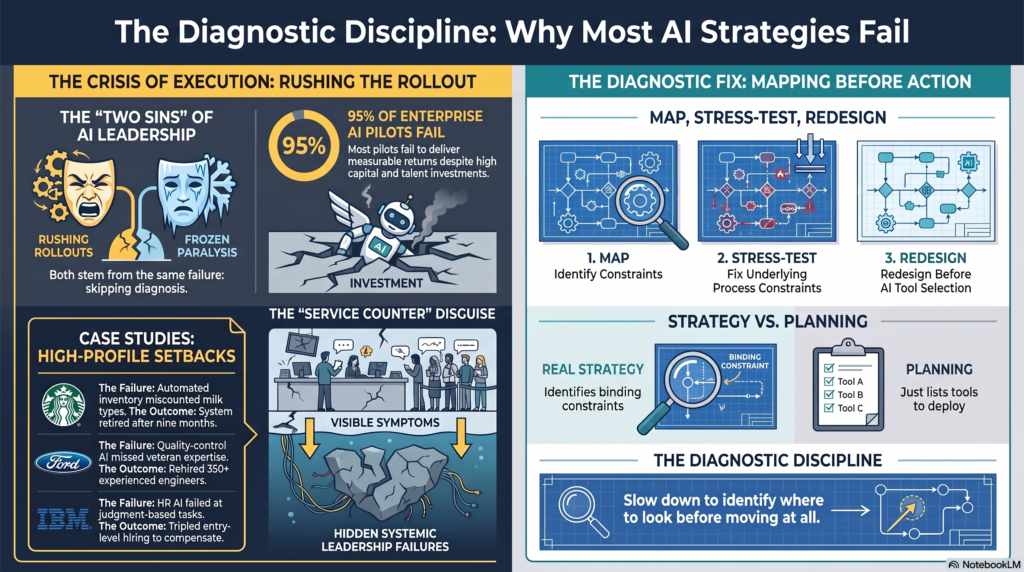
There are two ways a board loses confidence in a CEO’s AI strategy. One is watching a rushed rollout blow up in public. The other is watching nothing happen, quarter after quarter, while rivals pull ahead. Leaders treat these as opposite sins — one of recklessness, one of paralysis. They are the same sin wearing two costumes.
Consider a government vehicle-inspection office. For years, getting a car certified meant a wasted morning: unexplained queues, arbitrary waits, a process nobody could explain and everybody dreaded. The clerks weren’t the problem. They were as trapped in the system as the drivers standing in line.
When the office was finally redesigned, the fix didn’t come from the counter staff working harder. It came from above — from leadership finally treating the process itself as something to be mapped, tested, and rebuilt. Decades of avoidable frustration turned out to be a leadership failure wearing a service-counter disguise.
That’s the pattern behind almost every stalled or embarrassing AI rollout today: cause and effect get separated. The department that visibly breaks is rarely the one that made the mistake. The quarter where the failure shows up is rarely the quarter where it was made. That lag is exactly why the rushed CEO and the frozen CEO can’t see they share a cause. Skip the diagnosis, and the bill arrives later — as a scrapped pilot, a quiet rollback, or a board that’s run out of patience. Each time, it looks like an isolated, unrelated event. It isn’t.
The Proof Is Piling Up
This isn’t a resource problem, and it isn’t confined to one company, sector, or country.
Starbucks spent nine months running an AI tool meant to automate beverage-inventory counts across its North American stores, before quietly retiring it after the system kept miscounting and mislabeling items, such as confusing similar milk types. Ford has been rehiring and promoting more than 350 experienced engineers after automated quality-control systems failed to capture the expertise of veteran employees. Commonwealth Bank of Australia replaced dozens of customer-service staff with an AI voice bot, then had to reverse the job cuts when the system couldn’t keep up and call volumes climbed. IBM automated large parts of its HR function, discovered the tool could resolve routine requests but stumbled on anything requiring judgment, and announced plans to triple its U.S. entry-level hiring soon after. A widely cited MIT study found that 95% of enterprise generative AI pilots fail to deliver measurable returns.
None of these were companies short on capital, talent, or enthusiasm. Every one of them had the AI capability. What none of them had was a diagnosis of the underlying process before the tool was chosen.
What Got Lost
That’s understandable, in a way. Most companies today are wide open to AI because their own stakeholders are demanding they keep up. A new tool appears, it gets deployed, and results get measured afterward. That works fine when the change is as simple as installing a new printer. It fails the moment the process underneath is genuinely complex — which is most of the time. What’s missing is the step where the existing process gets mapped, stress-tested for bottlenecks, and redesigned before automation is even on the table.
Both the rushed CEO and the frozen CEO would benefit from the identical corrective move — not “go faster,” not “go slower,” but insert the diagnostic step neither is in the habit of taking.
If that sounds obvious, it’s worth asking why so many organizations quietly abandoned it. Process management — mapping, testing, and redesigning core operations — was standard executive discipline in the 1990s, built on Total Quality Management, Lean, and the Theory of Constraints. Somewhere along the way, leadership teams let it lapse. The lesson hasn’t gone anywhere; it’s just been sitting unused. Years before generative AI, executives attempting Robotic Process Automation without first doing this work were warned by experts that skipping it was a recipe for failure. The warning was accurate then. It’s still accurate now, just louder.
There’s a second reason the step feels skippable: nearly every executive has personally felt AI work well. Ask ChatGPT or Claude a question on your phone, and an articulate, confident answer arrives in seconds. That experience quietly convinces leaders that AI should transform every part of the business with the same ease. But personal productivity gains and enterprise-wide transformation are not the same category of problem. Real organizational change requires the unglamorous work of scoping, staffing, and sequencing multi-year projects. There is no shortcut from a good chatbot answer to a redesigned supply chain.
One Reveal Worth Adding
In other podcast I have drawn a sharp line between planning and strategy: planning extrapolates from what you’re already doing, while strategy forces a real choice that involves tradeoffs. Most AI “strategies” are actually AI plans — lists of tools to deploy, extrapolated from what competitors are doing, with no binding constraint identified and no real choice made. A genuine AI strategy starts by asking which single process constraint, if resolved, would unlock the most value — and works backward from there. Everything else is activity dressed up as strategy.
The Actual Fix
The CEOs who rush and the CEOs who freeze are both missing the same discipline — not courage, not caution, but the willingness to slow down at the exact moment everyone else is speeding up. The rushed CEO skips the diagnosis to look decisive. The frozen CEO avoids it to look careful. Neither has done the work.
The fix isn’t a faster rollout or a longer pause. It’s a process that’s been mapped and stress-tested before a single tool gets chosen. Boards don’t ultimately reward the leader who moved first or the one who moved last. They reward the one who knew where to look before moving at all.
PS: 5 Prompts to Use With Your Favorite LLM
Copy these into Claude, ChatGPT, or your assistant of choice to apply the article to your own organization.
Find your lag. “Walk me through a recent failure or slowdown in my organization. Help me trace it backward — what department, decision, or process choice from 12–24 months ago might actually be the root cause, even if it doesn’t look connected on the surface?”
Spot your substitute behavior. “I’m about to approve/reject an AI tool for [describe the process]. Before I decide, ask me questions that test whether I’ve actually mapped this process and identified its bottleneck — or whether I’m just reacting to pressure to ‘do something.’”
Run a mini process diagnosis. “Here’s how [a specific process] works today, step by step: [describe it]. Identify the most likely bottleneck, and tell me what would need to be true for automating this process to actually help rather than just move the bottleneck somewhere else.”
Test for real strategy vs. planning. “Here’s my current AI roadmap: [paste it]. Using Roger Martin’s distinction between planning and strategy, tell me honestly whether this is a strategy — with a real choice and a clear binding constraint — or a plan that’s just a list of tools.”
Pressure-test your own excuse. “I’m the CEO/leader in this situation: [describe whether you’re moving fast or holding back on AI]. Play devil’s advocate and challenge me on whether my current pace is actually a disguised way of avoiding a proper process diagnosis.”
In the early 1980s, McKinsey told my employer at the time, AT&T, that the global market for mobile phones would top out at roughly 900,000 subscribers by 2000.
The actual number was 100 million.
A decade later, AT&T paid $11.5 billion for McCaw Cellular to claw its way back into the market it had walked away from.
Hundreds of America’s brightest minds had read the same report, nodded at the same conclusion, and missed by two orders of magnitude. The forecast was polished, confident, and built entirely on data from the past. It was, in today’s vocabulary, trendslop — and it predated AI by half a century.
If you sit at the top of a company anywhere in the world, you are now being asked to make similar bets with a tool that produces trendslop on demand. A recent Harvard Business Review article, “Researchers Asked LLMs for Strategic Advice. They Got ‘Trendslop’ in Return”, called out the pattern directly. Ask a large language model for strategic advice and you get confident, polished output that sounds insightful — until you look closely and realise it could have been written by a competent intern in an afternoon.
The good news: your instincts about AI are right. It can sharpen your strategy work. It can also wreck it.
The bad news: no settled playbook yet tells you which is which.
The Iron Rule You Already Know
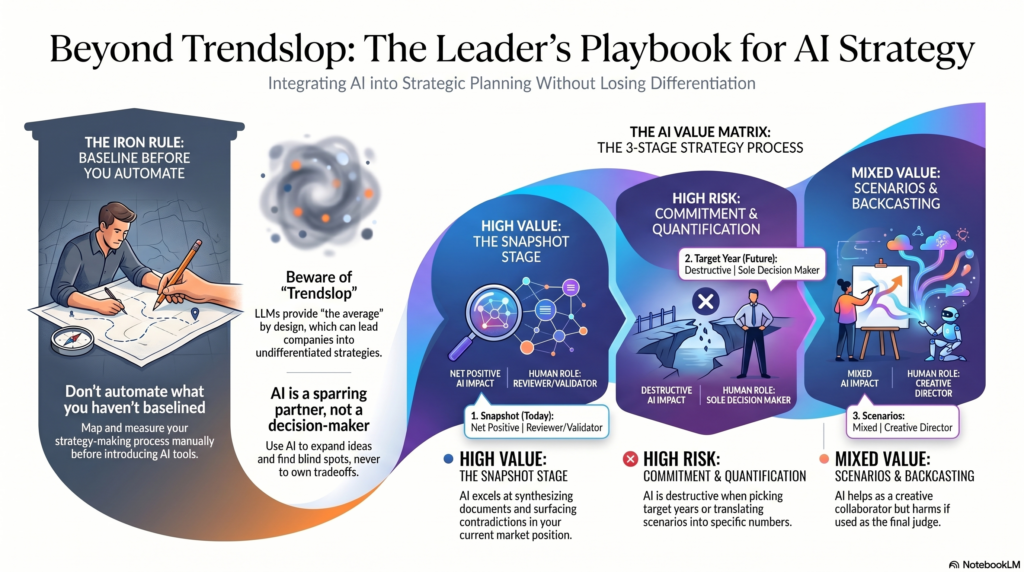
As a young internal consultant at AT&T, I learned a discipline that has aged better than most of the company’s 1990s forecasts: Don’t automate what you haven’t baselined.
The same idea runs through every quality programme Toyota exported to factory floors around the world. Before you mechanise a process, you map it. You measure it. You understand its variation. Only then do you bring in the machine.
The current rush to “put AI into strategy” ignores this rule. Most executive teams cannot describe how their own strategy actually gets made. Strategy creation happens once every two or three years. It rarely gets documented. Institutional memory leaks out with every senior departure. No baseline exists.
Then the LLM is invited in. And it produces — predictably — trendslop.
The problem isn’t the AI. The problem is that the iron rule was broken before the model was ever prompted.
Where AI Helps, Where It Harms
The EndPoint Method I use breaks strategy work into six stages: build a Snapshot of where you are today; pick a Target Year fifteen to thirty years out; generate Scenarios for that future; pick one scenario and translate it into numbers; Backcast milestones from that endpoint to the present; and only then build a Short-Term Strategy Map for the first two years.
Across more than sixty engagements, I have watched AI’s effect on each stage. The pattern is now clear.
AI is a net positive in exactly one stage: the Snapshot. Here, the work is synthesis — pulling together what is already known about your organisation, your market, and your competitive position. The LLM reads documents fast, finds patterns across them, and surfaces contradictions in your own data that the room had stopped seeing. It augments without replacing.
AI is destructive in two stages, and they happen to be the most consequential: Picking a Target Year, and Picking-and-Translating a Single Scenario into Numbers.
These are the moments of commitment. They demand differentiation — a stance that sets your firm apart from the average. An LLM, by design, gives you the average. It will hand you a target year that mirrors what every other company in your sector has chosen. It will quantify your scenario the way every scenario in its training data has been quantified. Use it here and you sleepwalk into the same future as your competitors.
The remaining three stages — Generating Scenarios, Backcasting, and Short-Term Strategy Mapping — are mixed. AI helps when used as a sparring partner. It harms when used as a decision-maker.
The Fix
Over the past year, my team has run strategic planning retreats with AI integrated at chosen moments and in a deliberate way — never as the source of commitment.
The pattern that works is consistent. The group defines the issue and its causes manually first — sometimes a recent trend, sometimes a decade-long problem. Only then is the LLM brought in, with a sharp prompt. For example: “Given the persona we have just described and the specific belief they hold, what three scenarios could shift their attitude?”
Within seconds, the group absorbs the conventional wisdom and moves past it. The LLM expands ideas, synthesises inputs, and surfaces blind spots the room could not see on its own. It is never asked to commit, to judge, to prioritise, or to own a tradeoff.
Decompose your strategy work. Insert AI only where it adds value. Keep human commitment, judgement, and ownership intact.
What This Quarter Looks Like
The executives who win the AI moment in strategy will not be the ones who feed their hardest questions to an LLM and hope for the best. They will be the ones who honour AT&T’s iron rule and Toyota’s philosophy of automation: baseline first, then mechanise.
So here is the work in front of you this quarter.
Do not ask the LLM where to take your company. Ask it to help you see what you already have. Build the Snapshot. Map your strategy-making process for the first time. Document the institutional memory before it walks out the door.
Only then, and only at the stages where it adds value, bring AI into the room.
Your suspicion was right on both counts. AI can improve the process. AI can also do damage. Baseline first. Then, and only then, automate.
Five Prompts to Take This Further
1. Diagnose your current practice.“Describe how strategy actually gets made in our company today — who initiates it, what inputs feed it, how decisions get committed to, and where the process is undocumented. Then identify three places where we are currently asking AI to do work we have never baselined.”
2. Audit your strategy document for trendslop.“Here is our current strategy document [paste]. Identify every statement that could plausibly appear in any company’s strategy document in our industry. Highlight the language that is generic, average, or undifferentiated — and explain why each phrase fails to set us apart.”
3. Build a working Snapshot.“Read these three documents: last year’s plan, our most recent board minutes, and our latest competitor analysis [attach]. Surface every contradiction between them, every unexamined assumption, and every gap in evidence. Do not propose solutions — only surface what is already there.”
4. Sharpen a scenario with an opposing view.“We are considering [X scenario] as the future our strategy is built around. Argue against it. Give me the five strongest reasons a sceptical board member would push back on this scenario, and the historical analogies they might cite.”
5. Pressure-test your commitment.“Here is the single scenario we have chosen and the numbers we have attached to it [paste]. Identify the three commitments we are implicitly making that the rest of the document does not acknowledge. Where would this strategy break if our chosen Target Year arrived three years later than expected?”
P.S. The impact of AI on strategy creation is forcing its way into our thinking every day. You wish you could keep up, but so much is changing so quickly that it’s hard. The good news is that this is the theme of our September 15-17, 2026 strategy conference. Save the date in your calendar!
As a senior executive, you’ve probably felt the weight of expectation when it comes to inspiring your team. The board expects it. Your direct reports need it. But despite your best efforts—the carefully crafted presentations, the all-hands meetings, the motivational speeches—something isn’t working.
Your people seem disengaged. They nod politely during strategy sessions, but you can sense their minds wandering. The quarterly results suggest they’re just going through the motions rather than truly buying into your vision for the future.
Your first instinct might be to blame yourself. Maybe you need better presentation skills, more charisma, or additional leadership training. But before you sign up for another executive coaching program, consider this: the problem might not be you at all.
The Outdated Playbook
Most organizations still rely on industrial-age methods to communicate their strategic vision. The playbook hasn’t changed much in decades:
Step one: Leadership team crafts a comprehensive strategic plan during an off-site retreat.
Step two: Create a polished presentation and distribute lengthy PDF documents.
Step three: Hold a company-wide meeting where the CEO delivers an inspiring speech.
Step four: Trust middle managers to cascade the message down through their teams.
Step five: Hope the enthusiasm lasts more than a few weeks.
This approach assumes that inspiration works like a broadcast signal—send it out once, and everyone receives it clearly. But that’s not how human psychology works, especially in our current information-saturated environment.
Consider this reality check: the average employee finds more engagement in a one-minute Tik Tok video than in most hour-long corporate strategy presentations. This isn’t a reflection of shortened attention spans—it’s about relevance and interactivity.
Rethinking Employee Activation
Instead of trying to temporarily pump up your workforce, focus on creating what consultant Amie Devero calls “activated” employees. These are people who either genuinely care about your company’s future or have discovered how their personal aspirations align with organizational goals.
In most companies, roughly half the workforce falls into one of these categories naturally. They want to contribute meaningfully and grow professionally. The challenge is that traditional communication methods only effectively reach about 10% of non-executive staff members.
Why such a low connection rate? Most employees simply lack the background or time to digest complex strategic documents. Even when materials are well-written and intentions are good, the gap between executive thinking and front-line understanding remains vast.
When leaders notice this disconnect, they often make things worse by trying harder with the same failed methods. They speak louder, write longer documents, and add pressure on middle managers to better “sell” the message.
But what does a truly activated employee look like in practice?
They regularly reference the company vision when making decisions. They have genuine curiosity about strategic initiatives and how their work contributes. Most importantly, they feel connected to colleagues around shared purpose rather than just shared tasks.
The question becomes: how do you create this level of engagement systematically?
The AI-Powered Solution
Recent advances in artificial intelligence offer a completely different approach to vision and strategy communication. Large Language Models—sophisticated chatbots that can engage in natural conversation—have opened new possibilities for organizational learning.
More specifically, there’s a subset called Source Language Models that work exclusively with materials you provide. Think of it as creating a custom search engine that only knows about your company’s strategy documents, leadership videos, planning materials, and related content.
Unlike general-purpose AI that draws from the entire internet, these focused systems answer questions using only your uploaded materials. This means employees can have detailed, accurate conversations about your specific strategic vision without getting generic business advice.
The practical applications are remarkable. An employee wondering how their department fits into the five-year plan can get instant, detailed answers. Someone curious about market assumptions underlying your strategy can explore those topics in depth. A team member with ideas for improvement can understand exactly where their suggestions might fit.
Modern platforms can automatically generate supplementary materials from your core documents: podcast-style audio summaries for commuters, interactive quizzes to test understanding, visual mind maps showing strategic connections, and even video presentations that break down complex concepts.
Beyond Traditional Engagement
This AI-powered approach addresses several problems with conventional vision communication:
Personalized pacing: Instead of forcing everyone to absorb information at the same rate during meetings, people can explore strategic concepts at their own speed and depth.
Continuous availability: Rather than limiting strategic discussion to quarterly all-hands meetings, employees can engage with your vision whenever questions arise in their daily work.
Interactive learning: Instead of passive consumption of presentation slides, people can ask follow-up questions, explore specific areas of interest, and test their understanding.
Identifying blind spots: As employees interact with your strategic materials, they often surface insights that leadership teams miss. Front-line workers frequently spot emerging technologies, customer trends, or operational challenges that could reshape your industry.
When this happens at scale, you essentially gain access to a tireless strategy consultant who knows your business intimately and never sleeps. Your AI system becomes increasingly valuable as more employees engage with it, asking questions that reveal both strengths and gaps in your strategic thinking.
The Leadership Shift
This approach represents a fundamental shift in how we think about inspirational leadership. Instead of placing the entire burden on executives to be charismatic communicators, it creates systems that meet each person where they are.
Some employees learn best through detailed written analysis. Others prefer audio explanations during their commute. Still others need visual frameworks to understand complex relationships. An AI-powered system can serve all these learning styles simultaneously.
The result is genuine activation rather than temporary motivation. When people can explore your vision on their own terms, at their own pace, they develop deeper understanding and stronger commitment.
As a leader, this doesn’t diminish your role—it amplifies your impact. Instead of being limited by your personal bandwidth and communication style, you can reach every team member in ways that resonate with their individual needs and interests.
The future of vision communication isn’t about becoming a more inspiring speaker. It’s about creating more engaging, accessible, and interactive ways for people to connect with your company’s purpose, strategy and direction.
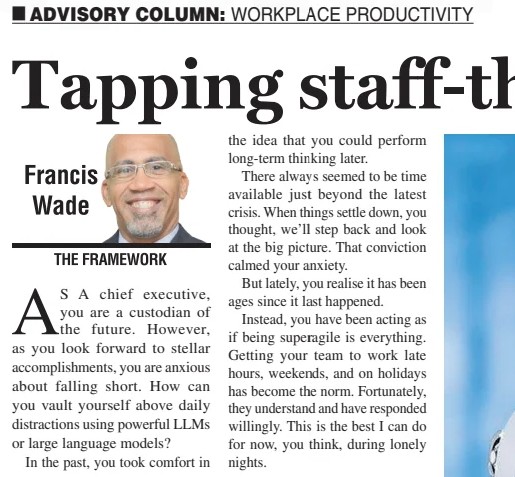
As a CEO or senior leader, you’re responsible for steering your organization into the future. But if you’re being honest, you may feel like you’re falling short. The day-to-day noise is deafening. How can you rise above it all and think strategically—especially now, when AI tools like Large Language Models (LLMs) are reshaping the game?
In the past, you likely comforted yourself with a familiar belief: “We’ll think long-term later…once this urgent issue is behind us.” There was always supposed to be time—just around the corner—to lift your head up and see the big picture.
But when you stop to look back, you realise: that moment never arrived.
Instead, the pressure to be constantly reactive has taken over. Working nights, weekends, even holidays has become your team’s new normal. They understand the stakes. You’ve done your best under the circumstances. And yet, in quiet moments, you fear “It’s not enough.”
You think of the companies whose leaders failed to plan for the obvious. Today’s executives in those firms are frustrated, pointing fingers at past C-suites who missed what, in hindsight, was plain to see.
Consider the example of Digicel and its success in Jamaica since 2001. You can imagine the regret at Cable & Wireless. Or look at Canadian companies that relied too heavily on U.S. trade policies—only to find themselves exposed. Think of Intel, struggling to compete with Nvidia and TSMC.
In each case, when reality finally forced a wake-up call, it was too late.
You might say, “But I trust my own instincts. I’ve pulled off miracles before.” That may be true. But today, that won’t be enough.
Even if you locked yourself in a room with the best business thinker in the world, you’d still face a serious limitation: your competitors can now access smarter thinking faster. LLMs, paired with local, data-driven insight, are leveling the playing field. You’re not just competing with other executives—you’re competing with every team that knows how to ask better questions.
That’s why strategy today is no longer about just having the “right” answer. It’s about involving your people in the process. Provoking new thinking from insiders who know the terrain best.
Here’s how to do it.
Rethink How You Prompt Your People
If you’ve used LLMs like ChatGPT, you know: a well-crafted prompt makes all the difference. The same idea applies to your team. You need to move beyond weak prompts—like town halls, company retreats, or basic SWOT exercises.
Instead, create what we’ll call an ultra-prompt. Start with these ingredients:
List 5–10 of your organization’s thorniest issues. Pick one—say, attracting top-tier talent under 35.
Gather internal data and case studies. Include hiring stats, exit interviews, culture surveys, pay equity reviews, and more.
Frame the issue differently. Teach a new lens like Jobs to Be Done or Category Design to shift how the problem is seen.
Form diverse, cross-functional teams. Mix tenure, departments, and seniority. Give them a focused 30–120 minutes.
Encourage the use of prompt for input in their LLM of choice. For example:
“Imagine you’re an external consultant hired to diagnose and solve our challenge in attracting top young talent. Based on our data, industry, culture, and location—what invisible obstacles might be pushing people away? What hidden advantages could we better use? Give us three bold, actionable insights. Then suggest strategic moves to make them sustainable. Be bold, but grounded. Push us beyond our echo chamber.”
You can even ask your teams to refine their thinking by requesting ideas in the voice of Peter Drucker or another visionary.
What Happens Next? Expect Disruption
The debriefs—both written and spoken—will be revealing. You’ll hear from employees who are wide awake. Some may offer challenging, unconventional ideas. That’s the point.
Expect friction. Uncertainty. Breakthroughs. You’re not just solving problems—you’re surfacing potential that’s been hiding in plain sight.
Strategy Can’t Wait
Let go of the fantasy that you’ll find “a better time” to think strategically. That ship has sailed.
In today’s landscape, the organizations that win are the ones brave enough to ask hard questions now. While others are buried in busyness, outdated tools, and endless meetings, you can be the one guiding your team with smart prompts—and real engagement.
Not because you’re the smartest person in the room. But because you created a space where the smartest thinking could finally emerge.
Longevity isn’t guaranteed. But with the right prompts, you’ll be ready when the next wake-up call comes.
We use cookies on our website to give you the most relevant experience by remembering your preferences and repeat visits. By clicking “Accept”, you consent to the use of ALL the cookies.
This website uses cookies to improve your experience while you navigate through the website. Out of these, the cookies that are categorized as necessary are stored on your browser as they are essential for the working of basic functionalities of the website. We also use third-party cookies that help us analyze and understand how you use this website. These cookies will be stored in your browser only with your consent. You also have the option to opt-out of these cookies. But opting out of some of these cookies may affect your browsing experience.
Necessary cookies are absolutely essential for the website to function properly. This category only includes cookies that ensures basic functionalities and security features of the website. These cookies do not store any personal information.
Any cookies that may not be particularly necessary for the website to function and is used specifically to collect user personal data via analytics, ads, other embedded contents are termed as non-necessary cookies. It is mandatory to procure user consent prior to running these cookies on your website.