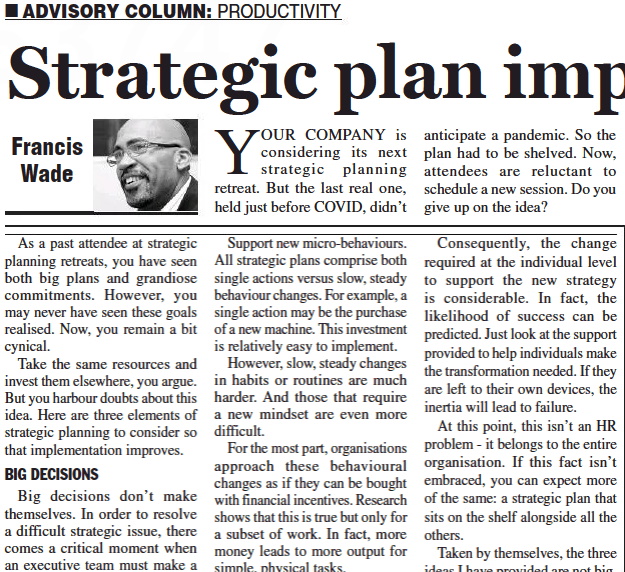
Strategic Plan Implementation Reset

Your company is considering its next strategic planning retreat. But the last real one, held just before COVID, didn’t anticipate a pandemic. So, the plan had to be shelved. Now, attendees are reluctant to schedule a new session. Do you give up on the idea?

Check out my past column on strategy and productivity at https://blog.fwconsulting.com

This is a public episode. If you’d like to discuss this with other subscribers or get access to bonus episodes, visit longtermstrategy.substack.com/subscribe

Ep 18 – Should We Design Peak Moments of Happiness?

COVID disrupted many of our regular routines, some of which have not recovered. In particular, if you work from home, you may notice that seeing the same people every day and working in the same space is quite convenient. But it’s also predictable – in the bad way. Many of us have lost a certain thrill that comes from being in close proximity to others and the surprises which go with it. They don’t invite us out as often, and we don’t meet up as frequently…outside of Zoom.

In a way, we don’t have as many new things to look forward to. Not surprisingly, this has an impact on our daily happiness. Having something – anything – to look forward to has an impact on our happiness.

Is there a sustainable solution to this dilemma?

I’m Francis Wade and join me and our special guest, Laura Vanderkam as we tackle this challenge.

Get full access to Francis A. Wade at 2timelabs.substack.com/subscribe

On Boring Your Staff with Small Goals

You’re a corporate leader who wants to inspire your organization. But you aren’t naturally charismatic, nor are you famous. Is there a way to energize and motivate stakeholders who must play a part in the transformation you envision?

A startling number of CEOs forget what it was like to be inspired in a manner that leads to hard work. They think of themselves as unicorns, born to lead. It’s a mystery to them why everyone doesn’t wake up with the energy they have, excited about the chance to accomplish great things.

Some give up. Their secret sauce cannot be replicated, so they don’t try. The best they can do is threaten, trick, or bribe staff into compliance. That’s “the only way to treat these people”, they convince themselves.

However, you may be different. Inspiring others is a leadership skill few possess, but you should be interested in learning what it takes. One of the critical elements is BHAGs (Big Hairy Audacious Goals), as articulated by Jim Collins and Jerry Porras. How can you use them to lift workers to better performance?

  1. People Want More Than Business as Usual

The easiest way to disengage staff is to send a signal that “there’s no need to pay attention.” This probably isn’t what you intend. Instead, you want board members, executives, managers, and employees to be sitting on their edge of their seats. In this mode, they bring their best ideas, maximum energy, and highest creativity to every task they do.

Recently, COVID-related emergencies have infused organizations with a kind of fake vitality. However, as the pandemic wanes, everyday operations resume. People are drifting back to ordinary standards.

If, as a leader, you don’t replace this temporary intensity with something more durable, expect your staff to be disappointed. They want to be like Apple and Netflix – companies which are moving forward. They enjoy using their products or services. Plus, the people who work for them are proud.

Meanwhile, some of your employees refuse to wear company uniforms in public.

But don’t see this as a rebuke. It’s a natural regression to dull, humdrum, mundane, corporate life. Daily work becomes a vision-less routine if you fail to disrupt it with your BHAG.

  1. People Want to Believe

However, you must be careful. Some leaders specialize in inspiring themselves…in isolation. Others may inspire a few colleagues – the ones they work with directly. But this should be an organization-wide game.

To communicate, lazy executive teams try to get by with traditional vision and mission statements. Unfortunately, times have changed. The usual saccharine bromides no longer work – they are just too vague. If your statements can be swapped with that of another organization without anyone noticing, consider them to be stale.

Instead, you need far more details to make your plan credible and worthy of an emotional investment. Skeptical staff need to see metrics and milestones stretched out over several years. They want a concrete bridge between today and the final outcome. Something they can trust. After all, their future careers are on the line. Why should they bet on your company? And your vision?

  1. People Want to Act Now

Ever had a conversation with a child who wants to become a surgeon? They are probably two decades or more away from realizing their dream.

But one benefit of their public commitment is that there are clear and immediate expectations. For example, wherever they are on their journey, academic excellence is required. “Are you studying hard right now?” This clarity orients the child towards daily priorities and choices.

Contrast this with the corporate world, where the opposite tends to happen. A CEO announces a BHAG. Then employees go back to whatever they were doing before, safely knowing that it’s the path of least resistance.

The fact is, no-one translates the vision into everyday action. Between retreats, the BHAG flops.

The solution? Craft game-changing projects. Then, enlist sponsors and participants who understand their importance and believe in taking action.

They’ll probably need to set aside other projects and delay competing commitments. But this is exactly what you want. If this is important, other efforts must cease so that you can focus people’s attention.

Fail to do this and you’ll be dismayed to see people going through routines which should have been eliminated. They’ll waste time on email messages and meetings simply because of inertia. You’ll fail to make progress as people sit on the sidelines…bored…waiting for something interesting to happen.

Instead, gather your leaders together and lead from the front, with BHAGs which inspire everyone. You’ll tap into discretionary effort which has remained dormant and assure a sustainable future for your organization.

Stop Boring Your Staff with Small Goals

You’re a corporate leader who wants to inspire your organization. But you aren’t naturally charismatic, nor are you famous. Is there a way to energize and motivate stakeholders who must play a part in the transformation you envision?

A startling number of CEOs forget what it was like to be inspired in a manner that leads to hard work. They think of themselves as unicorns, born to lead. It’s a mystery to them why everyone doesn’t wake up with the energy they have, excited about the chance to accomplish great things.

Some give up. Their secret sauce cannot be replicated, so they don’t try. The best they can do is threaten, trick, or bribe staff into compliance. That’s “the only way to treat these people”, they convince themselves. More

Find more articles on this topic at https://blog.fwconsulting.com


This is a public episode. If you’d like to discuss this with other subscribers or get access to bonus episodes, visit longtermstrategy.substack.com/subscribe

Ep 17 – Controversy. Can You Ever Stop Using Contexts for Your Tasks?

You have tried using contexts for your tasks in the past, perhaps following the advice of GTD. The idea was a sound one, and made a positive contribution. But as time went on, the technique seemed to lose its potency. The question is “Why?”

And did this experience imply that you needed to stop using them altogether? This may not make sense, because when you applied contexts to a raw list of todos, it made things better. So is the idea a bad one?

In this solo episode we take a deep dive into the research behind contexts done by 2Time Labs. I’ll share my latest thinking which shows why contexts are unavoidable, and why you need to move way past the ones suggested by Getting Things Done published in 2001.

Get full access to Francis A. Wade at 2timelabs.substack.com/subscribe

Ep 16 – Is Motion the Latest, Greatest Auto-Scheduler?

If you’re interested in using online calendars you may have seen ads for the auto-scheduler called Motion. You have probably wondered what it might be like to use it, but you don’t have the time or bandwidth for a proper test.

In this episode with Dr. Melanie Wilson we share the results of our actual firsthand tests for you. We both have spent years using auto-schedulers so we have a few insights you won’t hear elsewhere. Tune in to find out what we discovered and you could save some time, stress and even money.

Clarification – In this episode we stated the Motion does not have time maps, a SkedPal invention. It doesn’t, but their version is similar in functionality – just not as robust.

Get full access to Francis A. Wade at 2timelabs.substack.com/subscribe

Email is not a Nuisance – It’s Your Job

You are forced to deal with email every single day, most of it arriving at odd moments. At the same time, you need to be effective, but it seems that there’s invariably a slew of messages getting in the way. You want the problem to go away so that you can just focus on doing your job. This is a common sentiment, but is this frame of mind a help or hindrance?

To see other articles and columns, see  https://blog.fwconsulting.com

This is a public episode. If you’d like to discuss this with other subscribers or get access to bonus episodes, visit longtermstrategy.substack.com/subscribe

Email: Not a Nuisance, It’s Your Job

You are forced to deal with email every single day, most of it arriving at odd moments. At the same time, you need to be effective, but it seems that there’s invariably a slew of messages getting in the way. You want the problem to go away so that you can just focus on doing your job. This is a common sentiment, but is this frame of mind a help or hindrance?

It’s fashionable nowadays to complain about email. Why? There are always too many messages. They arrive at the wrong time, and important ones get buried by all the others.

But you’re not alone: everyone you know appears to be caught in the same trap. You derive some comfort knowing that some are even worse than you.

The only people who seem to be on top are the super-responsive. Apparently, they have nothing else to do each day but reply to email…within moments. But are they being effective? If they can reply to you immediately, are they actually doing any useful work?

You know you don’t want to become like them, but what are your alternatives? Here are some ideas you can use to be effective.

1- Email is not going anywhere

Whether you call it acceptance or resignation, your fate in using this technology is sealed. Asynchronous, digital messaging is a permanent fact of professional life. In other words, we aren’t going back to the days of paper letters, faxes, or telegrams. And time-consuming meetings, phone calls or Zoom won’t ever become a replacement.

So unless you’re retiring soon, take a deep breath and “hug up” this reality. And while you’re at it, stop complaining about your inbox being flooded. The fact is that email incompetence is afflicting almost everyone. The only ones exempt? The few who receive a trickle of messages each day…like less than 25.

Don’t aspire to be like them. Take responsibility now and in the future.

2- Your suffering is avoidable

Think back to the days when you were among the “exempt”. You didn’t have a problem. In fact, you were happy to be sent email. It showed that you mattered to other employees and friends.

However, your joy was short-lived. When 25 incoming daily messages turned into 150, you hit a threshold: your old techniques stopped working. For example, if you used to check email in the quiet intervals between tasks, meetings or projects, you probably saw this shortcut become impossible.

Instead, evening and weekend email became the norm. Plus, others began to complain that you are not returning messages fast enough. Your “time management” skills were questioned.

While this state of affairs is awful, there is an answer.

You need a different, new set of practices to address a high volume of email. Furthermore, this approach needs to scale so that you can handle double or triple the volume you receive today. Why? Not only is email unavoidable, its use is growing.

3- Instant Repair

The complex blend of habits and technologies we use means that fixing email is like plugging the leaks on a rickety boat. There are a vast number of things which can go wrong, all of which add to the overall burden. Tackling them all is beyond the scope of this article, but here is one basic concept. Set aside high-quality time for email by blocking time each day in your calendar.

With this technique, email transforms from a thankless chore to a prime activity. Here, you can give your full and undivided attention. Consider it to be an appointment you simply cannot skip. A professional requirement. For example, a surgeon would never skip washing her hands before an operation.

Why the high priority? The fact is, each email requires you to make a decision and this takes energy. Add in the fact that you must quickly switch mental contexts from one message to the next, and the challenge multiplies.

It’s as if each day’s most important choices are distilled into a single sprint. If you try to make them piecemeal, prepare to see your inbox turn into a bottomless pit of unmade decisions.

Setting time aside each day is the only way to ensure that the molehill doesn’t turn into a mountain. Unfortunately, it only takes a few days of neglect to turn a peaceful inbox into a ticking time-bomb.

The best method is not to respond like a firefighter. Instead, treat email as a priority that deserves its own time-slot, and mindset. Use a fresh head so that you can make a series of difficult, but high-quality snap-decisions.

Soon, it will become the heart of your job, rather than a nuisance. And you will be effective.

Francis Wade is the author of Perfect Time-Based Productivity, a keynote speaker and a management consultant. To search his prior columns on productivity, strategy, engagement and business processes, send email to columns@fwconsulting.com.

Is Your Company being Led By a Great Strategist?

Each day you go into the office, you want to be inspired by your work. Elevated by what your organization can accomplish. But if that’s not your daily experience, does the quality of strategic leadership have something to do with it?

Check out my prior columns at https://blog.fwconsulting.com

This is a public episode. If you’d like to discuss this with other subscribers or get access to bonus episodes, visit longtermstrategy.substack.com/subscribe

Is Your Company Being Led by a Great Strategist?

Each day you go into the office, you want to be inspired by your work. Elevated by what your organization can accomplish. But if that’s not your daily experience, does the quality of strategic leadership have something to do with it?

Perhaps you have seen the stories of companies led by executives with breathtaking strategies. These top teams produce game-changing innovations which revolutionize industries. Millions of lives are transformed. The likes of Facebook and Netflix displace also-rans who look stale by comparison, capturing hearts and minds in every corner of the world.

But when you compare what happens in these model organizations with your own, you see a big gap. Are you making an unfair contrast? Are the elements you focus on the right ones to examine? What are the naked truths you wish you could explain to your leaders if you had the chance?

  1. Bold Vision

COVID has led many CEO’s to limit the scope of what they say they want to achieve. Times are hard and uncertain, they admit, and things are changing too fast to think about big goals.

All they have is energy for survival. A vision would be a distraction.

Unfortunately, research shows they are likely to fail. Creating Big Hairy Audacious Goals (BHAGs) is, according to Jim Collins and Jerry Porras of Built to Last fame, essential. Their comparison between companies that use BHAGs versus those which don’t is stark.

However, this doesn’t mean you should throw together yet another vision statement. In fact, these pronouncements can damage productivity if they are vague, undated and insulting to the average person’s intelligence. When employees deduce a lack of seriousness, such declarations destroy motivation.

Instead of nebulous promises to be “world class”, create the kind of vision that paints a clear picture of a single destination. This means it must have a date, and an unequivocal set of target metrics, at minimum.

  1. Feasible Pathway

BHAGs are an essential part of great strategies, but in 2022, they aren’t enough. We have become more immune to aspirational statements than we were in 1994 when Collins/Porras published their book. Why? Oftentimes they include little more than wishful thinking.

The way to bring corporate dreams into existence is to go deeper in the planning stages. How? Craft a credible pathway between today’s reality and the final destination.

This is no easy feat to accomplish. It takes a small team an intense effort to lay out a plan that covers 15-30 years. It gets complicated: within each time period, certain financial and operational milestones must be hit.

While there are projects introduced during this planning horizon that drive the numbers, these should be realistic. In fact, it pays to be conservative.

This powerful exercise forces teams to confront realities that otherwise would be ignored. For example, a client’s strategy called for entering Latin America in a big way. The price? Moving the company’s headquarters to Miami.

This was too heavy a tax to pay and the plan was moderated.

Another client required the acquisition of competitors. But the firm had never undertaken such an activity and would need to hire expensive specialists. It shelved the idea.

Weak strategists leave such details to others. To save face, they pretend to buy-in, which dooms the effort to failure.

  1. Customer Obsession

Who would think that Carnival revellers would pay more for amenities such as mobile bathrooms, cool-down mist and makeup facilities? Tribe Carnival from Trinidad and Tobago has introduced a slew of innovations like these ever since its inception. Over time, they have produced exponential growth for the business, even though it charges a premium.

In a similar manner, clients of JMMB swear by a comparable approach to innovation in its investment operations. Like Tribe, the company has a relentless focus on the customer that leads it to do things other institutions scoff at.

From a strategic point of view, few companies understand their customers well enough to innovate around their deepest unmet needs. Such in-depth study is simply too hard and expensive to undertake.

As such, they end up following the lead of competitors like Tribe and JMMB. But this is the coward’s approach to innovation…to copy what others are doing after it’s been proven to work.

If your company is being led by a strong strategist, expect to see a struggle to capture customers’ unspoken sentiments. Once these are defined, they should be driving every new product and process development. If no such link exists, the strategy is likely to be ordinary.

This list of three activities great strategists undertake is not exhaustive, but it is essential. Use it to judge how your company is being led (not just managed) and to distinguish if today’s actions are inspired by more than mere survival.