You’re a productivity AND technology enthusiast which means that you are managing lots of inboxes. Each time you sign up for a new one, they give you another.
But is that a good thing? Or just another loose end you need to account for in your weekly review?
If it’s the latter, then why? In this episode we tackle the problem of Capture Points – physical and digital places where potential tasks are sitting…waiting. We’ll talk about your need to handle each and every one of them…or else. That is, if you hope to develop a flawless reputation for being on top of all the stuff people send your way, wanting a response.
Join me on this solo episode as we explore this challenge that affects every single knowledge worker in the entire world. It’s a continuation of Episode 21 on Capturing.
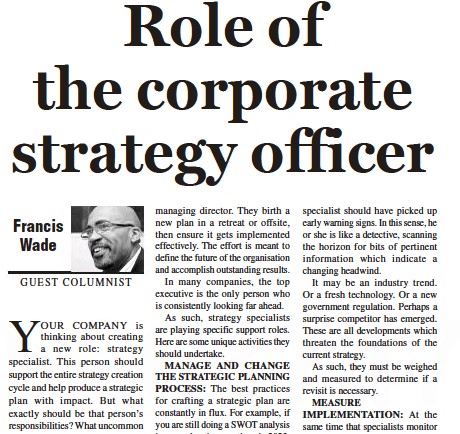
Your company is thinking about creating a new role: strategy specialist. This person should support the entire strategy creation cycle and help produce a strategic plan with impact. But what exactly should be that person’s responsibilities? What uncommon value should they add?
This is a public episode. If you’d like to discuss this with other subscribers or get access to bonus episodes, visit longtermstrategy.substack.com/subscribe
Your company is thinking about creating a new role: strategy specialist. This person should support the entire strategy creation cycle and help produce a strategic plan with impact. But what exactly should be that person’s responsibilities? What uncommon value should they add?
The challenge of filling this position is unique. Why? Strategy is the main job of the CEO or MD. They birth a new plan in a retreat or offsite, then ensure it gets implemented effectively. The effort is meant to define the future of the organization and accomplish outstanding results.
In many companies, the top executive is the only person who is consistently looking far ahead.
As such, strategy specialists are playing specific support roles. Here are some unique activities they should undertake.
Manage and Change the Strategic Planning Process
The best practices for crafting a strategic plan are constantly in flux. For example, if you are still doing a SWOT analysis in your planning meetings in 2023, it’s a sign of outdated thinking.
The most qualified person to manage and update the strategic planning process in your company could be the strategy specialist. They can do the research needed to uncover improvements and test fresh technology. This keeps the process running efficiently, engaging participants along the way.
The truth is, it’s quite hard to create a great strategic plan with a bad process. Some may think it’s a matter of personality, but I differ. While a “strong” leader can make a difference, this is a group effort.
A strategy specialist recognizes this fact and knows that a top quality plan needs a wide range of employees to implement them. What holds them together is a well-defined process and skilled facilitation.
Craft a Special Role During Implementation
When the planning cycle is over and implementation has begun, a strategy specialist needs to be wary of picking up the role of de facto project manager of “strategic initiatives.”
Instead, leave that role to the Project or Programme Management Office – PMO. This is, after all, their area of expertise. Alternately, focus on feeding the executive team with critical updates from outside. Here’s why it’s important.
Once a strategic plan has been completed, it’s not like adding another unit to a 1,000 home housing scheme. A carbon copy. Instead, it represents a compilation of brand new thinking.
As such, each strategic plan is built with a number of untested hypotheses, which themselves rest on a foundation of assumptions.
No-one can know for sure whether the hypotheses and assumptions are correct. But the strategy specialist must track whether they hold up as life unfolds.
In other words, long before an executive detects that there’s a huge threat to the current strategy, the specialist should have picked up early warning signs. In this sense, he/she is like a detective, scanning the horizon for bits of pertinent information which indicate a changing headwind.
It may be an industry trend. Or a fresh technology. Or a new government regulation. Perhaps a surprise competitor has emerged. These are all developments which threaten the foundations of the current strategy.
As such, they must be weighed and measured to determine if a revisit is necessary.
Measure Implementation
At the same time specialists monitor the external world, they should ensure that the plan is taking root in the organization.
Most companies have past horror stories about strategic plans which were crafted, and sounded good on paper, but never reached implementation.
There are a number of pitfalls which can occur. Some have to do with a lack of accountability. There are difficult, feedback conversations which just don’t take place.
Part of the reason lies with a manager’s missing skills. But he/she also lacks data.
I recommend you use the Balanced Scorecard to measure how well your strategic plan is being implemented. It can also be used to test the assumptions and hypotheses within the plan.
In both cases, the company’s leaders can see at a glance whether implementation is actually taking place. But are they required to watch the numbers this closely?
Absolutely. Every single strategic plan is intended to move the needle in an organization. This change occurs at the expense of prior habits and priorities. The battle to make these changes is real.
The specialist ensures that this progress is being made. They also raise a flag when not enough is happening to ensure success.
In summary, the strategy specialist role is an unusual one that most organizations have not identified clearly. However, every serious organization must perform these functions. Even if they are all conducted by the CEO, they should never be allowed to fall through the cracks.
This is a public episode. If you’d like to discuss this with other subscribers or get access to bonus episodes, visit longtermstrategy.substack.com/subscribe
So you’re a career person who has a family…..AND you want to return to school. But in your mind you can’t see how to reconcile the image you have of student life with your current obligations. After all, you have a job, a family, a commitment to your wellbeing, a spiritual life, friends, you belong to a community…all these things are not on the typical college students’ agenda.
In fact, most students seem to put these things on hold…on ice…while they focus everything on their studies. You cannot do that, to say the least.
Is there a way to have it all? You do know that people have done this before…you’re not the first. So there must be a way that can increase your odds of success.
But what are they?
Tune into this episode to hear from me and my special guest, Emily Cordwell, as we solve this challenging problem together.
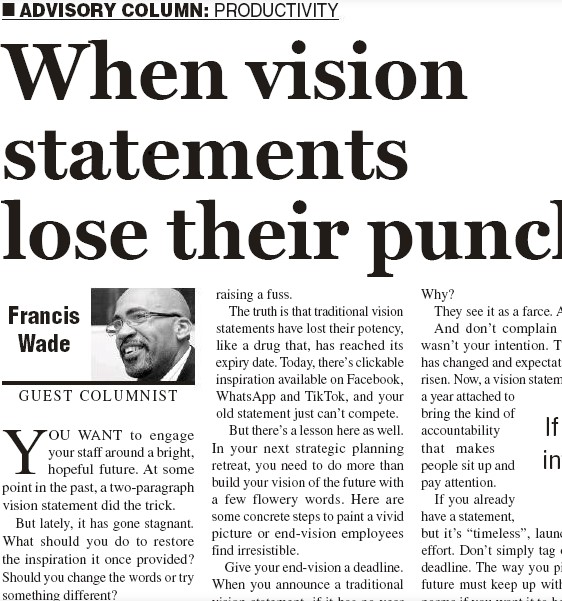
You want to engage your staff around a bright, hopeful future. At some point in the past, a two-paragraph vision statement did the trick. But lately, it’s gone stagnant. What should you do to restore the inspiration it once provided? Should you change the words, or try something different?
You aren’t alone. Most companies have vague statements which sound a lot like each other. With phrases such as integrity and world-class being thrown around, you could probably swap your statement with another company’s without anyone raising a fuss.
The truth is that traditional vision statements have lost their potency, like a drug which has reached its expiry date. Today, there’s clickable inspiration available on Facebook, WhatsApp and TikTok, and your old statement just can’t compete.
But there’s a lesson here as well. In your next strategic planning retreat, you need to do more than build your vision of the future with a few flowery words. Here are some concrete steps to paint a vivid picture or end-vision employees find irresistible.
Give Your End-Vision a Deadline
When you announce a traditional vision statement, if it has no year attached to it, folks in your audience do something interesting. Some believe it will be reached within a year, at most. Others assume 100 years. And if you leave this discrepancy in place, you force staff to eventually ignore it altogether. Why?
They see it as a farce. A con job.
And don’t complain that this wasn’t your intention. The world has changed and expectations have risen. Now, a vision statement needs a year attached to bring the kind of accountability which makes people sit up and pay attention.
If you already have a statement, but it’s “timeless”, launch a new effort. Don’t simply tag on a cool deadline. The way you picture the future must keep up with modern norms if you want it to be noticed.
A Vision Needs to Be Both Quantitative and Qualitative
Executives often make the mistake of believing that staff are motivated by financial results the way they are. Why? Most leaders’ rise up the ranks is a function of their ability to impact the bottom-line. Consequently, when they join the C-Suite, they are fluent in a certain language: the drivers of shareholder value.
However, employees aren’t interested as much.
Instead, a vision must be described in terms that do more than benefit the wealthiest 1%. Today, staff want to make a difference in the work they do and smart leaders develop empathy for this fact.
As such, the best executives describe holistic “visions” in detail. What do they look like? For a particular target year far off in the future, both quantitative and qualitative terms are used. They include as many as 20-40 descriptors and metrics. Together, these paint a rich picture of an end-game that pulls everyone in.
A Vision Must Include ESG Goals
At the moment, Environmental, Social and Governance (ESG) goal-setting is in its infancy. For most companies, it’s a response to investors’ complaints.
As such, organizations are adding a layer of ESG tactics on top of their profit motives.
But most of these efforts are reactive and will miss the boat completely. Why? The ESG movement is actually a revolt against short-termism.
How did it come about? By focusing only on 5-year results, corporate leaders forced organizations to be profit-driven only. As such, other factors and impacts were overlooked.
It’s an easy error to make. For example, many international companies doing business in Jamaica have ignored their surrounding communities. That is until their executives have to be airlifted and escorted from the compound in the middle of a violent strike.
But there’s a solution. Take your company through the process of developing a 15-30 year vision along with a strategy to accomplish it. This will return the balance. Why? When you plan far into the future, you are forced to consider all salient factors.
However, if you try to squeeze ESG concerns into your five-year plan, prepare for your staff to decry its stupidity. They may not complain openly. But their reaction will be to seek inspiration elsewhere, where they can find some authenticity, e.g. church or social media.
Not that this is easy. Big picture, long-term engagement is not taught in business schools.
But it can be learned and coached into existence. And it can be programmed into your business by following a sound long-term strategic planning process.
The world is approaching a time when only holistic visions, which are big, realistic and balanced, will gain respect. Investors have begun to notice and so have employees. Don’t let short-termism ruin your leadership.
You want to engage your staff around a bright, hopeful future. At some point in the past, a two-paragraph vision statement did the trick. But lately, it’s gone stagnant. What should you do to restore the inspiration it once provided? Should you change the words, or try something different?
This is a public episode. If you’d like to discuss this with other subscribers or get access to bonus episodes, visit longtermstrategy.substack.com/subscribe
In your company’s strategic planning activities, you hope to make more than incremental improvements. Instead, your team dreams of brilliant decisions and breakthrough results. But are these a matter of luck? While fortune plays a role, Digicel’s introduction to the mobile telephony market is an example of a new competency: “category design.”
Christopher Lochhead would be proud of Digicel. He belongs to a cohort of content creators who call themselves the “Category Pirates.”
This is a public episode. If you’d like to discuss this with other subscribers or get access to bonus episodes, visit longtermstrategy.substack.com/subscribe
We use cookies on our website to give you the most relevant experience by remembering your preferences and repeat visits. By clicking “Accept”, you consent to the use of ALL the cookies.
This website uses cookies to improve your experience while you navigate through the website. Out of these, the cookies that are categorized as necessary are stored on your browser as they are essential for the working of basic functionalities of the website. We also use third-party cookies that help us analyze and understand how you use this website. These cookies will be stored in your browser only with your consent. You also have the option to opt-out of these cookies. But opting out of some of these cookies may affect your browsing experience.
Necessary cookies are absolutely essential for the website to function properly. This category only includes cookies that ensures basic functionalities and security features of the website. These cookies do not store any personal information.
Any cookies that may not be particularly necessary for the website to function and is used specifically to collect user personal data via analytics, ads, other embedded contents are termed as non-necessary cookies. It is mandatory to procure user consent prior to running these cookies on your website.