
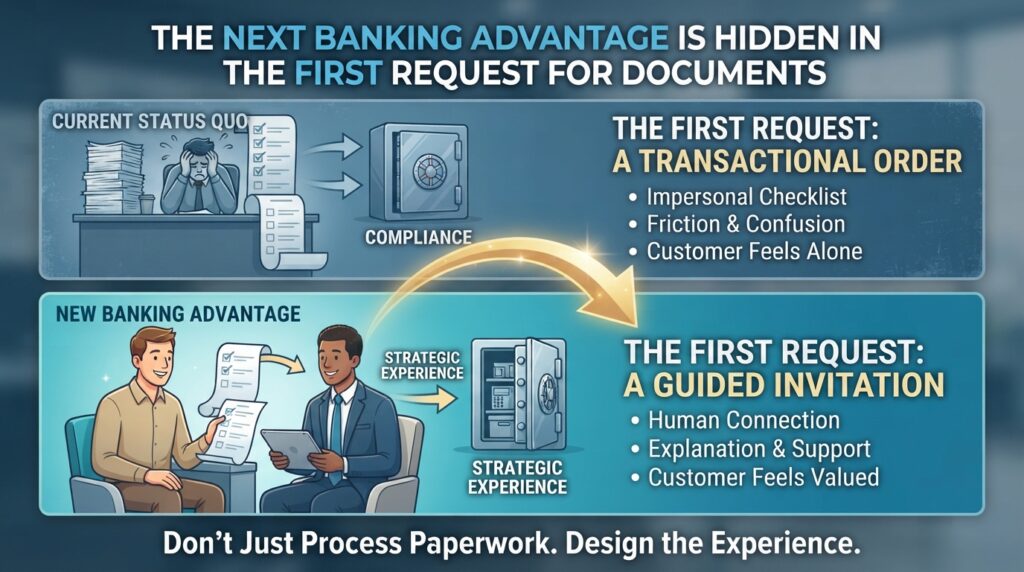
The Next Banking Advantage Is Hidden in the First Request for Documents

Think of a call you have taken more than once. Someone you respect, perhaps a former colleague, a relative or a friend who has always paid on time, is describing an afternoon at your bank that went badly. They wanted to move some money, open an account or make a routine withdrawal. They were handed a checklist, they brought everything on it, and then the checklist grew.

You listen, you sympathize, and then you say what bankers everywhere say. Anti-money-laundering and know-your-customer rules, set by the central bank or another financial authority, allow no exceptions, so the conversation ends there. Your hands are tied.

Or are they?

THE LOOP YOUR CUSTOMERS KNOW

The people who meet this loop most often are the ones without a private banker or adviser to absorb the friction for them. They arrive at a bank for something they believe is simple and submit exactly what they were told to submit. Each round of paperwork produces a new request, and each new request asks for something harder to find than the one before. Some of the documents are decades old, some sit in other institutions, and some no longer exist.

Eventually the customer quits, tired and relieved in equal measure. They find another way to manage that is far from ideal but less painful, and they tell friends and family the whole story. Prospective customers hear it long before they walk through your door.

I know this from the customer’s side. A financial institution once asked me for the original of a document that was forty years old, the kind most people have lost or never kept. No one had asked me for it before, and I was lucky enough to have it. I had also been promised the process would be easy, yet a basic withdrawal still took five confusing forms and a trip to the branch. I kept wondering what happens to the customers who do not have the document.

A DEFENSE THAT IS HALF TRUE

Banks have settled on a standard defense: the rule is out of our hands. It is half true. The rule fixes what must be verified. It says nothing about how a customer is prepared for the request, guided through it or supported when something goes wrong.

In meetings you will hear the same five lines: we have no choice, we cannot take chances, our hands are tied, we have bigger priorities, and customers just have to deal with it. Each one treats the customer’s experience as weather, something that simply happens.

Most institutions have merged the two questions into one. They measure the transaction, such as turnaround time and completed files, and treat everything the customer felt as an unfortunate by-product. In many institutions compliance owns the rule, operations owns the form and nobody owns how the customer feels.

TWO LAYERS, ONE ENCOUNTER

I find it useful to split the encounter into two layers, a distinction that owes a debt to Joe Pine’s work on the experience economy. The transaction layer holds the requests, promises, forms and documents. The experience layer holds how the customer feels at each of those points, and whether anyone is managing it.

Take the very first request for information, usually a templated email. It is accurate, it satisfies the transaction layer and the employee who sent it did the job. But the person reading it is alone, with no one on the line to explain the reasons, answer questions or handle the disappointment. A message that was correct on paper lands hard in the experience layer.

WHAT MEDICINE WORKED OUT

Doctors face a harsher version of your problem every day. They cannot change a diagnosis, yet medicine treats the way a diagnosis is delivered as a design problem in its own right.

Medicine also knows what failure looks like. According to news reports, a 78-year-old patient in intensive care in California was told by a doctor on a video screen, mounted on a remote-controlled machine, that his lungs were failing and comfort care was the only option. His family described the exchange as impersonal and devastating, and he died the next day. The clinical message may have been unavoidable. The method of delivery added to the distress.

Its successes are just as instructive. SPIKES, a protocol taught to clinicians for breaking bad news, structures the conversation into six steps. One of them is obtaining the patient’s invitation to share information, which is a long way from handing someone a list of demands. Ariadne Labs built a program around serious-illness conversations, with guides, training and implementation support for the institutions that adopt it, and it reports that about 80 percent of patients found those conversations worthwhile. The illness stays exactly as it is. What changes is how the patient meets it.

Controlled evidence exists too. In a randomized trial, 30 oncologists took a two-day communication workshop and researchers surveyed 1,192 of their patients. Patients of the trained oncologists reported lower depression scores at follow-up than those of the control group. Their satisfaction with communication style did not improve significantly, a result I find useful because it warns against judging an intervention by a satisfaction score alone.

I am not suggesting that a KYC request resembles a terminal diagnosis, and I do not know whether medicine’s methods carry over to banking. That is a hypothesis waiting for a test. The principle, though, travels well: a fixed requirement can be delivered in very different ways.

FIXES THAT MISS

Well-meaning fixes tend to miss. A new app or portal that asks for the same documents is the same demand in a modern wrapper. Courtesy training without the ability to explain the process leaves staff apologizing for something they cannot clarify. Longer checklists and FAQs raise the volume of information without raising understanding. Satisfaction surveys record frustration without turning it into a test at the point where it occurs. A single script for every employee ignores that a first-time customer and a seasoned one need very different explanations.

WHAT AN INVITATION LOOKS LIKE

Consider the first request for documents, the one moment every customer meets at every bank. Today it arrives as an order. Within five years, I expect at least one institution to decide it should arrive as an invitation.

What might that look like? A person calls before the checklist is sent, explains what will be needed and why, and says what happens if something is missing. Four practices make that repeatable:

– Structure the encounter. Plan how the conversation should unfold, in addition to what information must be conveyed.

– Train for emotion. Teach staff to recognize confusion, fear, embarrassment and anger, and to respond to each.

– Rehearse the hard moments. Use realistic scenarios and feedback instead of a policy manual and a courtesy workshop.

– Measure the experience. Test whether customers felt informed, respected and supported, and not only whether the paperwork arrived.

Every verification step stays in place. Nothing here weakens compliance. What changes is how compliance feels to the person on the other side.

WHY THIS WOULD DECIDE WHERE PEOPLE BANK

Why would this sway anyone’s choice of bank? I expect rates to keep converging and apps to keep looking alike, which leaves fewer ways for an institution to stand apart. The first request for documents is different, because every new customer meets it and most banks handle it as a formality.

An institution that turns that moment around gains something rivals will struggle to copy, since it cannot be bought with a rate cut or a new app. It has to be designed, taught and practiced.

A NAME FOR THE DISCIPLINE

I call this discipline SCOPE, short for Strategic Customer Opportunity and Performance Edge. It starts from the idea that a mandatory transaction and the experience around it are separate design problems, and it treats the experience as something a leader can own, test and improve. I cannot point to a bank that has done this end to end. What I describe is a scenario, and it needs a pilot before it can become a case study.

BACK TO THE CALL

The next time that call comes, the rule will still be there to explain. So will the question of who in your institution owns how that customer felt. The rule fixes what must be verified. How you ask is yours to decide, and the first institution to treat that freedom as strategy will turn a pain point every customer shares into a reason to recommend it.

Its competitors will be left wondering where their customers went.

——————————

The article was inspired by a Gleaner column and developed with the help of an LLM.

You can hear my podcast interview with Joe Pine on StratCinema.

————-

PS: Five prompts to try with an AI assistant

If you want to put these ideas to work, paste any of the prompts below into an AI assistant such as Claude or ChatGPT, and replace the bracketed parts with your own details. Leave out customer names and personal data. Treat what comes back as a starting point for your team to test, since an assistant cannot know your regulatory requirements.

1. Separate the two layers

“I work at a [bank / insurer / investment firm]. Walk me through our customer’s first request for documents in two columns. In the left column, list what the transaction layer requires: requests, promises, forms and documents. In the right column, list what the customer is probably thinking and feeling at each step, and who in our organization, if anyone, is managing that. Ask me questions about our process before you start, and mark anything you are assuming.”

2. Redesign the ask as an invitation

“Here is the first message we send customers asking for documents: [paste your template with names removed]. Rewrite it as an invitation. Keep every required document and verification step exactly as written. Add what the customer needs in order to feel prepared: why each item is needed, what happens if something is missing, and who they can contact. Then list anything in your rewrite that I should check with our compliance team before using it.”

3. Rehearse the hard conversation

“Play a customer who has just been told they must provide [an older or hard-to-find document] before completing [a routine transaction]. You are [confused / embarrassed / angry]. I will play the staff member. Respond as a real customer would, without making it easy. After six exchanges, step out of character and tell me which of my responses helped you feel informed, respected and supported, and which did not.”

4. Find the owner

“Our customers meet these moments in order: [list your steps, from first request to account opened or transaction completed]. For each one, help me identify who owns the rule, who owns the form, and who owns how the customer feels. Where the answer is nobody, suggest what a single accountable owner could do first. Also suggest one measure for each step that captures the customer’s experience instead of only speed or completion.”

5. Test the hypothesis

“I believe our customers’ experience of mandatory document requests can improve without changing any compliance step. Design a small pilot for [one branch / one customer segment] lasting [eight weeks]. Include what we would change, how we would measure whether customers felt informed, respected and supported, and what result would tell us to stop. Warn me about ways the pilot could mislead us, for example relying on a satisfaction score alone.”
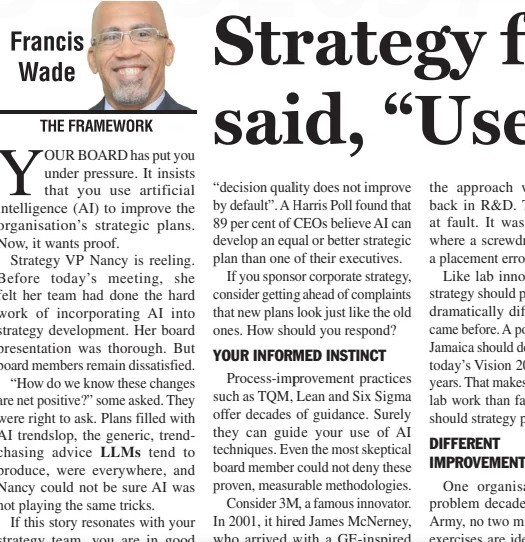
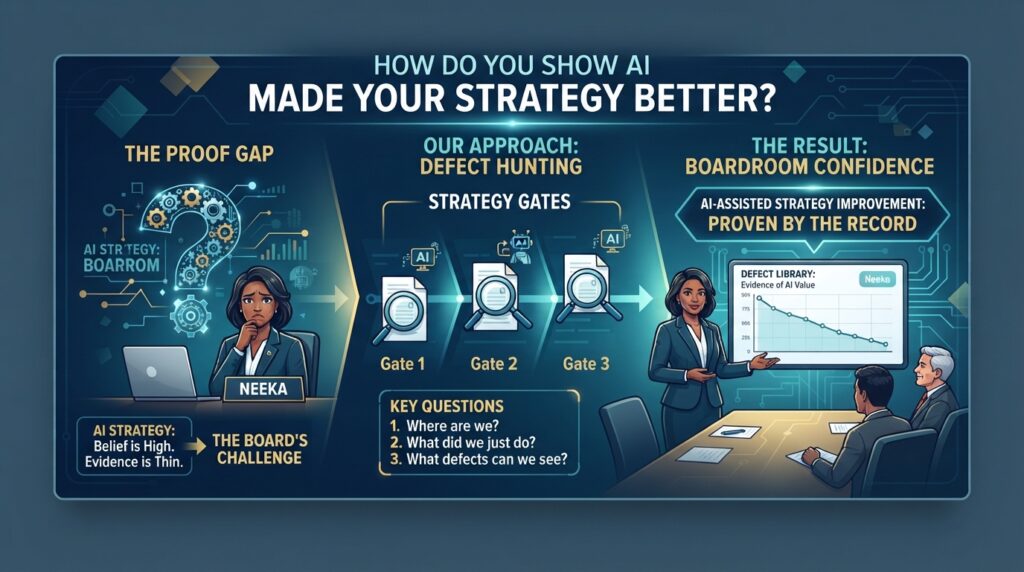
How Do You Show AI Made Your Strategy Better?

Neeka leaves the boardroom rattled.

Her team had done the hard work of building AI into the company’s strategy process. Her presentation was thorough. The board still wasn’t satisfied.

“How do we know this made the strategy better?” a director asked.

It was a fair question. Researchers have a name for what boards fear: trendslop, the generic, fashionable advice that language models tend to produce whatever your company’s situation. Neeka’s team had worked hard to avoid it. She couldn’t prove they had.

The board told her to use AI. Now it wants evidence that using it paid off.

What does she show them?

The proof gap

Neeka isn’t alone.

A Financial Times/Infosys survey of 300 directors at large North American companies found that 75% expect AI to significantly improve strategic decision-making. The same report warns that “decision quality does not improve by default.”

CEOs are more confident still. A Harris Poll for the software firm Dataiku asked 500 CEOs. Some 89% believe AI can write an equal or better strategic plan than one of their own executives.

Belief is high. Evidence is thin.

Capgemini surveyed 500 senior executives at companies with revenue above $10 billion. Some 47% reported noticeable gains in decision quality, though that is self-reported. And 52% listed their inability to verify AI’s output as a concern. Only about a quarter of their organisations have systems to validate it.

So leaders expect better strategy, say they’re getting it, and worry they can’t check. Your board will notice the gap.

Your first instinct

Neeka’s first instinct is sensible: take a workflow first approach, and borrow from process management.

TQM, Lean and Six Sigma carry decades of guidance and a deep library of case studies. Measure the work. Standardise it. Cut the variation. Few directors would argue with a method that is proven and countable.

Then consider 3M.

In 2001 the company hired James McNerney from GE. He brought Six Sigma with him and applied it widely, research labs included.

3M emerged financially stronger. Many researchers chafed. One R&D leader later described the company as “tool happy.” McNerney’s successor, George Buckley, de-emphasised Six Sigma in R&D.

Six Sigma suited the plants. In the labs, it was the right tool in the wrong room.

Strategy is lab work

A factory aims to repeat itself perfectly. Strategy aims to produce something different from last time.

Take Jamaica, in the Caribbean. Its national development plan, Vision 2030 Jamaica, runs out in a few short years. A successor that simply stretched it another twenty years, a possible Vision 2050, would waste the exercise. A national plan should break new ground, the way a lab does.

Corporate strategy has the same job. So how do you improve work that never repeats?

What the Army learned

One organisation faced this problem decades ago.

In the 1970s the US Army wanted to learn from its training exercises. No two missions are identical, so a fixed process couldn’t be the thing the Army improved.

It built the After Action Review: a short session after the event, built on four questions. What was supposed to happen? What actually happened? Why the difference? What should we sustain or improve? A facilitator leads it, usually not the most senior person present.

The Army improved a set of questions, rather than a set of steps. Strategy can borrow that.

At the same time, the review has a limit. It looks backward.

Moreover, a strategy’s results take years to show, and many other factors intervene along the way. That’s too late.

You need questions you can ask while the work is still open, before the strategy project ends.

Catch it before it ships

Software teams solved a version of this.

At PayPal, an engineer writes a one-page proposal describing the problem and the proposed design. The team then runs a pre-mortem. They assume the design failed and work out why. The engineer fixes what turns up before building.

PayPal says the practice catches issues early and exposes blind spots. That’s the company’s own account, not a measured result, and it comes from software design, not strategy. It’s the closest documented model I know of.

A pre-mortem is a defect hunt. A defect, in this sense, is anything wrong with the work that you can name, rank and fix.

Name your defects and you can show you removed them.

A grade isn’t a defect list

Some leaders already use AI as a critic.

Salesforce CEO Marc Benioff described his routine to the writer Bernard Marr. Each January he drafts his annual plan. He used to refine it with another executive. Now AI joins as a third collaborator. He asks it to compare the plan with his competitors’ and to “give me a letter grade.” He also asks where the plan is weak and where it is strong.

Smart habit. In the account I read, though, Benioff doesn’t say what the grade rests on. A letter says how a plan scored. It doesn’t say what was wrong, what you fixed, or whether this year’s process beats last year’s. A defect list answers all three.

Capgemini’s guidance on tracking AI-assisted decisions lists KPIs such as compliance scores and decision turnaround time. Those measure compliance and speed. They say little about the quality of the strategic choices.

SPEAR: your first experiment

I see the business world developing defect detection for strategy creation. The one I use with clients is SPEAR: Strategy Process Engineering for Analysis and Refinement.

It builds on the six stages of my EndPoint Method: a snapshot of where you are, a target year, scenarios, one chosen alternative expressed in numbers, a backcast from that endpoint, and a short-term strategy map.

SPEAR adds a short defect check at each gate between stages. At your next gate, pause the work for a few minutes and ask:

1. Where are we?

2. What did we just do?

3. What defects can we see?

4. Which ones matter?

5. What can we fix now?

6. What do we record?

7. What is the next gate?

Then repeat at the next gate. There’s no baseline project and no months of process mapping. It takes a meeting you already hold.

What your board sees

The record is your proof.

Over time you build a defect library: what went wrong at each stage, how you fixed it, what you learned. It comes from your judgement, and it waits for the next team.

It also shows where AI earned its place: the defects it helped catch or prevent. Time saved tells a board very little about strategy.

Neeka returns

Neeka’s next board meeting goes differently.

She brings a short list: the defects found at each gate, what the team fixed, what it recorded. Beside it sits a note on where AI helped.

The board asked her to prove it. The record does.

—

**Sources and further reading**

– Romasanta, A., Thomas, L. D. W., & Levina, N. (2026, March 16). “Researchers Asked LLMs for Strategic Advice. They Got ‘Trendslop’ in Return.” Harvard Business Review. https://hbr.org/2026/03/researchers-asked-llms-for-strategic-advice-they-got-trendslop-in-return

– Capgemini Research Institute (2026). “Inside the C-Suite: How AI is quietly reshaping executive decisions.” https://www.capgemini.com/wp-content/uploads/2026/01/Final-Web-Version-Research-Brief-Gen-AI-in-Decision-Making.pdf

—-

This article was inspired by a column I wrote for the Jamaica Gleaner. This began as an AI-drafted version of the original.

SPEAR is fully aired in a 2 hour LTSP26 conference replay edition.

P.S.

Five prompts to try with your own AI

Paste any of these into the AI tool you use. Replace the [brackets] with your own details. Each prompt asks the AI to question you first and to flag what it can’t verify. That cuts down the generic answers.

1. Run a defect check at your next gate

“I’m at a gate in a strategy project. The stages are: snapshot, target year, scenarios, one chosen alternative in numbers, backcast, short-term strategy map. I just finished: [stage and what you produced]. Ask me up to five questions about the work first. Then take me through these seven questions: where are we, what did we just do, what defects can we see, which ones matter, what can we fix now, what do we record, what is the next gate. A defect is something wrong with the work that can be named, ranked and fixed. Quote my own words when you name a defect. If you can’t find any, say so instead of inventing some.”

2. Ask for defects, not a grade

“Here is my draft plan: [paste]. Don’t give it a grade or a score. List the defects you find. For each one, give what is wrong, where it sits in the plan, why it matters and a suggested fix. Rank them from most to least serious. Mark each as ‘evidence in the text’ or ‘my inference’. Then tell me what else you would need to know to find more.”

3. Test your plan for trendslop

“Below is a strategy recommendation that AI helped produce: [paste]. Check it for trendslop, meaning generic, fashionable advice that would suit almost any company. For each recommendation, answer three questions. Would it fit my closest competitor equally well? What specific fact about my company supports it? What would the opposite choice look like, and why was it rejected? Then list the recommendations that fail these tests.”

4. Is your work factory work or lab work?

“I’ll describe a piece of work my team does: [describe]. Help me decide whether it is factory work (repeatable, so standardising helps) or lab work (should produce something different each time, so standardising can hurt). Ask me questions first. Then tell me which parts are which, and what kind of improvement method suits each. Challenge my answers where they sound like wishful thinking.”

5. Build the record your board can see

“I need to show my board whether AI improved our strategy work. Here are the defects my team has found, fixed and recorded so far: [paste, or write ‘none yet’]. Help me set up a defect library: suggest columns, categories and a format that fits on one page. Then draft a short board note listing defects found, fixes made, and where AI helped catch or prevent them. Don’t use time saved as evidence. If my records are too thin to support a claim, tell me what is missing.”

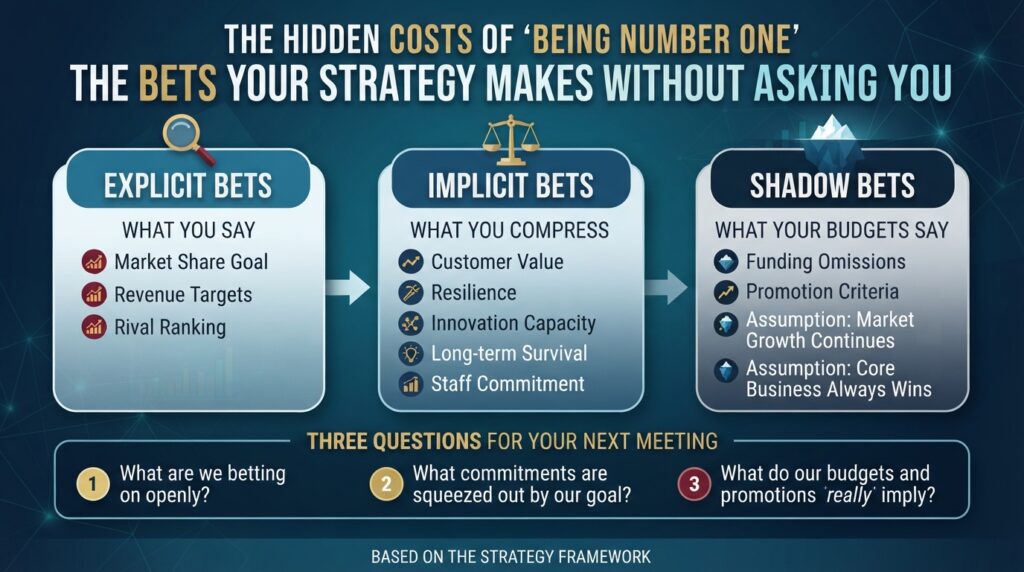
The Bets Your Strategy Makes Without Asking You

Your leadership team has announced a new ambition: be number one.

You nod along, but something nags at you. The goal is clear. It’s easy to repeat. Nobody could call it vague.

So why the unease?

Because a goal this simple hides more than it shows. In the next few minutes, I’ll cover what it hides, a case from the heavy-equipment industry, and three questions you can take into your next leadership meeting.

Seven Outcomes, One Phrase

Every organization answers to a long list of outcomes:

– Profit (or surplus, for a nonprofit)

– Customer value

– Staff commitment

– Resilience

– Innovation

– Social impact

– Long-term survival

“Be number one” keeps one line from that list: a ranking against rivals, usually measured in money or market share.

The other six stay in the business but drop out of the conversation. Nobody votes to give them up. They just aren’t in the room when the goal gets written.

Supporters of the single goal say people need something simple to rally around, and they’re right about clarity. The cost is what the simplicity conceals. The commitments you stop discussing are still commitments.

What One Famous Rivalry Cost

From the 1960s into the 1980s, Japanese equipment maker Komatsu pursued a stated intent: “Encircle Caterpillar.” Gary Hamel and C.K. Prahalad made the phrase famous, and business schools still teach it as a model of bold goal-setting.

It was more than a slogan. Komatsu’s yearly priorities and projects were measured against Caterpillar’s results.

For a long time it worked, because the global market for heavy equipment was growing. Then growth slowed. By the late 1980s, Komatsu’s own growth and profits had stalled. Its dependence on construction equipment and on its home market had become a weakness.

In 1989, a new president, Tetsuya Katada, spotted the deeper problem. Years of chasing a rival had narrowed how his managers thought. They knew how to track a competitor. They didn’t know how to find a new direction once the chase stopped paying off.

He replaced the old goal with a deliberately wide one: “Growth, Global, Groupwide.” Then he pushed managers to turn those words into specific new opportunities.

Look at what happened. Komatsu placed one bet in the open. When it ran out, the company placed a second. Between them, a number of bets went unnamed.

Three Kinds of Bets

Every strategy is a set of wagers. Sorting them into three types makes them easier to see.

Explicit bet. An outcome the company states out loud. For Komatsu: “Encircle Caterpillar.”

Implicit bet. A commitment squeezed out by the stated goal, such as customer value or resilience. The company trades it away without a decision. At Komatsu, one casualty was the managers’ habit of questioning direction. After years of single-target discipline, they had lost the skill.

Shadow bet. An outcome the company commits to through repeated choices, omissions and budget lines, without ever stating it.

Shadow bets are the dangerous ones. They never appear in a plan, and nobody can be polled on them.

Where Shadow Bets Hide

You find implicit bets by asking what a goal leaves out. Shadow bets slip past that question because nobody knows they’re making them. You find them by watching behavior: what gets funded, who gets promoted, what never receives a budget line.

Komatsu’s priorities were pegged to a rival’s results. That arrangement assumed the market would keep growing. Nobody wrote the assumption down. The budget stated it anyway.

Climate offers a current example. Many companies act as if climate change will leave their operations alone. That may hold for a few years. Behind it sits a second shadow bet: that future leaders will cope when the effects arrive. Neither bet appears in any strategy deck.

Consider a common arrangement: a company busy chasing a ranking sets up a small innovation unit “to explore new categories.” Look at the budget and you’ll find the shadow bet, that the core business will keep winning and the lab will stay a sideshow. This matters because a ranking only exists inside a category that already exists. A culture built around the ranking has little reason to invent a new one.

Short planning horizons make all of this worse. When a company plans five years out and no further, assumptions pile up unexamined. In the failed strategies I’ve studied, one pattern keeps recurring: short-term plans that led to disastrous long-term consequences. Firms that practice rigorous foresight make fewer shadow bets, and the ones they do make carry less risk.

Why the Usual Fixes Miss

Executives who sense the problem often try one of these:

– A softer slogan. “Market leader” or “first choice” instead of “number one.” Same bet, gentler words.

– A longer race. “Number one by 2040.” Longer horizon, same single outcome.

– A balanced scorecard. More metrics, all still rolling up to the ranking.

– A sustainability report. Run beside the strategy, not inside it. Climate becomes compliance instead of a bet.

– A listening tour. Stakeholders share what they care about. No budget changes.

Each adds activity. None puts a bet on the table where it can be examined.

The Executive Who Counts

Picture Maria, a composite character. Newly promoted into the C-suite, she’s startled by how much of the room’s time goes to the competition. In the last strategy update, she counted: 45 percent of the discussion was about beating the market leader from their position at number two.

She raised it afterward with the founder, a former Olympian and self-described hypercompetitive type. “You’d best become accustomed to us winning if you want to be a team player!” he barked, and cut the discussion short.

She never reached her real news. A new technology will reshape the industry in six or seven years. The two people who understand it have left to start their own firm, and the third is being courted by two competitors. Catching up would take about ten researchers and $10 million in new technology.

Maria has worked at the company for twenty years and doesn’t want to leave. That night, she updates her LinkedIn profile anyway.

Her story shows the social cost. When the conventional wisdom is simple and your peers stay quiet, a lone concern gets overridden. You need language that others can pick up and use. Without it, you’re one person with an unease.

Three Questions for Your Next Meeting

Take these into the room.

1. Explicit bets: What are we betting on?

2. Implicit bets: What does this goal compress, and what does the compression cost us?

3. Shadow bets: What do our budgets, promotions and omissions say we’re betting on?

An outside facilitator or an AI assistant can help with the third question, because neither is invested in your stated intentions.

Start with your own “be number one” goal. List what it says, what it compresses and what your budgets imply. The gaps between the three lists show where your unexamined risk sits.

Then try Maria’s method. Count the minutes your last strategy meeting spent on rivals, versus customers, staff, regulators and the world you’ll operate in a decade from now. That ratio is a bet too.

A company places bets every year through what it funds, whom it promotes and what it leaves unfunded. Ask the three questions. You may find bets nobody decided to make.

—-

This article is based on a column written for the Jamaica Gleaner. It’s first draft was AI-based.

P.S. Five prompts to put these ideas to work

Paste any of these into your AI assistant. Replace the [bracketed text] with your own details, and leave out names or figures you wouldn’t share outside your organization.

**1. Unpack your goal**

My organization’s stated ambition is: [paste your “be number one” or “be the best” goal]. A goal like this can compress seven outcomes into one: profit or surplus, customer value, staff commitment, resilience, innovation, social impact and long-term survival. Ask me, one question at a time, how my organization treats each of these in practice. Then show me which ones get airtime in leadership discussions and which have dropped out. Do not guess about my organization. Ask when you don’t know.

**2. Count the minutes**

Below are the agenda or notes from our last strategy meeting: [paste]. Estimate how much time went to rivals and competitor comparisons, and how much went to customers, staff, regulators and the future we will operate in. Show your reasoning. Then name the outcomes the discussion left out, and what it could cost us if they stay out. Mark clearly what you counted from my notes and what you are inferring.

**3. Hunt for shadow bets**

Here is what I know about where my organization puts its resources: what we fund, whom we promote, and what we leave unfunded or delay: [paste]. Act as a skeptical outsider with no stake in our stated strategy. Infer the bets these behaviors imply, including unwritten assumptions about growth, our market, climate or leadership succession. List up to five. For each, give the evidence from my notes and one question I could ask my team to test it. Say so when the evidence is thin.

**4. Test the category**

Imagine that in fifteen years the category we compete in has shrunk sharply or been replaced. Ask me five questions, one at a time, about our technology, talent, customers and funding. Then describe what a number-one ranking would be worth in that world, and list which of our current projects and budgets assume the category survives. Separate what I told you from what you assume. If you need facts about my industry, ask me.

**5. Rehearse the room**

Role-play a senior executive who believes “be number one” is the right goal. Raise objections such as: the market rewards leaders, simple goals motivate people, nobody can plan fifteen years out, and new categories are for startups. I will argue for naming our explicit, implicit and shadow bets. Push back realistically but fairly. After five exchanges, step out of character and tell me which of my arguments landed, which did not, and what language I could use to win allies instead of raising concerns alone.

When One Future Isn’t Enough

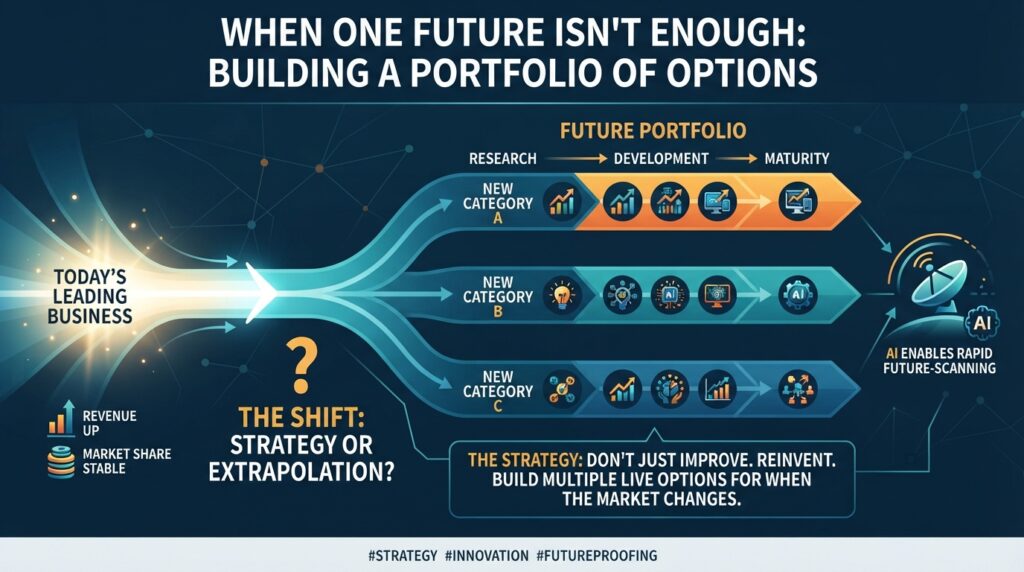
Your company is winning. Revenue is up, market share is stable, and the board likes what it sees. But look past the numbers and a real question is waiting: is this a strategy, or just an extrapolation of what’s worked so far?

That distinction matters more than it sounds like it should. Extrapolation works fine right up until the market shifts. By then, it’s too late to build an alternative.

Take Kodak and Fujifilm. Both companies had digital photography technology decades before it upended their industry. Kodak’s version of the story gets told the most: brilliant engineers, a dominant brand, and a board that shelved the innovation rather than risk film sales. When digital cameras finally took over, Kodak had no second act ready.

Fujifilm had the same technology and the same warning signs. Its leadership drew a different conclusion: photographic film would not pay the bills forever. So it went looking through its own laboratories for technologies that could become something else entirely. Two bets came out of that search, developed side by side. One was Instax, an instant-camera category built on Fujifilm’s imaging chemistry. The other was Astalift, a cosmetics line built on collagen and nanotechnology the company had originally developed for film. Neither was a better camera. Both answered a customer question film photography never asked.

That’s the real lesson. Improving a product and reinventing a category are not the same move. One extends an answer. The other asks a new question.

Kodak’s failure has company. Blockbuster stayed anchored to the physical rental store while Netflix built a fundamentally different way to watch movies, and filed for bankruptcy in 2010. Nokia kept optimizing handsets while Apple and Google moved the competition to software and app ecosystems, and eventually sold its phone business to Microsoft. Borders kept investing in the physical bookstore, outsourced its own online sales to Amazon in 2001, and liquidated a decade later.

Look closely at those three and you’ll notice they didn’t fail the way Kodak did. Kodak’s category disappeared: film photography became structurally unattractive, and there was nothing to pivot back into. Blockbuster, Nokia, and Borders had it worse in one sense. The underlying customer need never went away — people still wanted to watch movies, communicate on the go, and read books. What disappeared was their claim on it, because somebody else built a new category to serve that same need. A strong core business can keep performing right up to the moment a competitor creates the category that makes it irrelevant.

That’s what makes a portfolio of candidate futures worth the trouble. Amazon didn’t wait for online retail to plateau before placing its next bet. It launched S3 in 2006 and EC2 not long after, building the cloud-computing category while its retail business was still scaling. Alphabet does something similar on purpose: it runs a set of “Other Bets” — Waymo, Verily, and several others — deliberately kept at different stages of development, some barely past the research stage, so the company always has more than one shot at the future in play at once.

None of this is really new. IBM ran something similar in the early 2000s under a formal program that tracked what it called emerging business opportunities. Within three years, the portfolio had grown to seventeen candidates, spanning life sciences, Linux, pervasive computing, and business-process integration, each one tracked against its own milestones rather than forced through the existing business’s metrics.

Samsung did something comparable in 2010, naming five future growth businesses — including solar cells, batteries, and biopharmaceuticals — and committing serious capital to develop them in parallel. Some of the five went nowhere. A few became genuinely important. That’s not a coincidence, and it’s not a weakness in the approach. It’s the approach working as intended: the value isn’t in a high hit rate, it’s in having more than one live option when the environment shifts.

Naming that pattern is the easy part. Committing real resources to a future that might not happen is much harder, especially while the current category is still paying the bills. Few leadership teams even attempt to plan fifteen or thirty years out. Fewer still try to hold multiple long-range futures at the same time.

Until recently, that kind of work belonged to consultants and academics, who produced dense reports that ended up on a shelf. AI changes what’s possible now. It took the launch of ChatGPT to reveal what GPT-3 had only hinted at a year earlier, and most organizations planning long-term in 2021 missed that shift entirely, because nobody was scanning for it. Tools like Preempt.live can now surface thousands of plausible futures for an industry in an afternoon, which lowers the cost of asking “what else might happen” close to zero.

If your organization already has a few candidate categories in mind, the next steps aren’t complicated:

  1. Name a handful of candidate categories, with input from AI and your board.
  2. Assign each one to a champion who wants to see it succeed, not a department that inherits it as a side project.
  3. Teach each champion to use AI to track the faint signals that would tell you a candidate is starting to matter.

None of this requires certainty. It requires candidates, champions, and the discipline to keep watching for the next fifteen to thirty years.

Your current strategy is paying the bills today. Start building the one that will pay them next.

[This article is a longer, AI-generated version of an original Gleaner column.]

P.S. — Five prompts to run through your own AI tool

1. “List every product or service my organization sells today. For each one, tell me: if this disappeared entirely in the next ten years, would our underlying customer need disappear with it, or would someone else just be serving that need in a different way?”

2. “Based on what you know about my industry, name five to ten emerging categories that don’t exist yet but plausibly could within the next 15 years. Don’t filter for feasibility — I want the raw list first.”

3. “Play devil’s advocate: what is the single strongest argument that my current category will keep paying the bills for the next 15 years, with no need for a backup? Then tell me what would have to be true for that argument to be wrong.”

4. “If I had to hand one candidate future to a named person on my team — not a department — and ask them to genuinely champion it, who on my team already has the curiosity or skills to do that well, based on what I tell you about them?”

5. “Help me design a simple, low-effort way to monitor faint signals for [insert one candidate category]. What sources, search terms, or data points should someone check monthly to catch early movement?”

Why “If It Ain’t Broke” Is the Most Dangerous Thing Your CEO Can Say Right Now

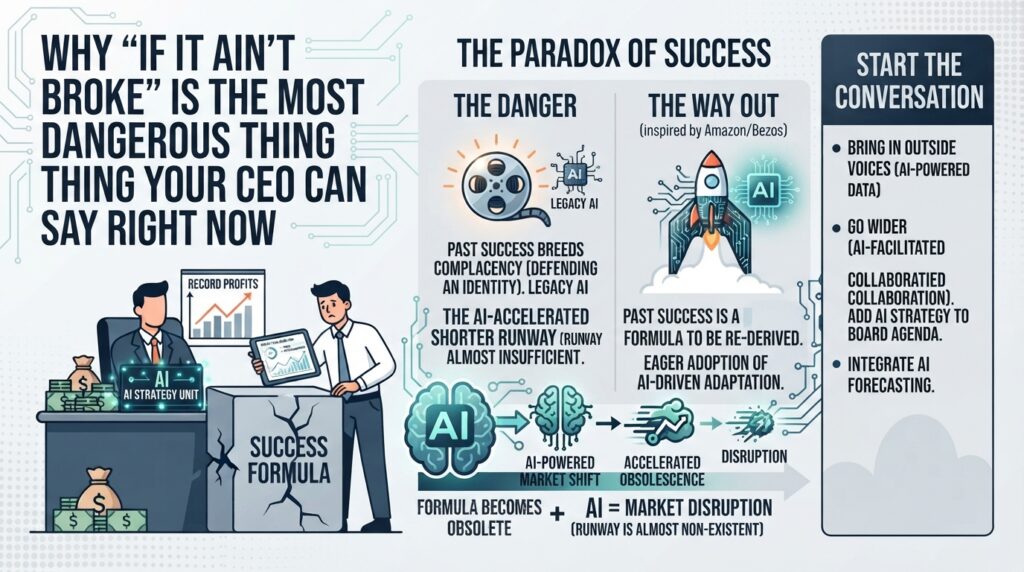
Somewhere right now, in a leadership meeting on some continent, someone who isn’t the CEO is trying to raise an uncomfortable question: what if the formula behind years of record results is starting to expire? And somewhere right now, a CEO is shutting that question down, defending the numbers as though the challenge were aimed at him personally rather than at the plan.

If that scene sounds familiar, you’re not watching a personality quirk unique to your organization. You’re watching one of the most common, and most expensive, mistakes in leadership: treating “if it ain’t broke, don’t fix it” as a strategy rather than an excuse.

The logic that doesn’t land

You’ve probably already tried the reasonable argument. Success, you’ve pointed out, has a specific shape — a set of conditions, decisions, and market circumstances that produced it. As automation and AI reorganize entire industries, that shape doesn’t stay fixed. It has to evolve, or it quietly turns into a liability.

That argument is sound. It’s also, usually, ignored. Which raises a real question: is this simply a personality trait particular to your CEO, or something bigger?

It’s bigger. The numbers back this up.

One widely cited study found that roughly one in five senior executives show clinically significant psychopathic traits, compared to about one in a hundred in the general population. Separate research out of Stanford’s Rock Center for Corporate Governance found a similarly elevated share of CEOs displaying moderate-to-high narcissistic traits.

The effect compounds, too: a 2025 Journal of Management study found that more narcissistic CEOs go on to appoint more narcissistic executives beneath them, and a 2024 Strategic Management Journal study of two decades of boardroom transcripts found narcissistic CEO-chairs are especially effective at steering their boards toward greater risk-taking.

Practically, it means a CEO in this position experiences the company’s wins as personal wins. Question the results, and you haven’t challenged a spreadsheet. You’ve challenged an identity. That’s why a reasonable request for a postmortem can trigger a reaction wildly out of proportion to the ask: the real argument was never about the data.

The paradox hiding inside “if it ain’t broke”

Here’s the part that should worry you more than a bad quarter. Failure triggers scrutiny almost automatically — boards ask questions, teams run retrospectives, egos get chastened enough to allow some honest reflection. Success does the opposite. The stronger the results, the less anyone feels entitled to examine how they were produced, and the higher the eventual risk of clinging to a formula that has already quietened past its expiration date.

In other words, the safest-looking companies are often carrying the most risk, precisely because nobody feels the need to check.

Kodak already had the answer, and still lost

If any company should have escaped this trap, it was the one whose own engineers invented the technology poised to replace its core business. Kodak’s researchers built digital photography years before it went mainstream. Kodak still died defending film, because its leadership had fused its identity to “we make film” rather than “we help people capture memories.” The evidence that its success formula had a limit came from inside its own laboratories, and it still wasn’t enough to change course.

Blockbuster tells a similar story from a different industry. Reports from the period describe its leadership dismissing a small, unproven mail-and-streaming service as a novelty rather than a threat, right up until that decision separated a company that no longer exists from one that went on to reshape entertainment worldwide. Different sectors, same failure: leadership treated past success as something to defend, not something to keep testing.

The CEO who proved there’s a way out

Fortunately, the escape route doesn’t have to come from a cautionary tale. Some of the clearest evidence comes from one of the most successful CEOs of the past three decades.

In his 2016 letter to Amazon’s shareholders, Jeff Bezos named the “eager adoption of external trends” as one of four disciplines that keep a company from sliding into decline, arguing that fighting a trend means fighting the future, while embracing it turns that same trend into a tailwind.

(Worth checking the letter directly if you plan to quote it — I want to flag that I haven’t independently verified the exact wording here.)

What makes this notable is timing. Bezos said this at the height of Amazon’s success, not while explaining away a failure. The identity he described wasn’t something to protect. It was something to keep re-deriving, deliberately, as new evidence came in.

That’s the real mental shift underneath all of this: retire the old belief that questioning success is disloyal or destabilizing. Replace it with a more useful one — success has a specific, describable shape, and that shape has an expiration date that moves as the environment moves. Structured planning tools, such as the well-known Three Horizons framework, exist specifically to help leadership teams map that shape and anticipate when it needs to change.

What to actually do about it

If you’re the person in the room who sees the risk but doesn’t have the final word, three moves tend to help. None of them require winning an argument outright.

Tell the story instead of making the case. A direct challenge to a CEO’s track record almost always triggers a defensive reaction. A neutral story about Kodak, or Blockbuster, or any company whose success quietly expired, does something a spreadsheet can’t: it lets the room draw its own conclusion, without anyone having to lose face in front of colleagues.

Bring in a voice with no stake in the outcome. One of the more underrated obstacles to an honest postmortem is political: everyone in the room is assumed to have an agenda. A large language model (LLM), used deliberately, doesn’t carry one. It can interrogate the assumptions behind a strategy with a bluntness that’s harder for a direct report to get away with, without anyone in the room having to be the one who said it first.

Go wider than the leadership team. Purpose-built tools for structured, AI-facilitated conversations — Blendification is one example — let every employee, not just the executives in the room, take part in a genuine, adaptive conversation about what’s working and what isn’t. Because the tool can run thousands of these conversations in parallel and compile the results within hours, it can surface cracks in a strategy long before they show up in a quarterly report.

None of this adds up to a finished methodology. It’s closer to a set of starting moves for a harder, wider conversation.

The point was never to beat the ego

None of it requires defeating the confidence that built the company in the first place. The goal was never to win the argument in the room. It’s to create enough space — through stories, honest postmortems, and a wider set of voices — for that confidence to be tested on its own terms, before the market tests it for you.

AI has simply shortened the runway. Formulas that once took a decade to become obsolete can now unravel in a fraction of that time. The organizations that last won’t be the ones with the strongest track record. They’ll be the ones still willing to ask what, exactly, their success is made of — and to keep answering that question honestly, long after the record books say they no longer have to.

P.S. — Try these prompts to go further

1. Map the shape of your own success. “Here’s a description of what my team/company does and why it has succeeded over [X years]. Help me identify the specific conditions, assumptions, and decisions that produced that success, and flag which ones are most vulnerable to changing due to AI or automation.”

2. Run your own mini postmortem. “Act as a neutral, outside analyst with no stake in my company’s past decisions. Based on this description of our strategy [paste details], give me the most honest, uncomfortable critique you can of what might already be outdated about it, even though results still look strong.”

3. Find your own Kodak moment. “Based on everything you know about my industry, what is the equivalent of ‘inventing digital photography and still defending film’ that my company or team might currently be doing? Push past the obvious answer.”

4. Draft a neutral story, not a confrontation. “Help me turn this concern about our strategy [describe it] into a short, neutral story — similar to how Kodak or Blockbuster are used as examples — that I could share with leadership without it reading as a direct challenge to anyone’s ego.”

5. Turn the lens on yourself. “Where in my own decisions, not just my CEO’s, am I treating past success as identity rather than as a formula worth re-testing? Be direct with me, even if the answer is uncomfortable.”

CEOs Respond Poorly to AI in Strategy Formulation

Ep 39 – “Trendslop”: Why AI Keeps Giving Strategists the Same Answer

You’ve started leaning on AI for your strategy work. ChatGPT, Claude, Gemini — pick your favorite. You’ve fed it your hardest question, the one that’s been on your desk for weeks. And the answer came back in seconds. Polished. Balanced. Articulate. It mentioned differentiation. It mentioned long-term thinking. It suggested you augment your team rather than automate them. It read like advice from a Harvard Business School case writer.

And it sounded like good advice.

But something is off. Because last week, a colleague at a different firm — different industry, different size, different problem — mentioned over coffee that she’d been doing the same thing. And when she described what her AI told her, it sounded suspiciously like what yours told you.

So now you’re sitting with a question you didn’t expect to be asking. If everyone is getting roughly the same advice, in roughly the same shape, dressed in roughly the same words — is anyone actually getting strategy at all?

Tune into this episode to join me in tackling this wicked problem which I first heard of in the famous Harvard Trendslop article from April 2026. It’s why AI keeps handing strategists the same answers — and what’s really going on underneath that has very little to do with AI.

AI in Strategy Creation | Beyond “Trendslop”

Theme of the Long-Term Strategy Conference Sep 15-17 2026

If you’re listening to this podcast just after its release, join us at the the LTSP26 conference. If you are seeing this after the date, then we’ll have replays for purchase.

This is a public episode. If you’d like to discuss this with other subscribers or get access to bonus episodes, visit longtermstrategy.substack.com/subscribe

The Strategy You Already Own, But Never Deploy

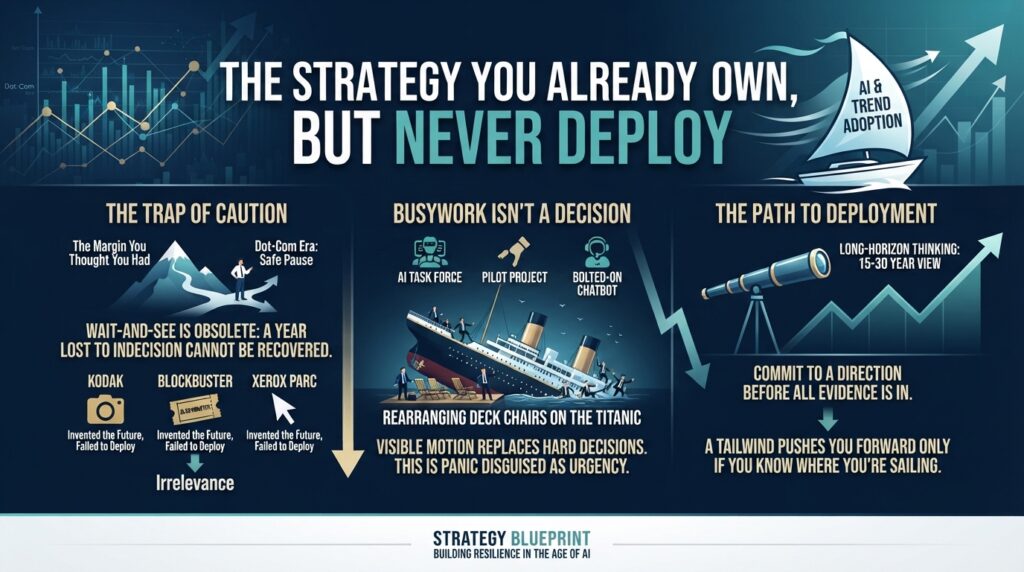
Somewhere in your leadership team’s meeting notes from last year sits a decision that probably didn’t feel like much of a decision at the time: wait, and see how this AI wave settles before committing to anything. It felt sound in the moment. Nobody in the room had a clear read on where things were headed, generative AI was still new enough that predictions felt like guesswork, and plenty of executives could still remember the dot-com collapse, when doing nothing turned out to be the smartest move a lot of firms made. Caution had worked before. Why wouldn’t it work again?

A year has passed since then. Walk the halls of your own organization and not much has changed: same teams, same processes, same planning cadence you had this time last year. Walk outside those halls, though, and the picture looks very different. Plenty has changed, and most of it happened somewhere you weren’t watching closely.

That gap is the part worth sitting with. The instinct that once looked like prudence now looks, on closer inspection, like exposure. Competitors are shipping products that would have taken your own team a full planning cycle just to get approved. You’ve heard the rumors, maybe more than rumors, of firms in your industry that dragged their feet and are now quietly winding down. Nobody on your leadership team wants to say it out loud, but the question is sitting in the room anyway, unasked: what if the real danger was never the disruption itself, but standing still while the ground under it kept shifting?

Here’s a fact worth revisiting, because most executives have heard it once and never thought about it again. Back in 2016, Jeff Bezos wrote to Amazon’s shareholders about what it takes to avoid sliding into complacency and eventual irrelevance. One of his four rules was the “eager adoption of external trends.” His logic was blunt: fight a trend and you’re fighting the future. Embrace it, and that same force instead becomes a tailwind pushing you forward.

That letter is nearly a decade old now. It gets quoted often enough in strategy decks and leadership podcasts. What almost nobody has done is build it into how they actually plan.

Two Failures, One Root Cause

Companies that freeze when a wave is clearly visible on the horizon tend to end up in roughly the same place: a diminished version of what they once were. Kodak is the example everyone reaches for first, and for good reason. Its own engineers invented the core technology that eventually replaced its film business, and the company still couldn’t bring itself to act on what it had built. Blockbuster watched a smaller, quieter rival mail out DVDs and later stream movies directly into people’s living rooms, and treated the whole thing as a niche experiment rather than an existential signal. Xerox PARC is the strangest case: its researchers built the graphical interface and elements of what became the personal computer years before almost anyone else had the concept, then watched other companies commercialize both while Xerox itself moved on.

Sears looks, at first glance, like the exception — a company that eventually did act. But by the time it moved, the moment for genuine structural change had already passed. What followed wasn’t a correction so much as a scramble that looked like decisiveness but never addressed the underlying planning failure. It was the same failure as Kodak’s or Blockbuster’s, just delayed and dressed up as urgency instead of paralysis.

That’s the part people consistently miss. Panic and paralysis aren’t opposites, even though they look nothing alike from the outside. They’re the same mistake, playing out on two different timelines. One postpones the decision indefinitely. The other skips the decision entirely and replaces it with visible motion. Neither one does the actual work of deciding where the company is headed.

The Busywork That Isn’t a Decision

If your organization has responded to generative AI at all, it’s probably done something visible, something you could point to on a slide if a board member asked what the company was doing about it. A pilot project here. An AI task force there, staffed by people who already had full-time jobs before this got added to their plate. A chatbot bolted onto customer service, mostly answering questions the FAQ page already answered. A dashboard tracking “AI trends to watch.” Maybe even a reorg, complete with a shiny new title for whoever now formally owns “AI strategy,” even though nobody’s strategy actually shifted as a result.

Every one of these things is real. Money got spent. Hours got logged. And yet none of them is, in any meaningful sense, a decision.

There’s a useful, if slightly dark, image for what’s happening here: the passengers on the Titanic who spent their final hour rearranging deck chairs. Not because it would help, but because doing something felt better than sitting with the discomfort of a decision not yet made. Most corporate responses to AI disruption look a lot like that scene: visible, energetic, and disconnected from anything that would actually change how the company decides what to build or where to invest.

Why the Old Playbook Stopped Working

During the dot-com era, waiting genuinely was a defensible strategy for a lot of companies, and it’s worth being honest about that rather than pretending caution was always foolish. If you sat out a cycle back then, you could usually catch the next one without much cost. Technology moved fast by the standards of the day, but slowly enough that a delay could be absorbed and corrected later. That was the safety cushion “wait and see” was built on, and for a long time it held up.

That margin has disappeared. A year lost to indecision today doesn’t come back next year, because the landscape itself won’t be the same one you paused in front of. Whatever assumptions justified the pause will likely be out of date by the time you revisit them. The runway you thought you had when you first decided to wait keeps getting shorter while you’re still taxiing down it, and there’s no obvious moment when someone announces it has run out. You just eventually notice you’re airborne with nowhere safe to land.

The alternative to freezing isn’t speed for its own sake. It’s the kind of long-horizon thinking that lets a leadership team see the whole shape of where things are heading — not just next quarter’s numbers or even next year’s roadmap, but the version of the industry that plausibly exists two or three decades out. That’s a considerably harder discipline to build than launching a pilot program, because it asks executives to commit to a direction before all the evidence is in. It’s also the only discipline that lets a trend like AI actually become a tailwind instead of a threat, because a tailwind only helps you if you already know which way you’re sailing.

The Cost of Ignoring Long Cycles

There’s a pattern worth borrowing from an industry that has nothing to do with software, which is exactly what makes it useful. Tree crops, cocoa, coffee, certain timber varieties among them, take years to mature after planting, and considerably longer still to reach peak yield. A grower who doesn’t plan a full decade ahead ends up, eventually, with an aging, under-producing plantation and no fast way to fix it. You can’t will a tree into maturity by working harder once the shortfall is already visible. The lead time is the lead time, fixed by biology rather than ambition or budget.

Something structurally similar is happening with the physical infrastructure behind AI itself. Building a new advanced semiconductor fabrication plant, the kind of facility that manufactures the chips training and running today’s large models, takes roughly three to four years from decision to operation, and billions of dollars in committed capital. I’d encourage you to verify that figure against current industry reporting, since capacity plans are shifting quickly. But the point holds regardless of the exact number: companies only now deciding to secure long-term compute capacity are, in effect, planting a tree they needed to plant several years earlier. There’s no accelerated version of that decision available now, no matter how much budget they’re suddenly willing to throw at it.

Short-cycle thinking doesn’t just delay a decision and leave it waiting patiently to be made later. It quietly forecloses options that can no longer be recovered on a short timeline, no matter how much urgency shows up afterward. Some doors, once missed, don’t reopen just because the company finally noticed them.

What Actually Breaks the Pattern

When I raise timelines like these with executives, the reaction is often disbelief, sometimes mild irritation. Surely the cultural shift their own organization needs can happen in a quarter or two, not years. It’s a comforting assumption, and it’s usually wrong. Cultures, like tree crops and fabrication plants, run on their own clocks. They don’t move faster just because a deadline is approaching.

The antidote to wait-and-see was never a faster reaction, even though that’s the instinct most organizations reach for once the discomfort of standing still becomes too much to bear. The real antidote is a longer view, deliberately and structurally built into how the company plans. That means a genuine long-horizon strategy, one that looks fifteen, twenty, even thirty years out, rather than a rolling set of one-year guesses dressed up in five-year language. That kind of thinking doesn’t eliminate uncertainty, and it isn’t meant to. What it does is give a company a fixed point far enough out on the horizon that even as the path toward it bends or gets rerouted entirely, the organization keeps moving instead of freezing at the first sign of ambiguity.

That’s the tailwind Bezos described almost a decade ago. It was never a secret, and it was never complicated to state. It has just rarely, if ever, been built.


PS: Five prompts to work through with your own AI assistant

  1. “Here’s how my company has responded to AI disruption so far [describe your pilots, task forces, or initiatives]. Help me identify which of these are genuine strategic decisions and which are ‘deck-chairing’ — visible activity that doesn’t change how we actually decide things.”
  2. “Walk me through what a 15-to-20-year horizon for my industry might plausibly look like, given current AI and automation trends. What would have to be true for my company to thrive in that version of the future?”
  3. “I want to test whether my organization is in ‘wait-and-see’ mode without realizing it. Ask me a series of questions that would reveal whether we’ve actually made a strategic decision about AI, or just delayed one.”
  4. “Help me draft three or four scenarios for how AI could reshape my specific industry over the next decade, ranging from gradual to disruptive, so my leadership team can pressure-test our current plan against each one.”
  5. “I want to explain to my board why ‘we’re waiting to see how this settles’ is riskier than it sounds. Help me build a short, non-alarmist argument, using examples of companies that lost their advantage through delay rather than through acting.”

The Strange Thing Successful CEOs Do Before They Fail

Picture a boardroom anywhere in the world. A new strategic plan is about to be built, and it follows a stretch of disappointing results. Someone at the table believes the old plan deserves an honest look before anyone writes a new one. The rest of the room disagrees, and the person leading that resistance is the chief executive.

This scene repeats itself constantly, across industries and continents, in companies large and small. And it repeats for a reason that has surprisingly little to do with the numbers on the page.

Somewhere in that room, someone already knows what went wrong. They stay quiet, and not because they lack nerve. Often the silence exists because the one person who most needs to hear the diagnosis has quietly turned the plan’s failure into a verdict on himself.

This has a name, though it is rarely the name people reach for. It isn’t stubbornness, and it isn’t ego in the casual sense most people mean when they use the word. It’s something closer to fusion: the CEO’s sense of identity has welded itself to the authorship of the plan. Criticizing the plan starts to feel indistinguishable from criticizing the man.

The Instinct to Diagnose the Leader

The common response to a struggling CEO is to assume he needs more self-reflection. That diagnosis feels intuitive, and it is usually wrong.

Executive coaches who work with senior leaders will tell you something consistent: top performers tend to run high on confidence, and sometimes on narcissism. Wins get filed under personal skill. Losses get filed under bad luck, timing, or a market nobody could have predicted. Which means owning a failure takes real effort, precisely because nothing in the leader’s usual operating system asks him to.

So what actually moves a confident leader to let go of a plan he built?

Three well-documented cases suggest an answer, and it isn’t introspection triggered by failure. It’s something closer to a deliberate choice, made from strength rather than crisis.

Garry Ridge spent over two decades running WD-40, and built one of the most studied culture turnarounds in modern business on a simple, command-driven mantra: be brilliant, be brief, be gone. At some point that mantra stopped fitting the company he wanted to build. He later described the shift in five plain words: he couldn’t do it alone.

Alan Mulally took over a struggling Ford and steered it through the 2008 financial crisis without the government bailout its competitors needed. About the plan that made that possible, he said something equally direct: it was bigger than him.

Satya Nadella went a step further at Microsoft. Rather than simply saying the company’s direction wasn’t his alone, he dismantled the senior leadership structure built to run things that way, on the theory that no single person, including the CEO, should hold that much of the answer.

None of these three men were failing when they made that call. Each was already succeeding, with every reason to keep doing exactly what had gotten him there. Yet each one gave up sole ownership of his company’s direction anyway, voluntarily, before a board or a crisis forced the issue.

That timing matters more than it first appears. It suggests the shift isn’t a symptom of failure, something a leader is forced into once the results turn bad. It’s a decision available to any leader, in good times or bad, and the best ones make it deliberately, long before anyone hands them a reason to.

Rejecting a Popular Premise

Ridge, Mulally, and Nadella weren’t managing their egos more skillfully than other executives. They were rejecting an assumption most organizations never examine: that a company’s direction is supposed to be authored by one person at the top, the way a founder might write a mission statement on a napkin and hand it down as scripture.

That assumption carries a flaw most boardrooms never name out loud. A company’s direction isn’t handed down from a single mind, however talented that mind happens to be. It gets surfaced collectively, through the accumulated judgment of the people running the business day to day, closest to the customers and the friction points a CEO rarely sees firsthand. The more a leader treats that direction as personal property, something he built and therefore owns, the more fiercely he will defend it against the one exercise that could actually improve it: an honest post-mortem.

The Same Reflex, Wearing Two Faces

This reflex shows up differently depending on how the last plan went, which is part of why it goes unrecognized so often.

When a leader senses the prior strategy failed, he tends to suppress honest discussion about it. Even a carefully facilitated review can land like an accusation rather than an exercise, and the room adjusts accordingly, softening its language until the review says almost nothing useful at all.

When a leader believes the prior strategy succeeded, the resistance shows up dressed differently, but the underlying mechanism is identical. Success gets defended as proof that nothing needs to change. This is the same instinct that kept a dominant film company comfortable with film long after digital cameras arrived, kept a video rental giant comfortable with physical stores while streaming quietly took over living rooms, and has repeated itself across a long list of once-dominant firms convinced that what worked before would keep working. Confidence in past results becomes the very thing that blocks an organization from spotting the threat forming just outside its field of view.

Failure resists a post-mortem out of self-protection. Success resists it out of certainty. Both come from the same place: a leader who has made the plan’s outcome personal, whichever direction that outcome happened to run.

There is a third variation worth naming, quieter than the other two. Some leaders resist not because the result was clearly good or bad, but because it was ambiguous, and ambiguity is harder to defend than either extreme. A mixed result invites the most debate, and debate is exactly what identity fusion is built to avoid.

What a Colleague Can Actually Do

If you aren’t the top leader, and you sense your CEO is standing in the way of an honest review, pressure rarely works. Direct confrontation tends to trigger the very defensiveness you’re trying to move past, and most people who have tried it once rarely try it the same way twice.

A better move is reframing the role itself. Help your CEO see himself less as the sole author of the company’s direction and more as its chief learner, or its lead experimenter, someone whose job is to keep testing the plan rather than defend it. That single shift in self-perception does more work than any argument about specific numbers ever will.

Ridge, Mulally, and Nadella are useful here, not as inspiration but as evidence. Each one answered the same question at the height of his influence, when nothing outside forced the admission: whose plan is this supposed to be?

Now picture your own CEO hearing that question, in your own boardroom, this week. He is still resisting the post-mortem, and you are still deciding how hard to push. The better question isn’t how hard. It’s which question you ask.

Not a challenge to his judgment. An invitation to a role he likely never chose for himself, and one he remains entirely free to choose now, at whatever stage his company’s story happens to be in.

——————————————-

PS: Five prompts to take this further with an AI assistant

  1. “I lead a team where a senior leader seems to be personalizing a past strategic failure. Help me identify three signs this is happening, based on the psychological pattern described in this article.”
  2. “Using the Ridge, Mulally, and Nadella examples, help me draft a short, low-pressure way to raise the idea of a strategy post-mortem with my own leader, without it sounding like a criticism.”
  3. “Walk me through the difference between a leader resisting a post-mortem out of failure versus resisting one out of past success. Which pattern sounds more like what I’m seeing in my own organization?”
  4. “Help me design a simple post-mortem process for my team’s last strategic plan that treats the findings as collective, not as an evaluation of any one person.”
  5. “If I wanted to reframe my own role from ‘owner of the vision’ to ‘chief learner,’ what would that change about how I lead the next planning cycle? Help me think through three concrete differences.”

Ep 38 – The Bellhop and the Sardines w/Amie Devero

Your company knows that it needs to move quickly once a corporate strategy has been developed, to get the document in the hands of the staff.

But what does it mean to “get it into their hands?” Send them a pdf? Get them to watch a video? Attend a town hall? Attend a briefing from their manager, after she has received her briefing?

This is a massive problem and here today to apply an AI-driven solution is Amie Devero. Tune into this episode to hear from us as we tackle the issue of strategy activation together.

Show Notes

You can try Contextuum at www.contextuum.ai

Amie and Contextuum will be featured at the Long-Term Strategy Conference 2026. This year’s theme is AI in Strategy Creation | Beyond Trendslop – https://strategyconf.fwconsulting.com

This is a public episode. If you’d like to discuss this with other subscribers or get access to bonus episodes, visit longtermstrategy.substack.com/subscribe

Ep 37 Why Global Conflict Has Your C-Suite Knee-Jerking Strategy Once Again

Your company prides itself on its long-term thinking, planning and acting. But now that times are difficult due to the outbreak of a war, you are wary of what might happen given your experience of COVID, supply chain breakdowns and sudden tariffs.

During these extreme events, you saw C-Suite executives delve into the weeds, doing the work of managers. As their time horizons shortened, they ignored the big picture until well after the crisis passed. This meant lost opportunities, and a lack of preparation for future threats.

How should you intervene given that it appears as if the roots of long-term thinking are weaker and shallower than you thought?

In this episode we look at your leadership system and where it lacks disciplined practices for long-term focus.

This is a public episode. If you’d like to discuss this with other subscribers or get access to bonus episodes, visit longtermstrategy.substack.com/subscribe