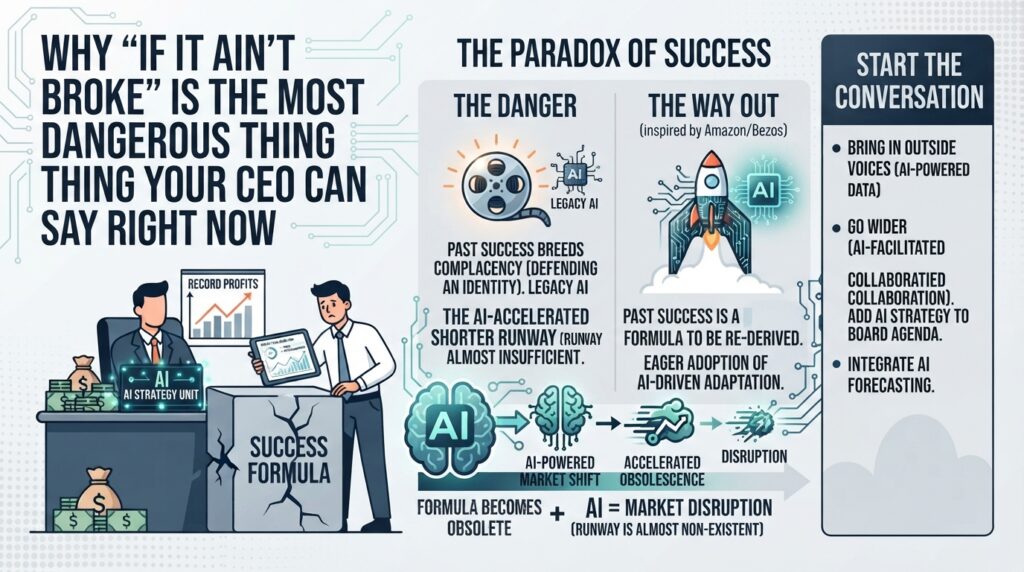

Somewhere right now, in a leadership meeting on some continent, someone who isn’t the CEO is trying to raise an uncomfortable question: what if the formula behind years of record results is starting to expire? And somewhere right now, a CEO is shutting that question down, defending the numbers as though the challenge were aimed at him personally rather than at the plan.
If that scene sounds familiar, you’re not watching a personality quirk unique to your organization. You’re watching one of the most common, and most expensive, mistakes in leadership: treating “if it ain’t broke, don’t fix it” as a strategy rather than an excuse.
The logic that doesn’t land
You’ve probably already tried the reasonable argument. Success, you’ve pointed out, has a specific shape — a set of conditions, decisions, and market circumstances that produced it. As automation and AI reorganize entire industries, that shape doesn’t stay fixed. It has to evolve, or it quietly turns into a liability.
That argument is sound. It’s also, usually, ignored. Which raises a real question: is this simply a personality trait particular to your CEO, or something bigger?
It’s bigger. The numbers back this up.
One widely cited study found that roughly one in five senior executives show clinically significant psychopathic traits, compared to about one in a hundred in the general population. Separate research out of Stanford’s Rock Center for Corporate Governance found a similarly elevated share of CEOs displaying moderate-to-high narcissistic traits.
The effect compounds, too: a 2025 Journal of Management study found that more narcissistic CEOs go on to appoint more narcissistic executives beneath them, and a 2024 Strategic Management Journal study of two decades of boardroom transcripts found narcissistic CEO-chairs are especially effective at steering their boards toward greater risk-taking.
Practically, it means a CEO in this position experiences the company’s wins as personal wins. Question the results, and you haven’t challenged a spreadsheet. You’ve challenged an identity. That’s why a reasonable request for a postmortem can trigger a reaction wildly out of proportion to the ask: the real argument was never about the data.
The paradox hiding inside “if it ain’t broke”
Here’s the part that should worry you more than a bad quarter. Failure triggers scrutiny almost automatically — boards ask questions, teams run retrospectives, egos get chastened enough to allow some honest reflection. Success does the opposite. The stronger the results, the less anyone feels entitled to examine how they were produced, and the higher the eventual risk of clinging to a formula that has already quietened past its expiration date.
In other words, the safest-looking companies are often carrying the most risk, precisely because nobody feels the need to check.
Kodak already had the answer, and still lost
If any company should have escaped this trap, it was the one whose own engineers invented the technology poised to replace its core business. Kodak’s researchers built digital photography years before it went mainstream. Kodak still died defending film, because its leadership had fused its identity to “we make film” rather than “we help people capture memories.” The evidence that its success formula had a limit came from inside its own laboratories, and it still wasn’t enough to change course.
Blockbuster tells a similar story from a different industry. Reports from the period describe its leadership dismissing a small, unproven mail-and-streaming service as a novelty rather than a threat, right up until that decision separated a company that no longer exists from one that went on to reshape entertainment worldwide. Different sectors, same failure: leadership treated past success as something to defend, not something to keep testing.
The CEO who proved there’s a way out
Fortunately, the escape route doesn’t have to come from a cautionary tale. Some of the clearest evidence comes from one of the most successful CEOs of the past three decades.
In his 2016 letter to Amazon’s shareholders, Jeff Bezos named the “eager adoption of external trends” as one of four disciplines that keep a company from sliding into decline, arguing that fighting a trend means fighting the future, while embracing it turns that same trend into a tailwind.
(Worth checking the letter directly if you plan to quote it — I want to flag that I haven’t independently verified the exact wording here.)
What makes this notable is timing. Bezos said this at the height of Amazon’s success, not while explaining away a failure. The identity he described wasn’t something to protect. It was something to keep re-deriving, deliberately, as new evidence came in.
That’s the real mental shift underneath all of this: retire the old belief that questioning success is disloyal or destabilizing. Replace it with a more useful one — success has a specific, describable shape, and that shape has an expiration date that moves as the environment moves. Structured planning tools, such as the well-known Three Horizons framework, exist specifically to help leadership teams map that shape and anticipate when it needs to change.
What to actually do about it
If you’re the person in the room who sees the risk but doesn’t have the final word, three moves tend to help. None of them require winning an argument outright.
Tell the story instead of making the case. A direct challenge to a CEO’s track record almost always triggers a defensive reaction. A neutral story about Kodak, or Blockbuster, or any company whose success quietly expired, does something a spreadsheet can’t: it lets the room draw its own conclusion, without anyone having to lose face in front of colleagues.
Bring in a voice with no stake in the outcome. One of the more underrated obstacles to an honest postmortem is political: everyone in the room is assumed to have an agenda. A large language model (LLM), used deliberately, doesn’t carry one. It can interrogate the assumptions behind a strategy with a bluntness that’s harder for a direct report to get away with, without anyone in the room having to be the one who said it first.
Go wider than the leadership team. Purpose-built tools for structured, AI-facilitated conversations — Blendification is one example — let every employee, not just the executives in the room, take part in a genuine, adaptive conversation about what’s working and what isn’t. Because the tool can run thousands of these conversations in parallel and compile the results within hours, it can surface cracks in a strategy long before they show up in a quarterly report.
None of this adds up to a finished methodology. It’s closer to a set of starting moves for a harder, wider conversation.
The point was never to beat the ego
None of it requires defeating the confidence that built the company in the first place. The goal was never to win the argument in the room. It’s to create enough space — through stories, honest postmortems, and a wider set of voices — for that confidence to be tested on its own terms, before the market tests it for you.
AI has simply shortened the runway. Formulas that once took a decade to become obsolete can now unravel in a fraction of that time. The organizations that last won’t be the ones with the strongest track record. They’ll be the ones still willing to ask what, exactly, their success is made of — and to keep answering that question honestly, long after the record books say they no longer have to.
P.S. — Try these prompts to go further
1. Map the shape of your own success. “Here’s a description of what my team/company does and why it has succeeded over [X years]. Help me identify the specific conditions, assumptions, and decisions that produced that success, and flag which ones are most vulnerable to changing due to AI or automation.”
2. Run your own mini postmortem. “Act as a neutral, outside analyst with no stake in my company’s past decisions. Based on this description of our strategy [paste details], give me the most honest, uncomfortable critique you can of what might already be outdated about it, even though results still look strong.”
3. Find your own Kodak moment. “Based on everything you know about my industry, what is the equivalent of ‘inventing digital photography and still defending film’ that my company or team might currently be doing? Push past the obvious answer.”
4. Draft a neutral story, not a confrontation. “Help me turn this concern about our strategy [describe it] into a short, neutral story — similar to how Kodak or Blockbuster are used as examples — that I could share with leadership without it reading as a direct challenge to anyone’s ego.”
5. Turn the lens on yourself. “Where in my own decisions, not just my CEO’s, am I treating past success as identity rather than as a formula worth re-testing? Be direct with me, even if the answer is uncomfortable.”