
There’s a number most government leaders would rather not think about. For Jamaica, it’s nine dollars.
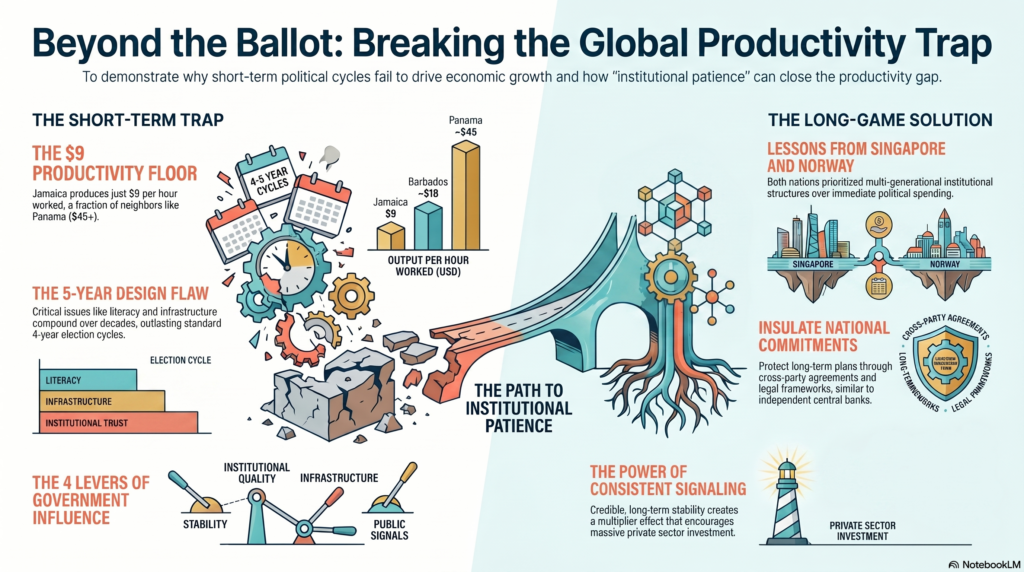
That’s the country’s productivity measured as output per hour worked — US$9. Barbados, a neighboring island economy, produces more than twice that. Panama produces five times as much. Most strikingly, Jamaica’s hourly output is only marginally ahead of Haiti’s — a country that has experienced decades of political collapse and natural disaster.
The numbers are sobering. But they are not unique to Jamaica. Across the developing world, governments face a version of the same arithmetic: their economies are generating far less per hour of human effort than they should, the gap is wide, and it has been wide for decades.
What is less often discussed is the role that government itself plays in perpetuating that gap.
The Largest Economic Actor in the Room
In many developing economies, government directly produces somewhere between 15 and 20 percent of GDP through goods and services. That makes it the single largest economic actor in the country — larger than any company, sector or industry.
But its true influence extends much further. Government shapes the entire environment in which the other 80-plus percent of economic activity takes place, through four distinct levers: macroeconomic stability, institutional quality, infrastructure and public goods, and the signals and expectations it sends to investors, businesses and citizens about the future.
That fourth lever is the most underestimated. When a government is unpredictable, inconsistent or widely distrusted, it suppresses private investment and enterprise far beyond anything that shows up in its own budget. Conversely, a government that signals credible, long-term commitment to stability and growth creates a multiplier effect on every dollar the private sector deploys.
Jamaica has made genuine, internationally recognized progress on the first lever. Its fiscal turnaround since 2013 has been studied by other nations as a model of discipline. Debt ratios have fallen. Inflation has been tamed. And yet GDP growth has not followed at the pace the data might suggest it should. The reason is that macroeconomic stability, while necessary, is not sufficient. The other three levers matter just as much — and progress on those fronts is slower and harder to sustain across electoral cycles.
Why Elections Are the Wrong Unit of Time
The deeper problem is structural. Governments, by design, operate on four- or five-year cycles. The problems that most constrain developing economies — workforce quality, institutional trust, infrastructure, behavioral norms — compound over decades. They cannot be fixed within a single term. Often they cannot be fixed within a generation.
Take literacy. Jamaica’s literacy rate trails comparable peer countries by five or more percentage points — a gap that has been building since the 1960s. That gap is a direct and stubborn drag on workforce productivity. Closing it requires sustained investment and policy consistency across twenty or thirty years, not one budget cycle.
The same logic applies to institutional quality, infrastructure and public trust. These are slow variables. They respond to patient, consistent effort — not to whoever won the last election.
This is not pessimism. It is arithmetic.
The Countries That Played the Long Game
Two examples are instructive, and they have been cited often precisely because they are so striking.
Singapore in the early 1960s had a GDP per capita comparable to Jamaica’s. It was a small, resource-poor island with a mixed population, uncertain regional relationships and no obvious competitive advantages. Today it is among the wealthiest and most productive nations on earth.
Norway had oil. So did Nigeria, Angola, and Venezuela. The difference was that Norway resisted the temptation to spend its resource windfall immediately and instead built institutional structures — including a sovereign wealth fund now worth over a trillion dollars — designed to distribute wealth across generations rather than electoral cycles.
Both Norway and Singapore have populations of around five to six million — comparable in scale to many Caribbean and Central American nations. Scale was not destiny. What separated them was institutional patience: the willingness to make commitments that no single government could unilaterally reverse.
The Design Flaw in Most Development Plans
Many developing nations have tried long-term national development planning. The typical failure mode is nearly always the same: the plan belongs to one party. When the government changes, the plan either changes with it or quietly fades from view.
Jamaica’s Vision 2030 — an ambitious plan built around the aspiration to become “the place of choice to live, work, raise families and do business” — started with a bipartisan commitment, but has largely followed this pattern in recent years. It is rarely invoked by either major political party today. Its successes have not been studied. Its failures have not been honestly diagnosed.
Trinidad and Tobago offers a cautionary parallel. Multiple governments there have attempted national development plans under single-party mandates. Without cross-party commitment, each plan has been vulnerable to revision or abandonment when power changed hands. The structural challenges — growth, productivity, crime — remain largely unresolved.
The evidence from countries that have succeeded suggests a different architecture is required. Long-term national commitments need to be insulated from ordinary political interference — protected by cross-party agreement, legal frameworks and institutional norms in the same way that independent central banks or electoral commissions are protected. The goal is not to remove politics from policy. It is to place the most consequential long-horizon commitments beyond the reach of short-term political calculation.
This is not a utopian idea. It has been done — in countries that once looked very much like Jamaica does today.
The Immediate Return on Patient Thinking
There is a paradox worth naming. Patient, long-horizon thinking doesn’t only produce results over decades. It produces its first results immediately — in the minds of the leaders who adopt it.
The moment a government leader genuinely shifts from “what can I deliver before the next election?” to “what structural commitment can I make that a successor will be bound to honor?” — that shift is itself a form of progress. It changes which conversations happen, which trade-offs get made, which investments get prioritized. Institutional culture changes before the metrics do.
For any leader in the public sector who recognizes the structural arithmetic above, the question is not whether to think long. It is whether to do so quietly or loudly.
Either way, the calculus is the same. The countries that changed their trajectories did not do it in four years. They did it by making four-year decisions that pointed consistently in the same direction for forty.
Only the nations — and the institutions — willing to make and protect patient commitments have a realistic chance of closing the gaps that actually matter.
5 Prompts to Put These Ideas to Work
The arguments in this article become more useful when applied to your own institution. These prompts are designed for use with any AI assistant (Claude, ChatGPT, Gemini, etc.). Work through them in order — each builds on the last.
Prompt 1 — Reflect “I lead [describe your ministry, agency or department] in Jamaica. The article I just read argues that government influences GDP through four levers: macroeconomic stability, institutional quality, infrastructure and public goods, and public signals and expectations. Ask me a series of questions to help me identify which of these levers my organization influences most directly — and where the biggest performance gaps are.”
Prompt 2 — Reflect “Here is my organization’s current strategic plan: [paste it]. Review it against this standard: which commitments are genuinely structural — meaning they require ten or more years to fully realize — and which are short-term fixes unlikely to outlast the current administration? Then identify what is missing from the long-term column.”
Prompt 3 — Apply “Jamaica’s literacy gap has been building since the 1960s and is described as a ‘stubborn contributor’ to low productivity. Help me identify the equivalent stubborn contributors in my sector — the slow-moving structural gaps that no single government can fix alone. What data would I need to make this diagnosis rigorously, and what would a credible 20-year improvement trajectory look like?”
Prompt 4 — Create “Using Singapore and Norway as reference points — both small nations that made long-horizon institutional commitments that outlasted individual governments — help me draft a one-page strategic hypothesis for my organization. It should answer: what is the single most important structural commitment my institution could make today that would still be bearing fruit in 2040? Start by asking me three questions about my organization’s current situation.”
Prompt 5 — Master “The article argues that Jamaica’s Vision 2030 failed partly because it lacked cross-party commitment — and that durable long-term plans must be insulated from political interference the way electoral commissions are. Help me design a cross-party commitment framework for one specific policy priority in my sector. What institutional mechanisms would make it durable enough to survive a change of government? What would have to be true politically, legally and culturally for this to hold?”
P.S. The impact of AI on strategy creation is forcing its way into our thinking every day. You wish you could keep up, but so much is changing so quickly that it’s hard. The good news is that this is the theme of our September 15-17, 2026 strategy conference. Save the date in your calendar!