
Somewhere in your leadership team’s meeting notes from last year sits a decision that probably didn’t feel like much of a decision at the time: wait, and see how this AI wave settles before committing to anything. It felt sound in the moment. Nobody in the room had a clear read on where things were headed, generative AI was still new enough that predictions felt like guesswork, and plenty of executives could still remember the dot-com collapse, when doing nothing turned out to be the smartest move a lot of firms made. Caution had worked before. Why wouldn’t it work again?
A year has passed since then. Walk the halls of your own organization and not much has changed: same teams, same processes, same planning cadence you had this time last year. Walk outside those halls, though, and the picture looks very different. Plenty has changed, and most of it happened somewhere you weren’t watching closely.
That gap is the part worth sitting with. The instinct that once looked like prudence now looks, on closer inspection, like exposure. Competitors are shipping products that would have taken your own team a full planning cycle just to get approved. You’ve heard the rumors, maybe more than rumors, of firms in your industry that dragged their feet and are now quietly winding down. Nobody on your leadership team wants to say it out loud, but the question is sitting in the room anyway, unasked: what if the real danger was never the disruption itself, but standing still while the ground under it kept shifting?
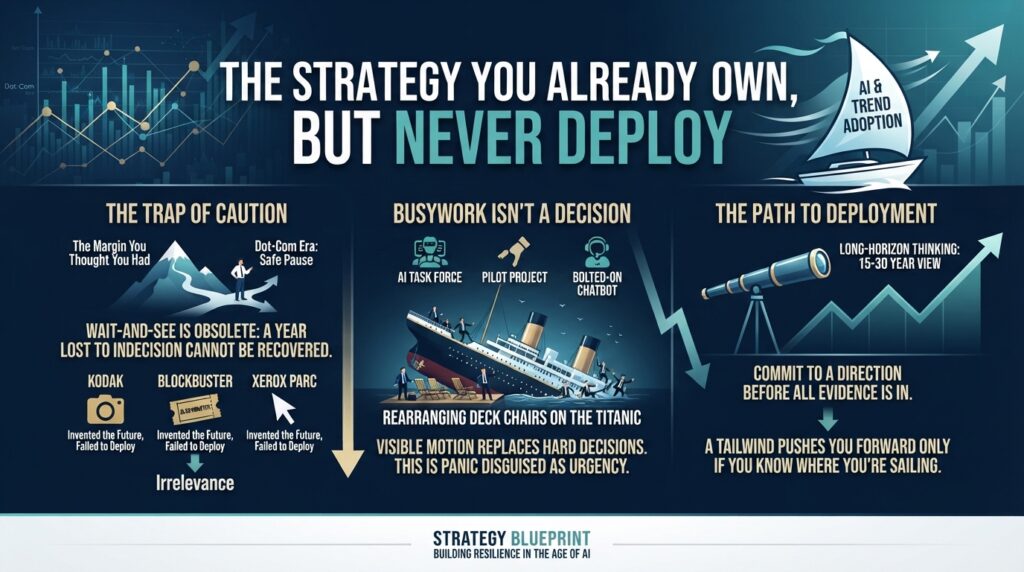
Here’s a fact worth revisiting, because most executives have heard it once and never thought about it again. Back in 2016, Jeff Bezos wrote to Amazon’s shareholders about what it takes to avoid sliding into complacency and eventual irrelevance. One of his four rules was the “eager adoption of external trends.” His logic was blunt: fight a trend and you’re fighting the future. Embrace it, and that same force instead becomes a tailwind pushing you forward.
That letter is nearly a decade old now. It gets quoted often enough in strategy decks and leadership podcasts. What almost nobody has done is build it into how they actually plan.
Two Failures, One Root Cause
Companies that freeze when a wave is clearly visible on the horizon tend to end up in roughly the same place: a diminished version of what they once were. Kodak is the example everyone reaches for first, and for good reason. Its own engineers invented the core technology that eventually replaced its film business, and the company still couldn’t bring itself to act on what it had built. Blockbuster watched a smaller, quieter rival mail out DVDs and later stream movies directly into people’s living rooms, and treated the whole thing as a niche experiment rather than an existential signal. Xerox PARC is the strangest case: its researchers built the graphical interface and elements of what became the personal computer years before almost anyone else had the concept, then watched other companies commercialize both while Xerox itself moved on.
Sears looks, at first glance, like the exception — a company that eventually did act. But by the time it moved, the moment for genuine structural change had already passed. What followed wasn’t a correction so much as a scramble that looked like decisiveness but never addressed the underlying planning failure. It was the same failure as Kodak’s or Blockbuster’s, just delayed and dressed up as urgency instead of paralysis.
That’s the part people consistently miss. Panic and paralysis aren’t opposites, even though they look nothing alike from the outside. They’re the same mistake, playing out on two different timelines. One postpones the decision indefinitely. The other skips the decision entirely and replaces it with visible motion. Neither one does the actual work of deciding where the company is headed.
The Busywork That Isn’t a Decision
If your organization has responded to generative AI at all, it’s probably done something visible, something you could point to on a slide if a board member asked what the company was doing about it. A pilot project here. An AI task force there, staffed by people who already had full-time jobs before this got added to their plate. A chatbot bolted onto customer service, mostly answering questions the FAQ page already answered. A dashboard tracking “AI trends to watch.” Maybe even a reorg, complete with a shiny new title for whoever now formally owns “AI strategy,” even though nobody’s strategy actually shifted as a result.
Every one of these things is real. Money got spent. Hours got logged. And yet none of them is, in any meaningful sense, a decision.
There’s a useful, if slightly dark, image for what’s happening here: the passengers on the Titanic who spent their final hour rearranging deck chairs. Not because it would help, but because doing something felt better than sitting with the discomfort of a decision not yet made. Most corporate responses to AI disruption look a lot like that scene: visible, energetic, and disconnected from anything that would actually change how the company decides what to build or where to invest.
Why the Old Playbook Stopped Working
During the dot-com era, waiting genuinely was a defensible strategy for a lot of companies, and it’s worth being honest about that rather than pretending caution was always foolish. If you sat out a cycle back then, you could usually catch the next one without much cost. Technology moved fast by the standards of the day, but slowly enough that a delay could be absorbed and corrected later. That was the safety cushion “wait and see” was built on, and for a long time it held up.
That margin has disappeared. A year lost to indecision today doesn’t come back next year, because the landscape itself won’t be the same one you paused in front of. Whatever assumptions justified the pause will likely be out of date by the time you revisit them. The runway you thought you had when you first decided to wait keeps getting shorter while you’re still taxiing down it, and there’s no obvious moment when someone announces it has run out. You just eventually notice you’re airborne with nowhere safe to land.
The alternative to freezing isn’t speed for its own sake. It’s the kind of long-horizon thinking that lets a leadership team see the whole shape of where things are heading — not just next quarter’s numbers or even next year’s roadmap, but the version of the industry that plausibly exists two or three decades out. That’s a considerably harder discipline to build than launching a pilot program, because it asks executives to commit to a direction before all the evidence is in. It’s also the only discipline that lets a trend like AI actually become a tailwind instead of a threat, because a tailwind only helps you if you already know which way you’re sailing.
The Cost of Ignoring Long Cycles
There’s a pattern worth borrowing from an industry that has nothing to do with software, which is exactly what makes it useful. Tree crops, cocoa, coffee, certain timber varieties among them, take years to mature after planting, and considerably longer still to reach peak yield. A grower who doesn’t plan a full decade ahead ends up, eventually, with an aging, under-producing plantation and no fast way to fix it. You can’t will a tree into maturity by working harder once the shortfall is already visible. The lead time is the lead time, fixed by biology rather than ambition or budget.
Something structurally similar is happening with the physical infrastructure behind AI itself. Building a new advanced semiconductor fabrication plant, the kind of facility that manufactures the chips training and running today’s large models, takes roughly three to four years from decision to operation, and billions of dollars in committed capital. I’d encourage you to verify that figure against current industry reporting, since capacity plans are shifting quickly. But the point holds regardless of the exact number: companies only now deciding to secure long-term compute capacity are, in effect, planting a tree they needed to plant several years earlier. There’s no accelerated version of that decision available now, no matter how much budget they’re suddenly willing to throw at it.
Short-cycle thinking doesn’t just delay a decision and leave it waiting patiently to be made later. It quietly forecloses options that can no longer be recovered on a short timeline, no matter how much urgency shows up afterward. Some doors, once missed, don’t reopen just because the company finally noticed them.
What Actually Breaks the Pattern
When I raise timelines like these with executives, the reaction is often disbelief, sometimes mild irritation. Surely the cultural shift their own organization needs can happen in a quarter or two, not years. It’s a comforting assumption, and it’s usually wrong. Cultures, like tree crops and fabrication plants, run on their own clocks. They don’t move faster just because a deadline is approaching.
The antidote to wait-and-see was never a faster reaction, even though that’s the instinct most organizations reach for once the discomfort of standing still becomes too much to bear. The real antidote is a longer view, deliberately and structurally built into how the company plans. That means a genuine long-horizon strategy, one that looks fifteen, twenty, even thirty years out, rather than a rolling set of one-year guesses dressed up in five-year language. That kind of thinking doesn’t eliminate uncertainty, and it isn’t meant to. What it does is give a company a fixed point far enough out on the horizon that even as the path toward it bends or gets rerouted entirely, the organization keeps moving instead of freezing at the first sign of ambiguity.
That’s the tailwind Bezos described almost a decade ago. It was never a secret, and it was never complicated to state. It has just rarely, if ever, been built.
PS: Five prompts to work through with your own AI assistant
- “Here’s how my company has responded to AI disruption so far [describe your pilots, task forces, or initiatives]. Help me identify which of these are genuine strategic decisions and which are ‘deck-chairing’ — visible activity that doesn’t change how we actually decide things.”
- “Walk me through what a 15-to-20-year horizon for my industry might plausibly look like, given current AI and automation trends. What would have to be true for my company to thrive in that version of the future?”
- “I want to test whether my organization is in ‘wait-and-see’ mode without realizing it. Ask me a series of questions that would reveal whether we’ve actually made a strategic decision about AI, or just delayed one.”
- “Help me draft three or four scenarios for how AI could reshape my specific industry over the next decade, ranging from gradual to disruptive, so my leadership team can pressure-test our current plan against each one.”
- “I want to explain to my board why ‘we’re waiting to see how this settles’ is riskier than it sounds. Help me build a short, non-alarmist argument, using examples of companies that lost their advantage through delay rather than through acting.”