Planning for Profits vs. People vs. Purpose

You need to add a widget, row, or prebuilt layout before you’ll see anything here. 🙂

Like most other business-people, you have almost given up on the task of combining short-term and long-term strategic planning.


It’s not that you don’t believe in it at some level. You acknowledge there is value in thinking expansively and inspiring others with BHAGs (Big Hairy Audacious Goals).


At the same time, things are changing too fast nowadays. You can barely find time to focus on solving short-term problems, let alone anything pie-in-the-sky.


But what if the popular conventional wisdom, that long-term strategic planning is dead, is wrong?


What if there were huge gains to be made in the following areas from an interwoven short/long-term approach?


Area 1 – gaining competitive advantage by planning for horizons just a bit longer than others. (Amazon)
Area 2 – inspiring staff with commitments that create an irresistible future. (Unilever)
Area 3 – becoming a sustainable organization that takes care of its own, organic ESG concerns first. (CVS)


These areas could be the keys to unblocking multiple goals at once, while bypassing the worst tendency of companies to fall into short-termism.


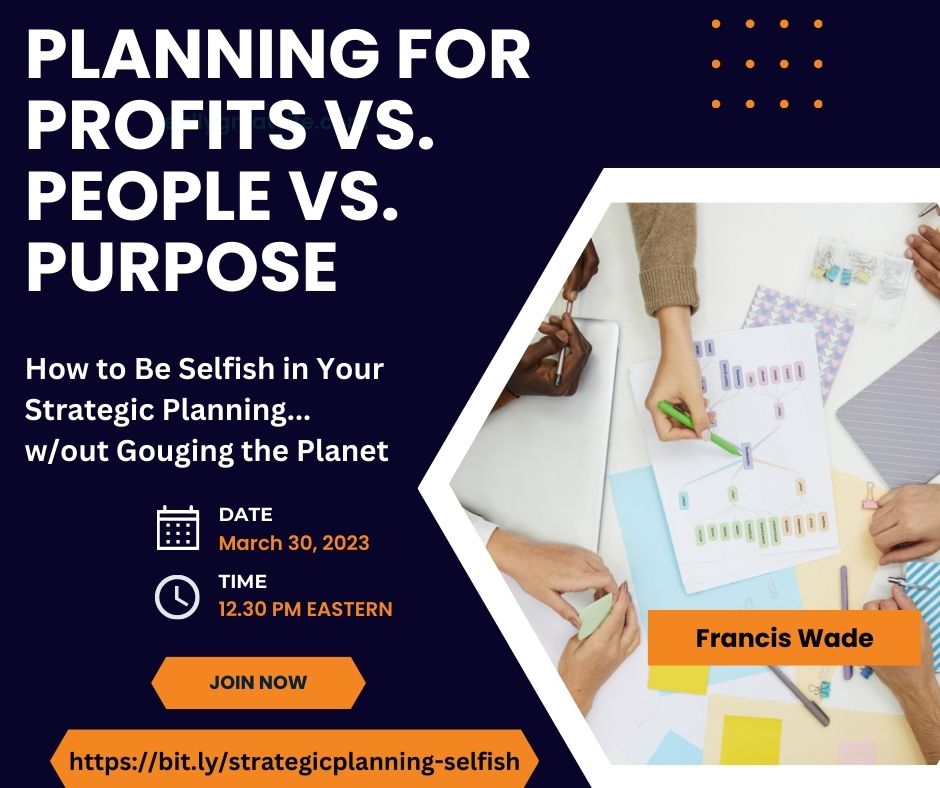
In this webinar, you’ll be exposed to a practical method of doing interwoven short/long-term strategic planning. You’ll find out how to invest two or three days (rather than weeks) in a way that returns game-changing results. But maybe most importantly, you’ll be well-informed.


Register today.
Time: Thursday March 30, 2023, 12:30pm Eastern
Join Francis Wade, two-decade veteran of 50+ interwoven short/long-term strategic planning retreats in this one-hour introduction.
NB – Space is limited

Creating the Future

Have some people in your company become reaction-machines? In other words, do they run around all day responding to the latest crisis? Deep down, you know they are inefficient, but what can you do to shift to a culture in which the future is created rather than feared?

For past columns, see blog.fwconsulting.com

This is a public episode. If you’d like to discuss this with other subscribers or get access to bonus episodes, visit longtermstrategy.substack.com/subscribe

Creating the Future

Have some people in your company become reaction-machines? In other words, do they run around all day responding to the latest crisis? Deep down, you know they are inefficient, but what can you do to shift to a culture in which the future is created rather than feared?

There is a debate raging within C-suites about the way companies should be led. Some believe that the world has become more VUCA (volatile, uncertain, complex and ambiguous.) As such, it’s not possible to plan for the future.

Instead, all you can do is react to the latest disruption. And if you have any energy left over, look ahead…but only for no more than five years. COVID has made this opinion popular.

But I think it’s an excuse.

The opposing point of view is that individuals and companies need a vision of the future.

If you believe in the latter, and prefer to create the future, here are ways to persuade others who feel the activity is a waste of time.

1) You can’t stop creating the future

Fact: in any company, the leadership team is always shaping the future. It may be disjointed, muddled, and hidden from view, but there is a destination being realised with every decision. This can’t be helped.

The only question is, is it being done well or badly?

In essence, a future being realised badly is one that lacks definition, so no-one can put words to it. In fact, two managers might say opposite things when asked. “Survival” may be the only commitment they have in common.

So it’s a free-for-all, with some people playing football while the rest are playing cricket.

As such, there’s a lot of drama, with balls flying everywhere. At the end of the day, when everyone is exhausted, the action stops. Some balls will be near the boundary, others lie in the back of nets, but no-one can tell the score.

Consequently, when good employees sense that the vision is poorly defined, they leave.

2) Things will always change

Another excuse given to avoid planning for the future is that conditions alter too often. Why create another disappointment? Instead, desist from planning because it would only add to a string of prior letdowns.

I think our experience in Jamaica with Vision 2030 is instructive: a country which is “the place of choice to live, work, raise families and do business.” Even though governments have changed, and mishaps have occurred, it remains a single point of focus for our citizens.

Even though we have much to accomplish with limited time left, the reality is that it is still our shared goal…whatever comes to pass.

This puts things in perspective, and allows us to lift ourselves from the most recent shooting, drought or political conflict. As a leader, you can also give your workers a sense of purpose.

They need not surrender to the latest drama unfolding in their email inbox.

3) You don’t know how

But perhaps the most salient reason companies get stuck in the short-term is that long-term planning is too hard. It takes too long.

Furthermore, they see the end-product as overly detailed and rigid.

In my firm, we recently began a study of 50 past long-term strategic planning retreats. Based on two decades of experience, I am able to declare that the old point of view is outdated. Fortunately, both short and long-term strategies may be completed together in a few days.

This means that with the right skills, there should be no obstacles.

But don’t take my word for it. Chances are, you belong to an organisation which does not have a 15 to 30-year strategic plan. It could be your place of work, church you attend, or even an alumni group.

Make this practical – gather people together in a meeting to create a big vision, and a multi-year strategy to underpin it. As you engage in the process, follow the steps outlined in my Gleaner columns from February 5, 2023, and November 3, 2019 as guides.

Remember that the point is to inspire your team with the possibility of a breakthrough result.

This exercise will take you one step closer and help reverse the myth that life today is more uncertain than ever. It’s not true. In fact, the end of World War II was more hectic, but it led to the creation of a number of long-term institutions such as the United Nations and World Bank.

Our challenges in 2023 pale in comparison. Take practical steps to give your organisations an inspiring future today. Don’t hold back because you are scared or misinformed.

Francis Wade is the author of Perfect Time-Based Productivity, a keynote speaker and a management consultant. To search his prior columns on productivity, strategy, engagement and business processes, send email to columns@fwconsulting.com.

Ep 26 – Pareto Improvements to Your Task Management

You’re someone who launches personal projects to improve your task management. You have made a number of changes in the past, but you haven’t seen the impact you wanted from each effort.

Is there something going on that you cannot see? Are some changes more fruitful than others?

After all, you know a thing or two about systemic change: that seemingly small improvements can yield disproportionate, breakthrough results. It applies to other areas of life…but how about your task management?

Tune into this episode to hear from me and my special guest, Danielle Baily, as we solve this challenging problem together.

Get full access to Francis A. Wade at 2timelabs.substack.com/subscribe

How to Connect Two Different Generations at Work

As someone born before 1988, you have noticed that newer staff in your company are acting and thinking differently. You suspect it may just be an expected generation gap, but now something seems to have shifted.

You conclude, new technology is powering the younger generation to change norms at an unprecedented rate. But how?

Among the many explanations of this transformation, the one by The Category Pirates stands out. In their books and newsletters on marketing, they offer a refreshing take.

According to them, the world is now divided between Native Analogs and Native Digitals. Here is a definition of the two groups, followed by ways to bridge the gap.

1. Native Analogs

These are over 35 years of age, Baby Boomers and Gen Xers who were born and grew up in a world of relatively limited technology. They remember the first computer they ever saw, and their first email address on the “world wide web”.

Also, when their land-based phones rang, they ran to answer them. Television, radio and cinema screens played primary roles in their entertainment.

In the workplace, many have adapted to a digital reality. However, their primary experience is live and in-person. Consequently, executives from this era don’t question the need for employees to return to the office post-COVID. After all, it’s obvious: this is how real work takes place.

Unfortunately, a return to a single physical location isn’t for everyone. To some Native Analogs, staff who resist the mandate are probably being lazy. Or wilfully ignorant of the historical fact that the company’s success was built on face-to-face contact which Zoom can never replicate.

Their reluctance to confront this reality is thought to be born of slackness. They need more discipline if they hope to be successful.

But what if that explanation so accepted by Native Analogs only makes sense in their world? The Category Pirates offer a revolutionary answer: there is another world which has arisen that Native Analogs cannot comprehend without effort.

  1. Native Digitals

According to the Pirates, Native Digitals represent a new category of human being. Because it’s being birthed in the open, the older generation is missing its significance.

The Pirates posit that this new generation is not “physical first, digital later” but the opposite…”digital first, physical later”. In other words, their primary reality is not physical, but digital.

About a decade ago, I once met a diaper-clad toddler playing with a tablet. After a few minutes, he set it aside to do something on the PC. The fact that the child could barely talk was a shock. How could this be happening?

Obviously, such an immersion in the digital world would have an impact on the individual. But the Pirates explain that this is a generational shift. Today’s Native Digitals tour the foreign physical world, so they can bring their experiences back to share in their online world.

As such, in the US 58% of workers say they would “absolutely” look for a new job if they had to return to the office. And Jamaican companies complain that they can’t find employees.

As a young Kingstonian explained to me, “I quit my local face-to-face job to work remotely for a company in California.”

Apparently, a traditional analog position is what you take when nothing else is available on Linkedin. Instead of rising the corporate ladder, the new generation wants an independent income from a place like YouTube. You can expect them to leave your organization as soon as they believe it’s within their grasp.

But this is more than a change in work preferences. Native Digitals increasingly buy products, services, experiences and transformations in their digital lives instead of their analog lives. Their choices are transforming all kinds of industries at scale. For example, remember when Jamaica had a cinema in every town, rather than one on each mobile screen?

  1. Adapting to the Change

If there truly is a new category of human emerging, we need to pay attention. This happens only once per few hundred years. But more importantly, the future of your business may be at stake.

At the moment, some 62% of managers are millennials and that number is steadily increasing. At some stage, it will hit a tipping point.

Unfortunately, we Jamaicans like to mentor downwards to younger people still paying their dues. As a result, we suppress young talent to hide old ignorance and incompetence. Obviously, that approach won’t succeed.

A better path is to find some Native Digitals to work with, if you are a Native Analog. And the opposite is also true. Neither side has a complete picture, but working together could predict your company’s success, or even its survival.

How to Connect Two Different Generations at Work

We all know what it’s like to be inspired by a vision of the future. It feels good, as if we are responding to a higher purpose. But why do corporate visions fall often flat?

For other articles see https://blog.fwconsulting.com

This is a public episode. If you’d like to discuss this with other subscribers or get access to bonus episodes, visit longtermstrategy.substack.com/subscribe

Ep 25 1/2 – Once You Realize that One-Size-Does-Not-Fit-All…Now What?

You are a productivity enthusiast, someone who loves to grow and learn in the area of your task management. You are aware of most of the gurus out there – the inventors of practices like GTD, apps like Todoist and devices like the Bullet Journal.

You also have realized at some point – maybe a long time ago, or just as you are listening to this episode, that one size does not fit all. In other words, even though gurus and developer claim that they have figured everything out, you know that’s not true. You have been around long enough to distrust anyone who tells you that they have the perfect solution.

But is that enough?

Perhaps this realization is just the beginning of a new journey. 

In this solo episode I will look at the issues we all have with one-size-fits-all thinking and what you can do about it in the short-term and long-term.

Get full access to Francis A. Wade at 2timelabs.substack.com/subscribe

Moving Beyond One-Size-Fits-All Productivity

You have a serious concern for your personal productivity. It’s annoying to realise moments where you could have done things more efficiently. Why? You are someone who hates to see time being wasted. But when you reach out for help, all you receive is “foreign” advice, far removed from your experience.

To read prior columns, see blog.fwconsulting.com

This is a public episode. If you’d like to discuss this with other subscribers or get access to bonus episodes, visit longtermstrategy.substack.com/subscribe

Move Beyond One-Size-Fits-All Productivity

You have a serious concern for your personal productivity. It’s annoying to realise moments where you could have done things more efficiently. Why? You are someone who hates to see time being wasted. But when you reach out for help, all you receive is “foreign” advice, far removed from your experience.

At this point, most of us throw up our hands in frustration. I certainly did when I moved back to Jamaica in 2005. I quickly realised that much of what I had learned about being productive didn’t work locally.

It was humbling.

As a teacher of time management programs, I thought I knew a thing or two. Instead, I was struggling to apply a formula I had used for over 20 years of professional life in the USA.

But I decided that I should find an expert to understand my new situation. If there was a “Personal Productivity in Developing Countries” book, I required it.

After searches on Google and Amazon, I gave up. So I tried searching “War Zone Time Management”. Nothing there either.

But what I wanted seemed obvious to me. I needed to manage my task-load productively in ways that fit my hectic circumstances. And culture. This meant I could not simply mimic what experts in New York or London were doing.

Therefore, I had to dig deeper for some answers. Here are the main findings which became part of my second book, Perfect Time-Based Productivity, and today shows up in training and conferences.

Finding #1 – We teach ourselves the art of task management…but haphazardly.

We all know we learn how to run at an early age. However, it’s not the sprinting Usain and Shelly-Ann practice as professionals. That has to be learned, which means that several habits must be unlearned.

The same applies to task management. After we are shown the concept of time as eight-year-olds, we begin to create tasks. At the start, it’s mostly a memory game.

Finding #2 – Challenges to Becoming Better

Improving your skills in this area isn’t easy. Unlearning old habits is hard, and this topic is just not taught in school. Instead, it’s sink or swim for students.

Also, task management is not an occasional obligation. Unlike sprinting, you are doing it all the time, every single day. Therefore, you just cannot pause to step back and reflect in order to improve. You must develop while you are executing.

Furthermore, this isn’t an optional activity. We are required to use one technique or another so we can be fully functional adults. The only question is, at what level will we perform? And should we do so consciously or not?

Finally, if you have a knowledge worker’s role, you must adopt digital technology. The most common are email and WhatsApp. Some also employ task management software, perhaps supplemented by paper – the most ordinary technology of all.

This all makes the job of becoming a better task manager hard. In this case, being smart or experienced doesn’t help. The playing field is level and anyone can ascend to greater heights with the right knowledge.

Finding #3 – The Key to Improvement is Not a Guru

While great sprinters need coaches, you probably don’t have one for your task management. Therefore, you must mimic what they do and become an expert at diagnosing your current performance in this area.

The best place to start is with the defects – moments when you notice a problem which indicates you have fallen below your desired standard.

For example, each time you forget a task, find yourself late, lose track of an email message or feel overwhelmed…these are all helpful signs that your system has broken down. To determine the best solutions, you need to engage in conscious self-diagnosis.

Do so with the leading tools available. Some are described in my book, but there are self-diagnostic tools offered in workshops, webinars and articles. Their intent is to help you get to the source, so that you can fix problems and effect improvements.

Unfortunately, most of us are satisfied way too early. We look around at others in the office and decide what the average performance might be. Then we set our aspirations accordingly. We end up being mediocre.

However, if you are committed to world-class achievement, there is a lot to choose from. While local role models may be hard to find, they should also be envisioned from case studies. They’ll assist you in departing from one-size-fits-all answers to crafting custom solutions.

In summary, unlike the mid 2000s when I returned to Jamaica, this challenge can be met. “Jamaican Productivity” need not be an embarrassing joke. We are faster on the track than anyone in the world, and can also become just as individually effective.

Francis Wade is the author of Perfect Time-Based Productivity, a keynote speaker and a management consultant. To search his prior columns on productivity, strategy, engagement and business processes, send email to columns@fwconsulting.com.

Ep 25 – Why is ”Emptying” Tasks So Difficult to Master?

Like most people who do knowledge work, there is a surplus of tasks waiting for you to complete everywhere you look. Your inboxes, todo lists, and task management software are full to the brim. You want to be on top, free of overwhelm… but there seems to be no way out.

Have you created a problem for yourself by writing down all your unfinished tasks? Does it make sense to save unread emails? Why can’t you just get rid of them all and pretend they never happened?

Maybe if you were a superstar in this area, you would never fall behind the job of emptying inboxes and todo lists. Is that even possible now…or in the future

In this solo episode, I’ll be sharing my most recent thoughts about the skill of Emptying and exploring new thinking that can help you make some headway.

Get full access to Francis A. Wade at 2timelabs.substack.com/subscribe