Non-Specific Corporate Vision is Uninspiring

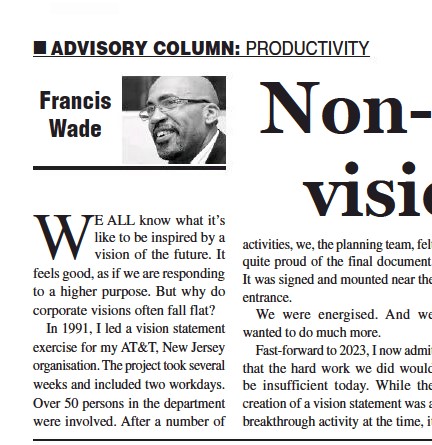
We all know what it’s like to be inspired by a vision of the future. It feels good, as if we are responding to a higher purpose. But why do corporate visions fall often flat?

This is a public episode. If you’d like to discuss this with other subscribers or get access to bonus episodes, visit longtermstrategy.substack.com/subscribe

Why Your “Non-Specific Vision” Has Stopped Inspiring Staff

We all know what it’s like to be inspired by a vision of the future. It feels good, as if we are responding to a higher purpose. But why do corporate visions fall often flat?

In 1991, I led a vision statement exercise for my AT&T, New Jersey organization. The project took several weeks and included two workdays.

Over 50 persons in the department were involved. After a number of activities we (the planning team) felt quite proud of the final document. It was signed and mounted near the entrance.

We were energized. And wanted to do much more.

Fast forward to 2023, and now I admit that the hard work we did would be insufficient today. While the creation of a vision statement was a breakthrough activity at the time, it would hardly move the needle now. Why?

Things have changed. If you intend to motivate staff with a view of an inspiring future, you must use more precise tools. Here are some insights.

1. Follow the “Fool-Yourself Rule”

Thanks to Facebook, Instagram, Whatsapp, Twitter, and Tik Tok, we are flooded with inspirational memes. Perhaps your friends also send 5-10 quotes with a pretty background each day.

Given the overwhelm, you probably aren’t as easy to arouse as you used to be. In fact, now you could be a bit jaded.

This isn’t a personal problem and there’s nothing wrong with you. The most likely explanation? You have raised the bar.

For example, statements that everyone can claim to be true don’t lift you up. Case in point: “Thankful I am near the top of my profession!”

Anyone can post this accolade on their timeline because it lacks specific measurements. It’s vague. Unclear. And falls flat.

Today, the same problem pervades corporate statements. Check your company’s vision. If it sounds as if it’s already been done, then it’s failing the test. So does the AT&T department vision of old.

Today, effective organizational visions prevent people from fooling themselves into thinking they have arrived. Instead, they create a useful tension because they evoke a clear gap.

2. Fill in the Details

Today, we are exposed to would-be inspirations via text, image, videos, audios, and interactives. Dynamic communicators use these elements to paint vivid portraits of their visions.

In like manner, we need to create detailed pictures of the future. For example, in addition to saying “a company that is diverse” we would say:

– no more than 50% of our staff comes from any tertiary institution.

– at least 35% of employees originate from other CARICOM countries.

– no single gender dominates new hires by more than 10%.

These specifics raise pointed questions such as: Why are these numbers chosen? What is the target year? What is today’s baseline?

They provoke a followup: “How will we get there?”

In the past, company leaders could get away by saying “Trust Me”. But those days are gone. Now, a written strategic plan must bridge the gap between today and tomorrow before employees buy in.

3. Detail the Steps

Use your strategic planning retreat to create a vision, give it details, and link it back to 2023 with a plan. Start with a structured, high-level brainstorm to bring everyone together on the same page around your vision. You can begin with words, but make sure it has a date such as Vision 2030 Jamaica.

Then, once agreement is reached, convert the words into metrics. What will be the KPI’s in the chosen year? Also, craft a list of interventions needed to move the numbers in the right direction.

Finally, use a modern tool – back casting – to connect your vision for the future with today in a single timeline. How does it work?

Simply start with the future and work back towards the present. For example, if you choose a 25 year target, start in 2048 and work backwards to this year.

But here’s an important tip – don’t try to do this exercise in a large group. Instead, hand-pick a small one.

During its deliberations, the smaller team crafts a logical and feasible timeline. It should be conservative. Easy to understand. And showcase a host of cause-and-effect relationships so that others can follow your logic.

But above all else, it must be credible. Now, any stakeholder can be taken through the long-term strategic plan and believe in it.

This is all a far cry from the vague vision statement we put up at the entrance at AT&T. That document had neither a target year, nor specifics, nor a means to accomplish its goals.

If your company is still parading a vague vision statement in its corridors, retire it. Create a new detailed vision for a specific year that energizes staff.

Francis Wade is the author of Perfect Time-Based Productivity, a keynote speaker and a management consultant. To search his prior columns on productivity, strategy, engagement and business processes, send email to columns@fwconsulting.com.

Ep 4 – MB#4 – – What’s the First Order of Business in Your Next Strategic Planning Retreat?

This is a free preview of a paid episode. To hear more, visit longtermstrategy.substack.com

Become a “Fair Witness”: In his book, Stranger in a Strange Land, Robert Heinlein

Richard Rumelt / The Crux: How Leaders Become Strategists (thecruxbook.com)

Best timeline for strategic plans

You are about to begin a fresh round of strategic planning. The team is eager, but before the retreat starts, you have a tricky decision. What length of time should your organization create a plan for?

Some already have strong opinions. The head of sales wants a 2-year plan. He needs the retreat to be short so he can go back to hitting his numbers.

At the other end of the spectrum, the V.P. of innovation and research wants some clear guidance on which technologies to pursue. The choices are wide, and a poor decision could doom the organization. She is thinking of a 40-50 year planning horizon.

They are both persuasive, but you need to make a choice. What are your next steps as the sponsor of the upcoming strategic planning retreat?

  1. Punt the Decision

Fortunately, there is an approach that relieves you of duress. Given the importance of the planning horizon, get the team to make the choice during the meeting. How does this work?

First, explain to them why this is critical – the specific year and time elapsed (e.g., 2043, 20 years). It’s a critical one that deserves the input of all involved. As such, it should be crafted in real-time, face to face, but only when all the facts are on the table.

Therefore, the act of choosing the horizon should not be the first item on the agenda. Instead, begin by following a process to share pertinent information from all areas together in one place so that the team has a common understanding. During this preliminary session, remind the team that the next session will require them to choose a planning horizon. Ask them to keep this in mind as they review past performance and today’s issues.

This should actually help them remain hopeful. Why? Some of your company’s challenges probably only have complex, long-term solutions. In prior meetings, leaders gave up because they didn’t have enough time available. Now, they do.

When the subsequent session begins, explain the mistake of choosing a planning horizon which is too short or too long. Offer them the following two “warnings” to help pick the optimal timeframe.

  1. The Too-Short Warning

Ask the team, “What happens if we choose a tiny horizon?” They may admit (after some reflection) that a 2 to 3-year plan will simply extend the past. Why? It’s only human.

They won’t say it out aloud, but people unconsciously prefer continuity and hate uncertainty. Our default mentality is to pick a predictable future. A short planning horizon keeps things comfortably the same.

But what about the power of a transformation? You should also remind them that if they don’t use time as a deep resource, they won’t create a Jim Collins-like Big Hairy Audacious Goal (BHAG). Such objectives are meant to inspire and uplift. They give meaning and add resilience, especially to younger staff.

Also, with a short planning horizon, key problems which need time will remain unsolved. Plus, you’ll also be missing important trends. For example, a 5-year planning horizon blocks you from seeing developments which take 7 years to mature. By contrast, if your competitors consider a longer time frame, they might include the trend in their thinking to their advantage.

Finally, aggressive executives love short-time frames because they see it as a way to force staff to work harder, and achieve results sooner. The problem is that some projects (like pregnancy) can’t be rushed. Don’t pretend that magic is real, or you’ll see employees merely going through the motions, doing the minimum.

Why? At its heart, short-termism is a synonym for selfish leadership. “My current needs trump your future needs.” It’s as if the team is also saying, “Instead of making difficult decisions now, we will leave them for you young folk in the hope that you still have time.” It’s the very opposite of sustainable business thinking.

  1. The Too-Long Warning

Sometimes team members become true believers in long-term reasoning. They say “the more the merrier!” and call for a one-hundred year planning horizon. They may even cite examples of Asian organizations which do so.

However, you should take a look at your environment. Chances are, a planning horizon which is too long will mystify stakeholders who can’t relate. Instead of being inspired, they’ll become cynical.

Also, you might not have the resources or skills to plan too far out. Remember, whatever horizon you choose must be connected back to today.

Get your team to find consensus on the optimal time horizon in a healthy, real-time debate. It will set the stage for the success of your organization’s strategic plan.

Francis Wade is the author of Perfect Time-Based Productivity, a keynote speaker and a management consultant. To search his prior columns on productivity, strategy, engagement and business processes, send email to columns@fwconsulting.com.

Best timelines for strategic plans

You are about to begin a fresh round of strategic planning. The team is eager, but before the retreat starts, you have a tricky decision. What length of time should your organization create a plan for?

Visit our archives for past columns – https://blog.fwconsulting.com

This is a public episode. If you’d like to discuss this with other subscribers or get access to bonus episodes, visit longtermstrategy.substack.com/subscribe

Culture still eating strategy for breakfast

You have heard the saying that “Culture Eats Strategy for Breakfast”. It has a ring of truth to it, but you don’t want to believe that strategic planning is futile – a victim of large, negative forces which cannot be overcome. But if it’s neither entirely right nor wrong, can we still use it?

To access my archive of past columns, see https://blog.fwconsulting.com

This is a public episode. If you’d like to discuss this with other subscribers or get access to bonus episodes, visit longtermstrategy.substack.com/subscribe

Ep 24 – Achieving the Best Flow State

So you’re a creative person and getting into the Flow State is the key to your success. Like Michaelangelo or Leonardo, you use focused high energy times to do your best work. And you love it.

BUT… you have a Tik Tok account and the people you’re following are a growing distraction…and you can’t help yourself…you just want to take a peek…and another…

And when someone forcibly takes away your smartphone, you are able to focus, but then you overfocus and work for 15 hours straight, and then collapse. At that point you hate to return to your computer. 

Getting and staying in the Flow state is not so easy after all.

Tune into this episode to hear from me and my special guest, Manlio lo Giudice, as we solve this challenging problem together.

Get full access to Francis A. Wade at 2timelabs.substack.com/subscribe

Culture Still Eats Strategy for Breakfast

You have heard the saying that “Culture Eats Strategy for Breakfast”. It has a ring of truth to it, but you don’t want to believe that strategic planning is futile – a victim of large, negative forces which cannot be overcome. But if it’s neither entirely right nor wrong, can we still use it?

The most depressing naysayers warn us that fancy plans can only go so far. Jamaican culture on a whole, or a specific corporate culture, will only allow so much change, but no more. But is this just a cynical way of looking at the world? Should it be discarded, or is there an element of truth that should be included in your planning for 2023?

After all, you don’t want to waste time shaping interventions meant to move the company forward, which could be doomed from the start.

In this context, what is culture made of? While there are many definitions, let’s assume that it comprises unconscious habits, practices, and routines. We all have them. And when we humans come together in an organisation, we can’t help but bring these elements, combining them into one.

For example, all companies have people who complain about being treated unfairly. Some leave their ruminations in the car park. Others spend most of their workdays kvetching to themselves. But our definition would focus on the complaints which are continually shared in workplace conversations.

By contrast, the occasional complainant, who resolves matters quickly, does not add to the culture. When a single problem is solved, it goes away.

This definition of culture is one your strategic planners should adopt. Why? Most teams I work with want to include some kind of cultural transformation in their long-term plans. Unfortunately, they lack expertise in this area. They only know enough to label organisations they have experienced from the past, judging some as superior, and others toxic.

However, they don’t know how to create a large-scale shift from one level to another. Without this expertise, their objective remains more of a hopeful wish than anything they can operationalise. To make things more concrete, here are some practical steps to take to forge the kind of culture that supports your strategic plan.

  1. Go Past Current “Values” and “Purpose” Statements

If your company hasn’t revamped its core statements in the last year, chances are they are no longer offering much guidance. In the worst cases, staff only use them to point out hypocrisy gaps…the places where your leaders are not walking their talk.

If you find yourself in this kind of situation, the standard advice is to undertake a refresh. Rather than driving up further cynicism and resignation, retire the statements and declare that they have done their job. Set up an effort to define new ones in light of a fresh strategy. Point out their purpose: to help accomplish a specific long-term vision.

This is Blue Ocean-style, opportunity creation at its finest.

But most leaders may still want the documents to be vague, echoing the tone of the ones they are replacing. Today’s best practice calls for a different approach. Instead of being ephemeral and high-level, look to define specific behaviours so they can’t be mistaken.

  1. Specific Behaviours Listed in the Corporate Strategic Plan

It may become clear as you do your planning that some of your corporate culture must be changed. For example, a culture of constant victimhood isn’t likely to be innovative and entrepreneurial…the behaviours your new strategy needs to succeed.

But these initial phrases are only clues. They aren’t detailed enough. Instead, take a deeper dive into the specific behaviours you want to change. Here, they need to pass the Video-Tape Test. If they can be enacted on film, then they are clear enough to be included in your strategic plan.

For example, a phrase like “responsibility” may fail the test because it doesn’t speak to a specific behaviour. By contrast, “I apologise to those I have wronged” is a specific behaviour which is undeniable.

It’s also one which can be trained, coached, measured and added into a performance system. As such, it becomes a tool to assist in accomplishing the strategic plan.

While you may group similar behaviours for ease of transmission, it’s important to be careful. Why?

The fact is, this isn’t about a change for its own sake. Instead, the planning team should see a clear cause-and-effect relationship between newly envisioned behaviours and critical elements of the strategy.

As such, these are carefully defined, culture-change projects designed to shift specific behaviours. Although such efforts are challenging, don’t allow them to languish or be eaten up by a toxic culture no-one supports.

Ep 23 – Capture Points! What They Are and How to Manage Them

You’re a productivity AND technology enthusiast which means that you are managing lots of inboxes. Each time you sign up for a new one, they give you another.

But is that a good thing? Or just another loose end you need to account for in your weekly review?

If it’s the latter, then why? In this episode we tackle the problem of Capture Points – physical and digital places where potential tasks are sitting…waiting. We’ll talk about your need to handle each and every one of them…or else. That is, if you hope to develop a flawless reputation for being on top of all the stuff people send your way, wanting a response.

Join me on this solo episode as we explore this challenge that affects every single knowledge worker in the entire world. It’s a continuation of Episode 21 on Capturing.


Get full access to Francis A. Wade at 2timelabs.substack.com/subscribe