You built a strategic plan. Leadership signed off. It launched with fanfare. Six months later, engagement scores are worse, not better, and someone in the room says it: “Culture eats strategy for breakfast.”
That line isn’t wrong. It’s just not useful. It gives everyone permission to stop looking.
Take a CEO — call her Elena. She ran the full rollout playbook: division townhalls, a slick explainer video, a one-page summary, focus groups to gather feedback. A month later, her engagement survey showed staff more confused about direction than before the rollout began. Her leadership team had a ready explanation: culture. Discipline. Willpower. The usual suspects.
None of them held up. Elena’s people weren’t lazy or resistant. They’d been talked at, thoroughly and repeatedly, by a strategy that never once talked back.
The Direction Problem
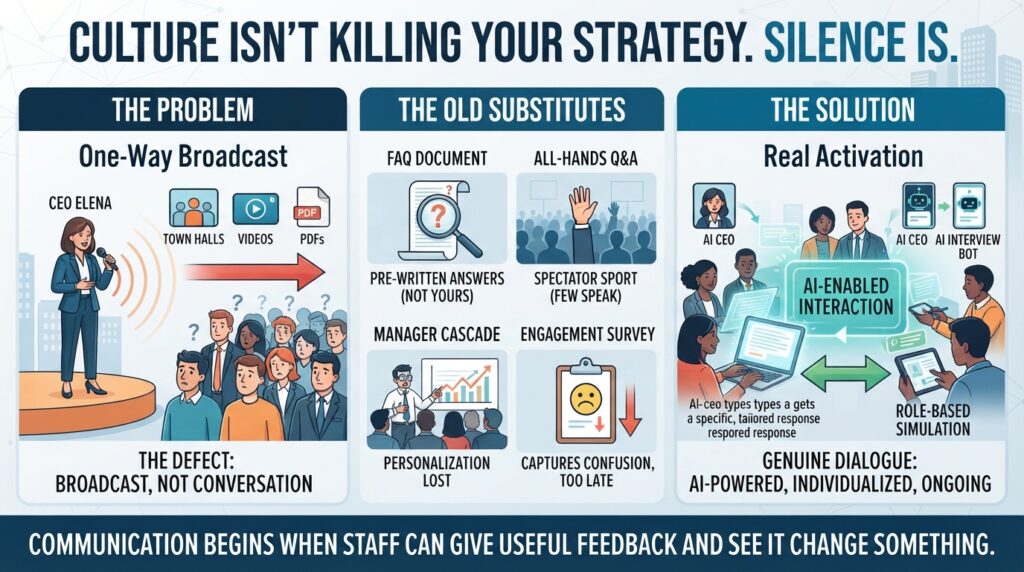
Strip away the blame-shifting, and the actual defect is structural: every channel Elena used ran in one direction only. Town halls, PDFs, infographics, cascaded briefings from managers — all of it broadcasts. None of it lets an employee bring their specific situation into the conversation and get a specific answer back. (Most town halls don’t result in real Q&As even if they are repeatedly requested.)
For most of business history, this didn’t matter, because one-way was the only method available. A shift is now underway.
I recently spoke with B. Joseph Pine II, whose new book The Transformation Economy argues that real value increasingly comes from experiences that change the person going through them, not just inform them — moving someone from a passive recipient of information into a different, more capable version of themselves. Applied to strategy rollout, that’s the distinction: informed staff know the plan exists. Activated staff have engaged with it directly enough that it’s changed how they act.
Every manager has watched this happen in miniature. An employee seeks out a mentor. A handful of real conversations later, that person works differently. It’s not mysterious. It’s just expensive, or time-prohibitive, to do at scale — which is exactly why most organizations quietly substitute something cheaper for it.
The Substitutes That Don’t Work
Faced with the cost of scaling real conversation, most companies reach for a lookalike instead:
- The FAQ document — answers questions anticipated in advance, not the one the employee actually has.
- The all-hands Q&A — technically interactive, but only a few brave voices ever speak; everyone else spectates.
- The manager cascade — assumes every supervisor can personalize a strategy for each report, without ever giving them a tool to do it.
- The engagement survey — captures a reaction, then feeds it into a report acted on months later, if at all.
Elena’s confusion was built from exactly this list. So is most organizations’. None of it is communication in any sense that produces change — it’s distribution.
There’s a fifth, sneakier substitute worth naming directly: the strategy chatbot. Many leadership teams believe they’ve already solved this problem with an AI tool.
Look closely and it’s usually a scripted FAQ bot wearing an AI label — competent at retrieving pre-written answers, useless at helping someone reason through what the strategy means for their actual role. It’s the imitation of the solution, not the solution.
What Real Activation Looks Like
Genuine one-to-one, AI-enabled activation is a different animal, and it’s already running inside serious organizations.
At Sumitomo Mitsui Financial Group, one of Japan’s largest banking groups, employees can now consult an “AI CEO” — a tool modeled on Group CEO Toru Nakashima’s own management thinking, built to help staff refine proposals and think through strategic direction, rather than simply announce it to them.
At the Norwegian School of Economics, researchers built an AI interview bot modeled on their own rector, Helge Thorbjørnsen, and sent it out to conduct one-to-one conversations with more than 800 students, staff, alumni, and partners over a few weeks. The result was the most comprehensive stakeholder input the institution had ever gathered for a strategy process — and, notably, people said more to the AI, unscripted, than they typically say in an anonymous survey.
Neither of these is a chatbot answering FAQs. Both put the person on the other end of a realistic exchange, where their specific situation shapes the response they get back.
A newer tool aimed squarely at this gap is Contextuum AI, software built specifically to convert one-way strategy communication into real-time, interactive decision support. Rather than delivering the plan as a document, it drops employees into role-based simulations that force them to make the same strategic choices their job actually requires — turning a plan they’d otherwise skim into a set of decisions they’ve already practiced making.
The Shift This Requires
The old assumption was: staff has been told enough times; that should be sufficient. The better standard is: communication has only really begun once staff can give useful, specific feedback back into the strategy — and see that feedback change something.
That’s a genuinely different kind of rollout. It doesn’t start with a document dump. It starts by putting each employee into a live exchange — AI-powered, individualized, ongoing — where their first real encounter with the strategy is active, not passive.
Elena didn’t need another town hall. She needed a channel that could talk back.
The next time your organization launches a strategy and momentum stalls, resist the easy explanation. Culture didn’t eat it. Silence did — and silence has a fix.
PS — Five prompts to use with your own AI assistant
- “Here’s our current strategy summary [paste it]. Ask me questions, one at a time, about how this applies to my specific role — and don’t move to the next question until my answer makes sense to you.”
- “I’m a manager trying to cascade this strategy to my team without garbling it. Interview me about my team’s day-to-day work, then help me translate the strategy into three concrete implications for them specifically.”
- “Play devil’s advocate: what are the three most likely reasons this strategy quietly fails to get implemented in an organization like mine? Push back on my answers until we land on the real risk, not the comfortable one.”
- “Based on what I’ve told you about my team’s actual work, draft two or three questions I should be asking my own staff — not townhall questions, but ones that would surface whether they’ve actually understood how this changes their work.”
- “Six months from now, what evidence would tell us this strategy was genuinely activated rather than just announced? Help me define that before we start, not after.”